


Straw Preparation
A paddy straw bed is won or lost before the spawn packet is opened. Bundle size, soaking time and the way the layers are laid decide whether heat and moisture stay where the mycelium needs them.
- By the end you can choose and bundle straw the way the ICAR-DMR bulletin describes.
- By the end you can soak, drain and judge moisture by hand.
- By the end you can build a layered bed, place spawn correctly and cover it.
- By the end you can name the other DMR methods and say when to look at them.
A bag of paddy straw mushroom spawn; it is broken into pieces and laid along the edge of each straw layer.
- BundleTie fresh hand-threshed straw into 0.75 to 1 kg bundles.
- Soak12 to 18 hours in clean water in a cemented tank.
- DrainStand bundles until dripping stops; squeeze test for 60 to 65 percent moisture.
- Layer and spawnCross-laid layers on a raised platform; spawn along the edges 5 cm apart.
- CoverPress, cover with a clean sheet, hold 30 to 35 °C, no air for 3 days.
Read numerical examples with their source, method and crop context. They are not universal operating instructions. Historical prices are not current quotations.
Build a traceable bed
- Notice
- Material preparation and bed arrangement belong to the selected method.
- Understand
- Extra water or supplements change the growing conditions.
- Try it
- Label each bed with its substrate, spawn lot and preparation history.
01Choosing the straw
Use fresh, dry, golden paddy straw stored under cover since harvest. Straw that got wet in the rain or has turned grey carries mould spores and is not worth the spawn. DMR prefers hand-threshed paddy: the stems stay long and whole, so bundles hold together. Machine-threshed straw is crushed and short and makes loose beds that dry out.
Make bundles of 0.75 to 1.0 kg, about 80 to 95 cm long and 12 to 16 cm thick, tied at both ends. A DMR conventional bed uses 30 to 40 kg of dry straw. TNAU's smaller bed uses 10 to 15 kg. Start small: a first bed of 10 to 15 kg teaches the same lessons.
02Soaking and draining
Immerse the bundles in clean water in a cemented tank for 12 to 18 hours. DMR describes soaking in plain water or a weak lime solution; use plain clean water unless a specialist advises otherwise. Muddy pond water brings bacteria and insects into the bed.
Lift the bundles out and stand them on a slope until water stops dripping. DMR's key practice list asks for 60 to 65 percent moisture in the substrate. Test by hand: squeeze a fistful hard. A few drops at most should appear and your palm should feel damp, not wet. Spawn as soon as the straw has settled at about 35 °C, not before.
03Laying and spawning the bed
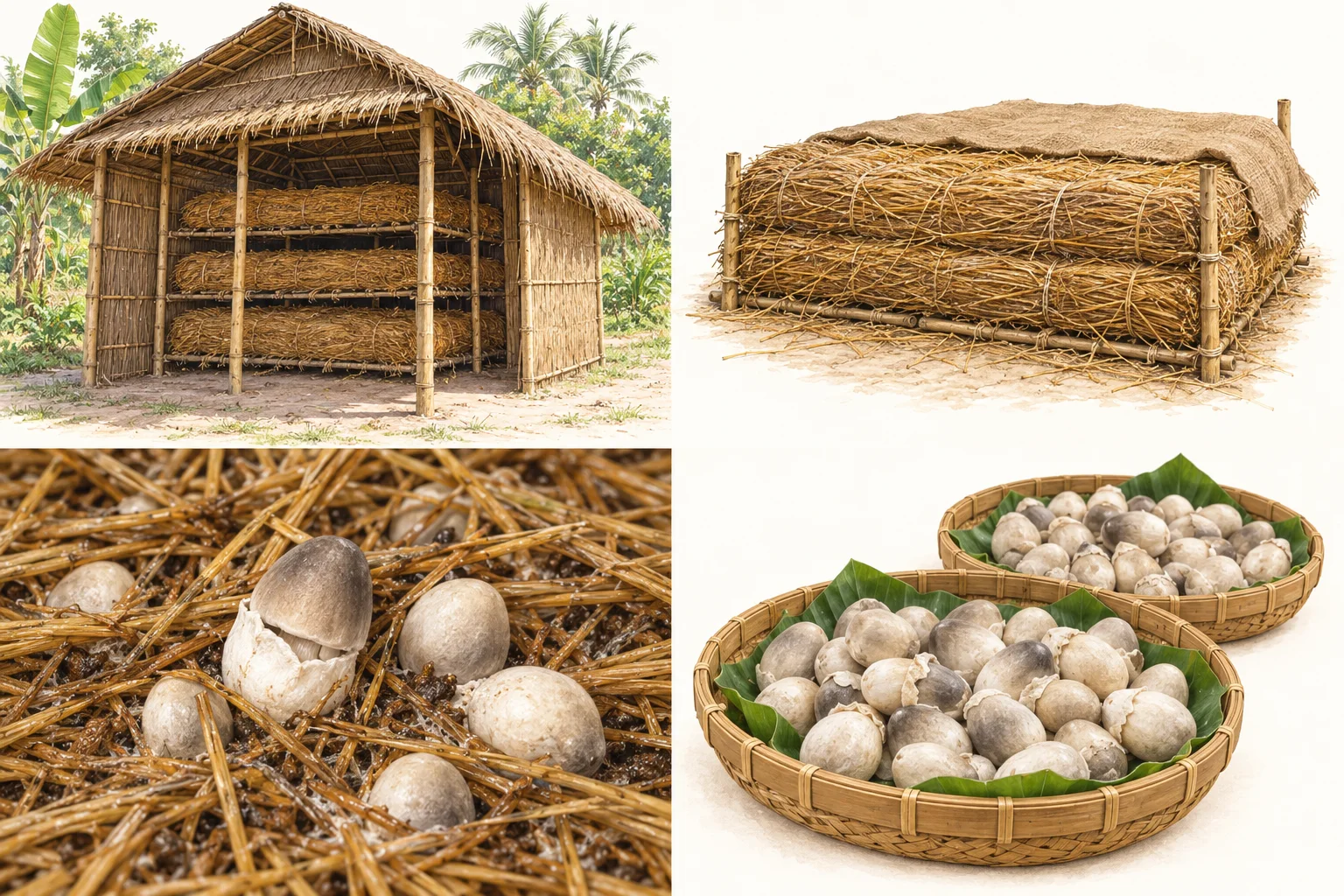
Build the bed on a raised platform of bamboo or bricks in a shaded, closed shed, never on bare soil. Lay the first layer of bundles side by side, then the next layer across them, so the bed stays firm. DMR lists bed sizes of 100 by 100 by 100 cm, 60 by 60 by 30 cm and 60 by 60 by 120 cm.
Break the spawn into small pieces. Place them along the edges of every layer, 5 cm apart, leaving a margin of 12 to 15 cm from the edge. DMR uses 500 g of spawn and 150 g of red gram (arhar) powder for a 30 to 40 kg bed; the powder is a nitrogen supplement dusted over the spawn. Press the finished bed down from the top.
04Under the sheet
Cover the pressed bed with a clean plastic sheet. The sheet traps heat and humidity so the bed sits at 30 to 35 °C and 80 to 85 percent relative humidity, the share of moisture the air is holding. Give no ventilation for the first 3 days.
DMR's bed method removes the sheet 7 to 8 days after spawning; its key practice list says 4 to 6 days. Both are DMR, so watch the bed: when white mycelium covers the surface, take the sheet off. Then hold 28 to 32 °C and about 80 percent humidity. Mushrooms start 4 to 5 days after the sheet comes off.
05Other DMR methods, briefly
The bulletin describes five more methods. The cage method packs 60 short bundles, treated in boiling water for 20 to 30 minutes, into a wooden cage with 2 bottles of spawn; pinheads come in 10 to 15 days. The box method uses chopped straw in shallow boxes. The outdoor method lays 4 layers of bundles in summer and 7 in the rains. The indoor method composts cotton waste or straw with lime, steam-pasteurises it and spawns at 1.4 percent; colonisation takes 4 to 6 days at 32 to 34 °C. The circular method winds soaked bundles around poles. Master the bed first; every other method reuses its logic.
Build one trial bed this week
- Set aside 10 to 15 kg of clean, hand-threshed straw and tie it into bundles; weigh two bundles.
- Soak for 12 to 18 hours in clean water, drain, and do the squeeze test; note what you felt.
- Lay cross-wise layers on a raised platform in a closed shed; spawn along the edges with a 12 to 15 cm margin.
- Cover with a clean sheet and put a thermometer under it; read morning and evening.
- Note the day white mycelium reaches the surface and remove the sheet.
Write in your farm diary: Straw weight, soak hours, squeeze test result, spawn weight, sheet-on and sheet-off dates, bed temperature twice daily.
Mistakes that cost a crop
- Using machine-threshed, broken straw: bundles fall apart and the bed dries and cools unevenly.
- Laying the bed on bare wet ground: soil moulds and insects move in from below.
- Lifting the sheet on day two to look: heat and humidity escape before the mycelium has taken.
Check yourself
Three questions, instant answersHow long are straw bundles soaked in the DMR bed method?
Where does spawn go on each layer?
What do you check just before spawning a drained bed?
An editorial self-check, not a certificate. Answers are not stored, not even on this device.
Words used in this lesson
- Substrate
- The material the mushroom feeds on; here soaked paddy straw.
- Supplement
- A small nitrogen-rich addition such as red gram powder that feeds early mycelium.
- Platform
- A raised bamboo or brick base that keeps the bed off wet soil.
- Relative humidity
- The share of moisture the air holds; 80 to 85 percent keeps the bed from drying.
References & further reading
Species, strain, climate and production method must remain explicit.
Open current reference