

A practical guide to growing mushrooms in IndiaA joint educational initiative by MushroomWale & DMR Solan ↗
MushroomFarming.in

A joint educational initiative by

MushroomWale.com
ICAR–Directorate of Mushroom Research, Solan logoICAR–DMRSolan

MushroomFarming / article

Oyster species selector

Compare candidate Pleurotus groups through location, season, observed temperature, method and substrate instead of an unsourced best-species ranking. Evidence, method and India-context boundaries remain visible.

Practical explanation + detailed referenceSources & review ↓
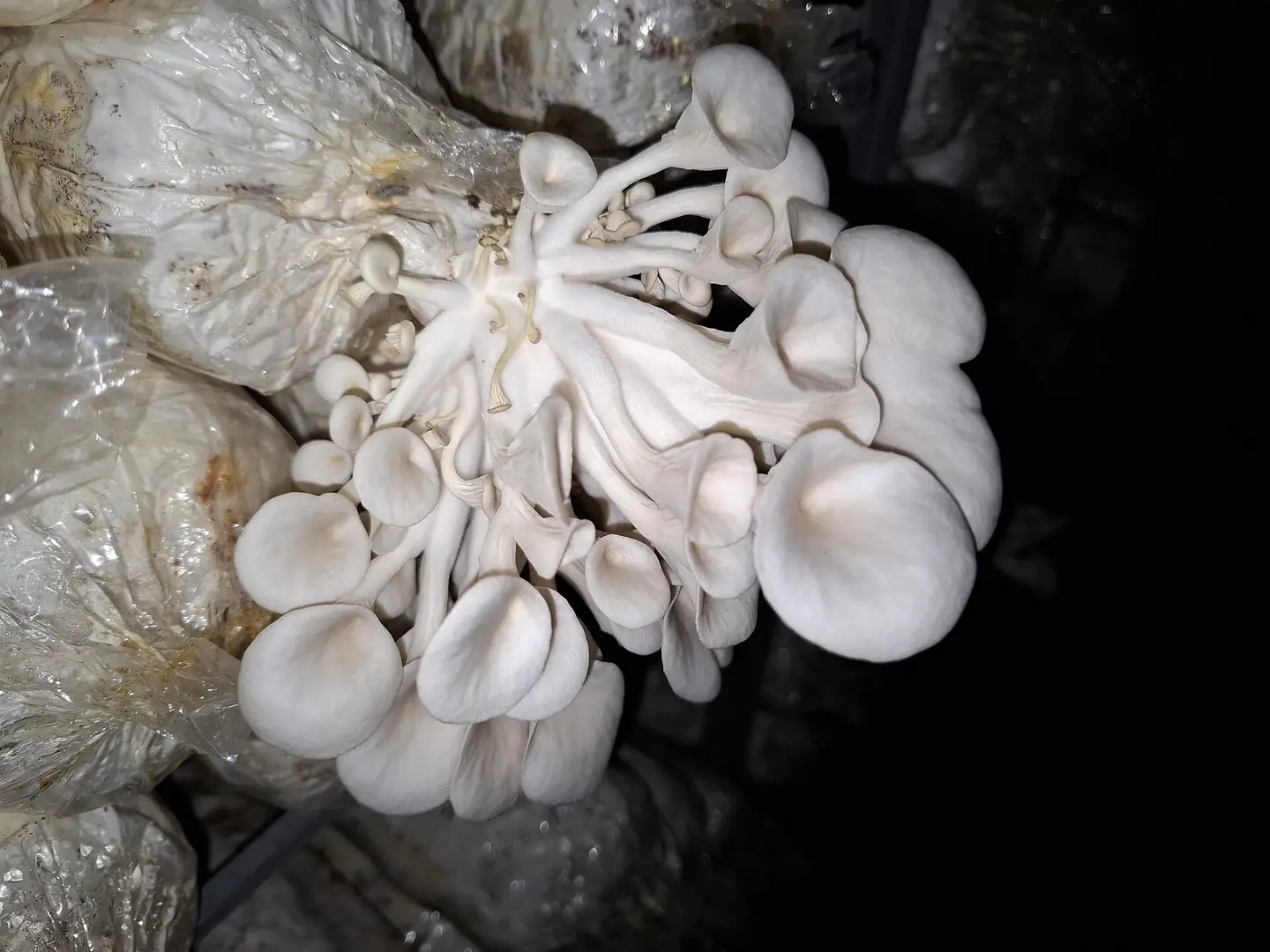
A dense cluster of white oyster mushrooms with short stems emerging from a plastic bag.
Real cultivation photograph. Read its source for location and context; it is not a universal operating specification.MarvinBikolano · CC BY-SA 4.0View full photograph ↗
On this pageChoose a section, or keep reading below

Read this in the full guide: Understand the whole Oyster mushroom bag cycle →

Understand the topic

What you need to know.

Oyster mushroom, or dhingri, is a group of Pleurotus species with different temperature needs. This page shows the temperature bands ICAR-DMR publishes for each species, why a strain name matters as much as a species name, which months suit which region, and how to test your own room before you buy spawn. It is for growers deciding what to plant next.

Teaching revised 2026-09-24. Source-linked editorial synthesis; this date does not imply independent technical review.

Part 01

Dhingri is a group of species, each with its own temperature

Oyster mushroom, called dhingri in India, is not one mushroom but the genus Pleurotus. The ICAR-DMR manual counts 38 species recorded worldwide, and 25 of them are grown commercially somewhere in the world. Their caps are shell, fan or spatula shaped, in white, cream, grey, yellow, pink or light brown depending on the species.

For a grower the difference that matters is temperature. The manual sorts the cultivated species into two groups: winter or low temperature species that fruit at 10 to 20 °C, and summer or moderate temperature species that fruit at 16 to 30 °C. The groups behave differently at the edges. Summer species can still fruit when the weather turns cool, but winter species will not fruit in heat; they need a drop in temperature before they start.

So the useful question is not how to grow oyster. It is which species and strain will fruit in your room during the months you plan to crop.

Sources: ICAR-DMR manual, 2011 · ICAR-DMR oyster folder

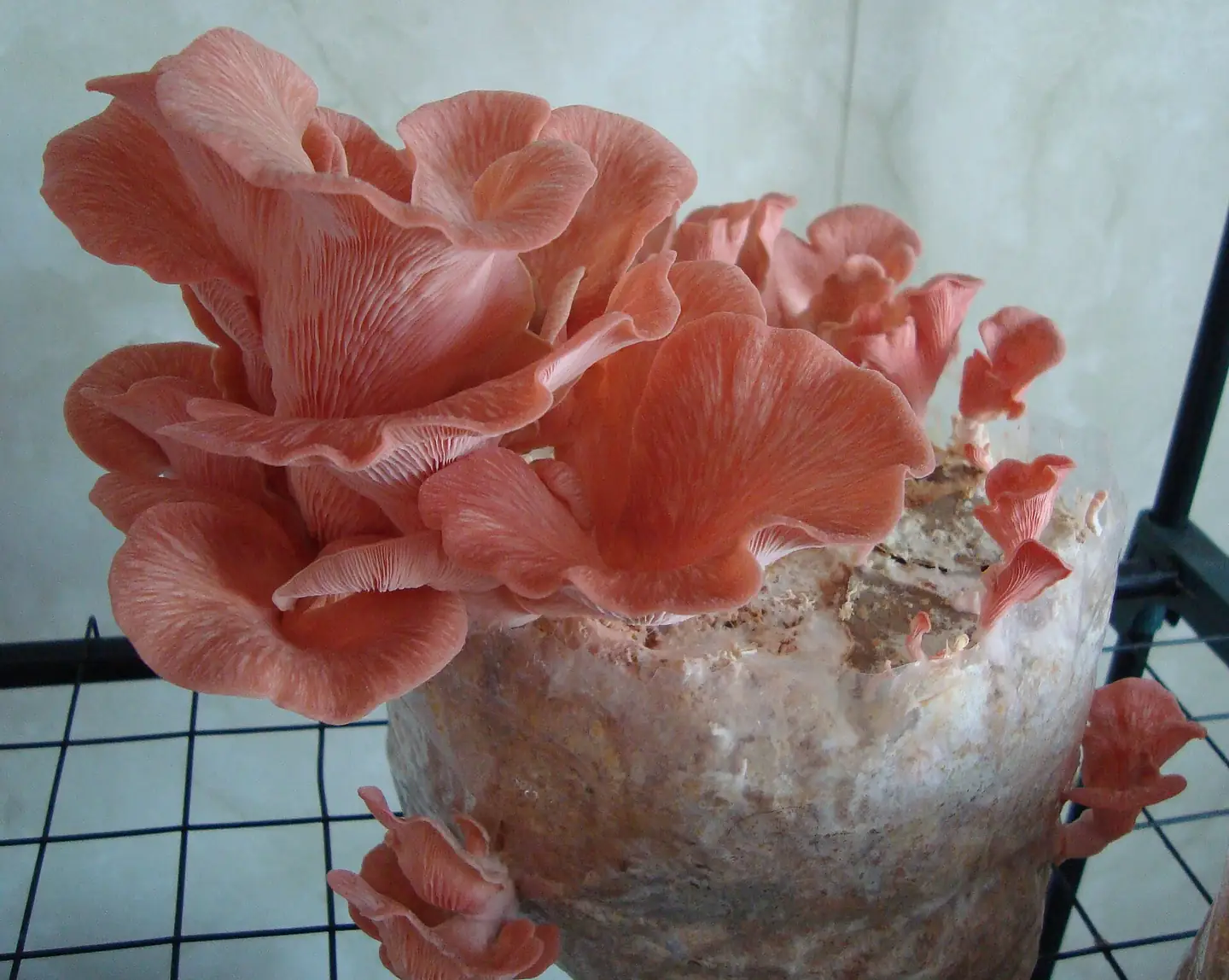
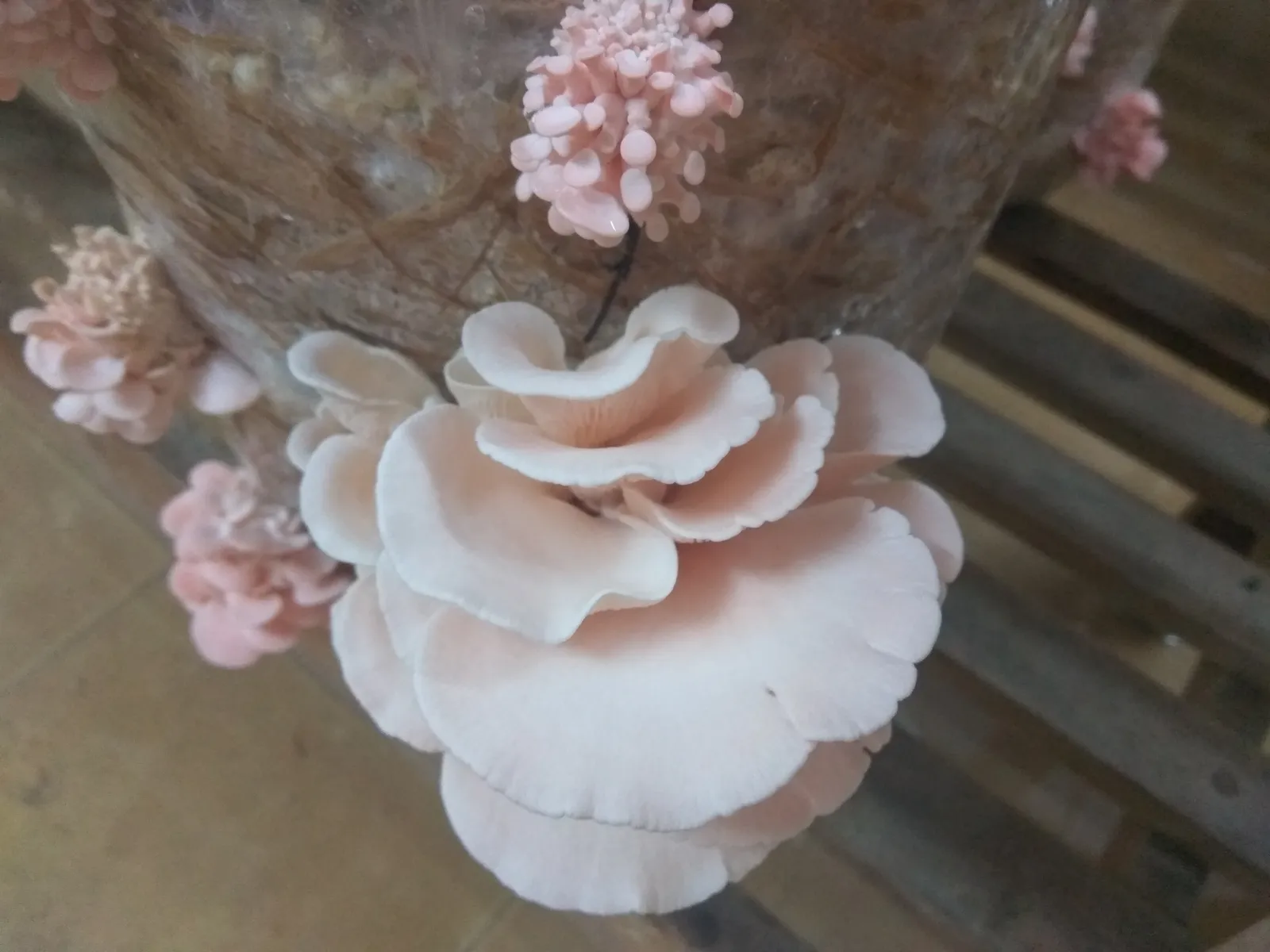
Large frilly pink oyster mushroom caps growing from the top of a plastic substrate bag on a wire shelf.
Pink oyster (Pleurotus djamor) fruiting from a substrate bag on a wire rack, grown at home by the photographer. The ICAR-DMR oyster folder lists P. djamor as a summer choice. Photo: Gerly123, CC BY-SA 3.0. Source
Part 02

Spawn run and fruiting temperatures ICAR-DMR gives by species

ICAR-DMR gives two temperatures for each species: one for spawn run, when mycelium spreads through the straw, and one for fruiting. The same table appears in the manual's round-the-year chapter and in the Hindi seasonal folder. Treat the values as published examples for these species, then check them against your strain's supplier guidance.

P. florida18 to 22 °C for fruitingSpawn run at 25 to 30 °C.
P. sajor-caju22 to 26 °C for fruitingSpawn run at 25 to 32 °C.
P. flabellatus22 to 26 °C for fruitingSpawn run at 25 to 30 °C.
P. eryngii14 to 18 °C for fruitingSpawn run at 18 to 22 °C. The table calls it Kabul dhingri.
Winter group10 to 20 °C for fruitingP. ostreatus, P. florida, P. eryngii, P. fossulatus and P. cornucopiae.
Summer group16 to 30 °C for fruitingP. flabellatus, P. sapidus, P. citrinopileatus and P. sajor-caju.

Sources: ICAR-DMR manual, 2011 · ICAR-DMR seasonal folder

Part 03

The same species name can mean a winter or a summer strain

ICAR-DMR documents do not always place a species in the same season, and the strain explains part of it. The manual's oyster chapter lists P. florida and P. cornucopiae among the low temperature species, yet reports a wild P. cornucopiae isolate suited to growing at 15 to 25 °C. The manual's table of species and strains available in India lists P. florida strain-III for winter but P. florida again for summer, and places a P. cornucopiae strain-II under summer.

Local names are a second trap. The manual's introduction calls P. fossulatus the Kabul dhingri and P. eryngii the king oyster, while its temperature table gives the name Kabul dhingri to P. eryngii.

So buy spawn by Latin species name and strain, never by a local name alone, and ask the supplier which season the strain was selected for. Named varieties exist too: the manual cites releases from TNAU such as M-2 of P. sajor-caju and MDU-1 of P. djamor.

Source: ICAR-DMR manual, 2011

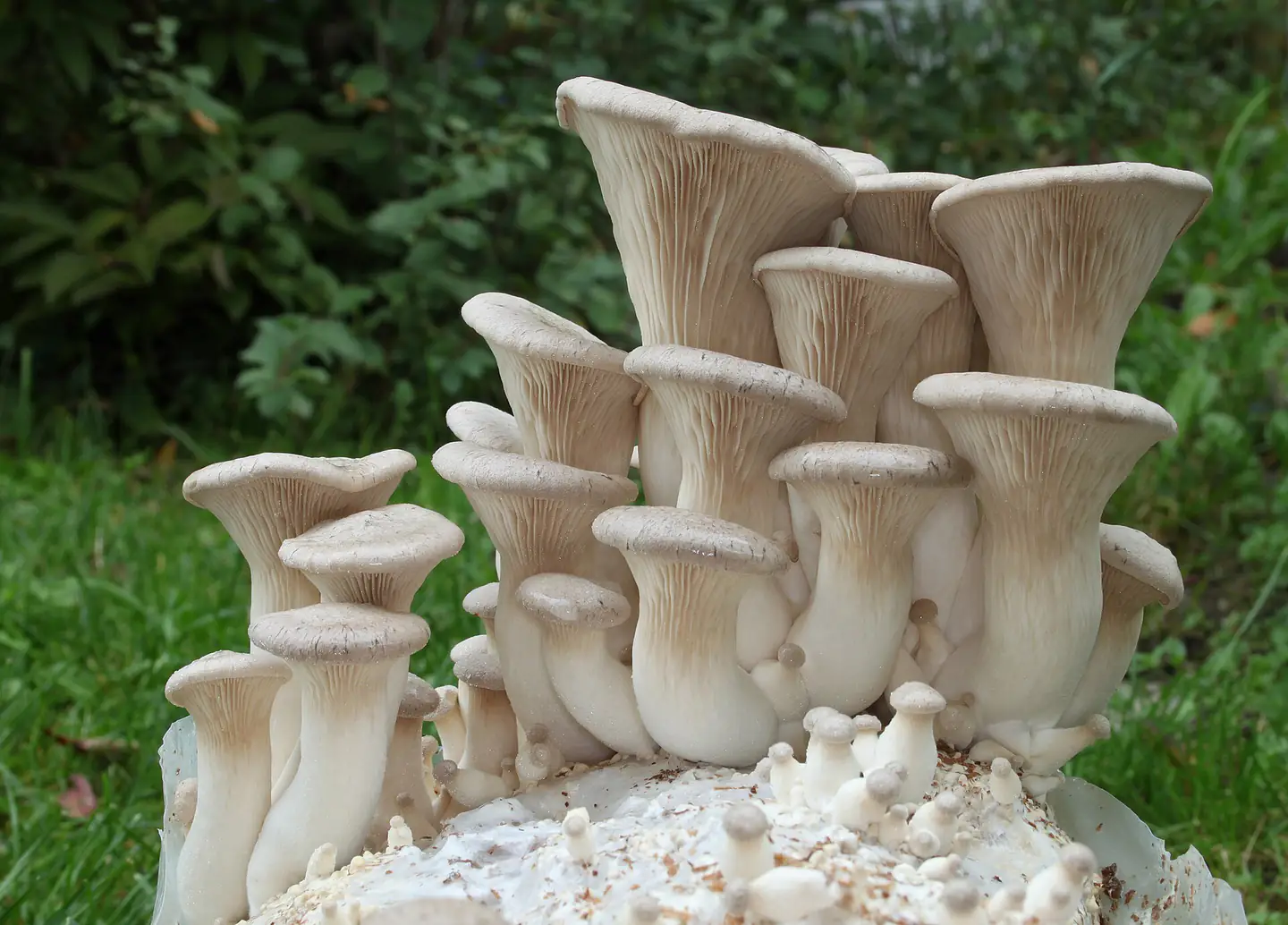
A group of pale king oyster mushrooms with thick white stems and grey-brown caps rising from a substrate block.
A cultivated cluster of king oyster (Pleurotus eryngii) in Germany, with thick stems and small funnel-shaped caps. ICAR-DMR places this species in its low temperature group. Photo: Holger Krisp, CC BY 3.0. Source
Part 04

Choose by region first, then by month

ICAR-DMR sets the oyster season by region. Within that season, the oyster folder switches species as the air warms or cools. These windows come from the manual's round-the-year chapter and the Hindi seasonal and oyster folders.

IfYour farm is on the north Indian plains
ThenPlan oyster from September to May, the window both the manual and the seasonal folder give.
IfYour farm is in the mid hills
ThenOyster can run almost the whole year; the seasonal folder says all year.
IfYour farm is in the high hills
ThenGrow oyster in the summer season; the seasonal folder gives May to August.
IfYou farm in a coastal state
ThenThe seasonal folder says oyster can be grown all year in the natural climate.
IfYou farm in central or western India
ThenThe seasonal folder allows oyster in every season except summer.
IfRoom air falls below 20 °C
ThenThe oyster folder recommends P. florida or P. cornucopiae.
IfIt is the summer season
ThenThe oyster folder recommends P. sajor-caju, P. flabellatus, P. sapidus, P. djamor or P. citrinopileatus.

Sources: ICAR-DMR manual, 2011 · ICAR-DMR seasonal folder · ICAR-DMR oyster folder

Part 05

Test your room against a species before you order spawn

A species table is only useful once you know your own temperatures. Start recording at least a week before you order.

  1. Record highs and lowsHang a maximum-minimum thermometer at bag height and write down the daily high and low. The manual asks for both room and bed temperatures to be recorded.
  2. Allow for bag heatBags run warmer than the room. The manual puts bed temperature generally 2 to 4 °C above room air.
  3. Match the bandPick a species whose fruiting band covers your readings on most days. If the room cannot hold it, change species with the season or plan cooling first.
  4. Ask for the label detailsThe manual's spawn standard says each spawn bag should state the lot number, date of inoculation, variety or strain, and quantity. Ask for all four.
  5. Buy from a traceable sourceChoose a spawn maker who can say where its culture came from. The same standard requires a culture from a research organisation or another authentic source.

Source: ICAR-DMR manual, 2011

Part 06

Species mistakes that only show at fruiting time

Common mistakeKeeping a winter species going into the hot months.

Do this insteadWinter species will not fruit at high temperatures. Change to a summer species as the season turns.

Common mistakeExpecting the same cap colour all year.

Do this insteadTemperature changes colour. The manual reports P. florida light brown at 10 to 15 °C but white to pale yellowish at 20 to 25 °C, and P. sajor-caju white to dull white at 15 to 19 °C but whitish brown to dark brown at 25 to 30 °C. Agree colour with your buyer.

Common mistakeWalking into a fruiting room first thing in the morning without a mask.

Do this insteadOyster releases large numbers of spores, which can cause allergy in workers. The oyster folder opens windows and doors two hours before the morning harvest and covers the nose with a mask or cloth. The manual lists the lack of a sporeless commercial strain as a limitation.

Common mistakeStarting a culture from wild oyster mushrooms.

Do this insteadThe manual notes that two species, P. olearius and P. nidiformis, are reported to be poisonous. Buy spawn of a named species from a known source.

Sources: ICAR-DMR manual, 2011 · ICAR-DMR oyster folder

Go deeper

Technical reference, records and tools.

Detailed crop-stage information, parameters, diagrams and specialist tools are kept together below. This material retains its source conditions and review limits.

Open the complete technical reference

oyster · taxonomy

Oyster species selector

Compare candidate Pleurotus groups through location, season, observed temperature, method and substrate instead of an unsourced best-species ranking. Evidence, method and India-context boundaries remain visible.

Publication
Editorial review in progress
Evidence records
5
External review
Not yet recorded
Wild ID
Not provided
A large pink oyster mushroom (Pleurotus djamor) cluster and young pins fruiting through the side of a straw-filled polythene bag on a rack, Coimbatore, Tamil Nadu.
Pink oyster mushroom cluster fruiting from a polythene bag. Photo: Shreevaishnavi96, CC BY-SA 4.0. Source

The oyster bag method in six steps

Source: ICAR-DMR oyster folder and the 2011 manual.

  1. Chop the strawWheat or paddy straw cut to 2 to 3 cm (manual method uses 5 to 10 cm).Day 0
  2. Hot-water treatmentFolder: 60 to 65 °C for 20 to 30 minutes (manual: 65 to 70 °C for one hour), then drain off the excess water.Day 0
  3. Spawn and fill bags2 to 3 percent spawn on wet-straw weight, in layers; 10 to 12 holes per bag (manual: 10 to 15).Day 0
  4. Spawn run22 to 26 °C in the dark for 15 to 25 days until the bag is white through.Days 1 to 25
  5. Open the bag and fruitLight, fresh air, 75 to 85 percent humidity, CO₂ below 600 ppm (folder: 800 ppm). Pins in about a week.From day 16
  6. Harvest and next flushNext flush 8 to 10 days later. Manual: 500 to 700 kg from one tonne of dry straw in 45 to 60 days.Up to day 60

Quick orientation

Compare candidate Pleurotus groups through location, season, observed temperature, method and substrate instead of an unsourced best-species ranking. This topic belongs to a Pleurotus substrate-bag or validated block system. The species or strain, substrate treatment and fruiting-air context must travel together.

01

Why this stage matters

Compare candidate Pleurotus groups through location, season, observed temperature, method and substrate instead of an unsourced best-species ranking.

02

Method boundary

This topic belongs to a Pleurotus substrate-bag or validated block system. The species or strain, substrate treatment and fruiting-air context must travel together.

  • Confirm the culture as Pleurotus spp., with strain or variety recorded where available.
  • Confirm one method: straw bag or validated lignocellulosic bag or block.
  • Record substrate source, treatment class, batch and contamination observations.
03

Observe and record

Use batch records, stage dates, room observations and contamination patterns. Compare the crop with its own prior condition before changing several variables at once.

04

Evidence status

The page publishes process relationships supported by primary institutional sources. Numeric recipes remain absent where source context, strain identity or specialist review is incomplete.

There is no universal best Oyster

Build the comparison request first.

Production method records

One species can require more than one cultivation model.

OYS-STRAW-BAG

Treated straw bag system

Substrate
clean cereal straw with method evidence
Container
perforated or opened cultivation bag
Treatment
Pasteurization-class treatment or another validated method; not interchangeable with sterilization.
Scale context
home trial to commercial batch, with different hygiene and climate responsibilities
  1. Material check
  2. Treatment
  3. Cooling and moisture check
  4. Spawning
  5. Spawn run
  6. Fruiting transition
  7. Cluster harvest

Trace the boundary

Evidence and limitations

institutional · tier AResearch programmes

Current institutional scope for cultivated and specialty mushroom research in India.

Research scope does not by itself establish a farm recommendation, commercial readiness or strain-specific operating range.

Open primary source
technical-bulletin · tier ATechnologies developed by ICAR-DMR

Institutional method history for oyster, milky, paddy straw, shiitake and selected specialty mushrooms.

Method descriptions are context-specific and contain numeric and broad substrate statements that require independent technical review before operational publication.

Open primary source
current-advisory · tier ACurrent crop advisory

Time-stamped Indian seasonal crop context and the need to choose oyster species for conditions.

Chemical directions are excluded from this platform unless a current label and jurisdiction are independently verified.

Open primary source
technical-bulletin · tier AOyster mushroom cultivation FAQ

Indian institutional distinction between warm- and cool-fruiting Pleurotus species, plus an occupational spore-exposure warning.

The species bands are source context, not a strain guarantee. Generic yield, storage and legacy chemical statements are not carried into operational guidance.

Open primary source
technical-bulletin · tier APost-harvest technology of mushrooms

Species-specific post-harvest deterioration patterns and handling context.

Historic shelf-life statements depend on maturity, handling, packaging and storage conditions and are not reproduced as guarantees.

Open primary source

Read the evidence

Sources & review.

Editorial update: 2026-09-03. Independent technical review is not recorded for this entry.

  1. Research programmes ↗

    ICAR Directorate of Mushroom Research

  2. Technologies developed by ICAR-DMR ↗

    ICAR Directorate of Mushroom Research · 2020

  3. Current crop advisory ↗

    ICAR Directorate of Mushroom Research · 2026

  4. Oyster mushroom cultivation FAQ ↗

    ICAR Directorate of Mushroom Research

  5. Post-harvest technology of mushrooms ↗

    ICAR Directorate of Mushroom Research

Reading a source is not the same as applying its instructions to every farm. Confirm species, strain, crop stage, system, region and publication date. Old chemical recommendations are not current-use instructions.

See something that needs correcting? Tell us →