A practical guide to growing mushrooms in IndiaA joint educational initiative by MushroomWale & DMR Solan
MushroomFarming.in

A joint educational initiative by

MushroomWale.com
ICAR–Directorate of Mushroom Research, Solan logoICAR–DMRSolan
← All books

Costs, sales and cash

Contents · choose a chapter or topic
Start here
  1. 01Costs, sales and cash
  2. 02What you need before starting
From crop to customer
  1. 03Harvest weight and saleable grade are different
The process
  1. 04Define what the budget includes
  2. 05Reconcile quantities
  3. 06Test a weaker result
  4. 07Follow payment timing
In the field
  1. 08Define what the calculation includes
  2. 09Keep four records rather than one profit number
  3. 10Reconcile the kilograms before calculating revenue
  4. 11Worked learning example: from harvest to cash
  5. 12Test a weaker crop and a slower buyer
  6. 13Write it in your farm notebook
  7. 14Fund the gap between paying for inputs and collecting sales
  8. 15Where the field guidance comes from
Revenue, Cost & Cost/kg
  1. 16Revenue, Cost & Cost/kg
  2. 17Receipts are not profit
  3. 18Receipts are not profit · continued
  4. 19The three cost layers
  5. 20Cost per kilogram and its denominator
  6. 21A published model figure is not your figure
  7. 22A published model figure is not your figure · continued
  8. 23Read the numbers in context
  9. 24Read the numbers in context
  10. 25Cost sheet for one finished cycle
  11. 26Avoid these mistakes
  12. 27Check your understanding
  13. 28Check your understanding
  14. 29Check your understanding
  15. 30Words used in this lesson
  16. 31Sources and field reference
CAPEX, OPEX & Working Capital
  1. 32CAPEX, OPEX & Working Capital
  2. 33Capital spend buys the box
  3. 34Capital spend buys the box · continued
  4. 35Operating spend feeds the box
  5. 36Working capital is a timing problem
  6. 37Working capital is a timing problem · continued
  7. 38Where the scheme does not help
  8. 39Where the scheme does not help · continued
  9. 40Read the numbers in context
  10. 41Read the numbers in context
  11. 42Read the numbers in context
  12. 43Three column bill sort
  13. 44Avoid these mistakes
  14. 45Check your understanding
  15. 46Check your understanding
  16. 47Check your understanding
  17. 48Words used in this lesson
  18. 49Sources and field reference
Market Validation
  1. 50Market Validation
  2. 51From an assumption to a buyer
  3. 52From an assumption to a buyer · continued
  4. 53Grade and pack decide the price
  5. 54Grade and pack decide the price · continued
  6. 55Shelf life draws your selling radius
  7. 56Shelf life draws your selling radius · continued
  8. 57Channel, price and payment
  9. 58Channel, price and payment · continued
  10. 59Read the numbers in context
  11. 60Read the numbers in context
  12. 61Read the numbers in context
  13. 62Three weeks of buyer evidence
  14. 63Avoid these mistakes
  15. 64Check your understanding
  16. 65Check your understanding
  17. 66Check your understanding
  18. 67Words used in this lesson
  19. 68Sources and field reference
Break-Even, Cash Flow & Risk
  1. 69Break-Even, Cash Flow & Risk
  2. 70Break even in kilograms
  3. 71Break even in kilograms · continued
  4. 72Run the downside first
  5. 73Run the downside first · continued
  6. 74Cash flow month by month
  7. 75Cash flow month by month · continued
  8. 76A risk list you will actually use
  9. 77Read the numbers in context
  10. 78Read the numbers in context
  11. 79Read the numbers in context
  12. 80Build three cases on one sheet
  13. 81Avoid these mistakes
  14. 82Check your understanding
  15. 83Check your understanding
  16. 84Check your understanding
  17. 85Words used in this lesson
  18. 86Sources and field reference
Practise and review
  1. 87Mistakes to avoid
  2. 88Make three linked sheets
Sources and next steps
  1. 89Keep learning with the field guides

Start here

Chapter opening

Costs, sales and cash

Build a transparent business model from your own inputs. The worked arithmetic is for learning, not a current market quotation or yield forecast.

Read one page, study its picture, then turn to the next. Use Contents whenever you want a particular topic.

Costs, sales and cash01

Start here

Practical workbook

What you need before starting

Keep these beside you while you learn. You do not need to buy equipment just to read this book.

  1. A clearly defined crop and production boundary

  2. Current written quotations and buyer terms

  3. Separate harvest, accepted-sales and payment records

Costs, sales and cash02

From crop to customer

Look closely

Harvest weight and saleable grade are different

The three lots show why one harvest can have different outcomes. Intact compact clusters, broad fragile clusters and broken pieces may not meet the same buyer specification. Agree the crop, maturity, pack and quality requirements before the harvesting shift.

Keep weights separate for each accepted grade, rejects, unsold stock and returns. Do not quietly place every kilogram into the highest-price category. Handle gently and follow the applicable hygiene and temperature-control procedure; the illustration is not a safety assessment of any product.

For an invented record, suppose 20 kg is picked, 16 kg meets the agreed grade, 2 kg is damaged and 2 kg remains unsold. The production sheet shows 20 kg; the accepted-sale sheet does not. Costs were incurred for the full crop, including the portion not sold.

Costs, sales and cash03

The process

Practical workbook

Define what the budget includes

Separate long-lived assets, recurring production costs and working cash. Identify omitted items such as owner labour, repairs, packaging, transport or financing instead of hiding them inside a favourable margin.

Costs, sales and cash04

The process

Practical workbook

Reconcile quantities

Hypothetical example: 100 kg harvested minus 10 kg rejected or unsold leaves 90 kg sold. At an assumed ₹150/kg, sales are ₹13,500. The other 10 kg still consumed resources.

Costs, sales and cash05

The process

Practical workbook

Test a weaker result

Change one assumption at a time before combining risks. Lower accepted output, lower price, higher energy use or buyer deductions can change the outcome independently. Keep the original case visible for comparison.

Costs, sales and cash06

The process

Practical workbook

Follow payment timing

If ₹11,000 of the example’s ₹13,500 sales is collected, ₹2,500 remains receivable. That does not change sold kilograms. A farm may have a positive operating result and still lack cash for its next input purchase.

Costs, sales and cash07

In the field

Field notes

Define what the calculation includes

Begin with one named crop, one production system and one period. State whether you buy compost or make it, own or rent the building, and sell at the farm or deliver. Otherwise two cost-per-kilogram figures can describe entirely different businesses. Record the units behind each input: dry straw, wet substrate and delivered compost are not interchangeable quantities.

Separate investment from operating expenses. Building work and equipment create assets; substrate, power, packaging and routine labour support production. Include maintenance, owner labour and shared costs explicitly. For a profitability view, account for asset use and financing with a qualified adviser. For cash planning, record when the actual payments fall due. A capital purchase and its depreciation must not both be deducted as the same period's operating expense.

Costs, sales and cash08

In the field

Compare the evidence

Keep four records rather than one profit number

Keep four records rather than one profit number
RecordWhat goes in itQuestion it answers
Investment registerAssets, installation, delivery, taxes and exclusionsWhat must be funded before operation?
Crop cost sheetInputs, labour, utilities, packing and allocated overheadWhat did this crop consume?
Sales ledgerAccepted grades, quantities, prices, returns and deductionsWhat revenue was earned?
Cash calendarActual and expected receipts, payments and loan instalmentsCan the farm pay its bills on time?
Costs, sales and cash09

In the field

Field notes

Reconcile the kilograms before calculating revenue

Weigh harvest and record where it goes: sold, held as stock, rejected, used as samples or lost. Split sales by grade and buyer because prices and deductions differ. Revenue from accepted credit sales and cash received are separate measures; an unpaid invoice may be a receivable, not an immediate cash receipt. Returns and bad debts need their own treatment.

Use the denominator that matches your question. Production cost per harvested kilogram describes production. Cost per sold kilogram also exposes unsold and rejected output. Cash collected per kilogram describes collections, not the biological performance of the crop. Label the period so that a payment received this month for last month's crop does not distort this crop's result.

Costs, sales and cash10

In the field

Field notes

Worked learning example: from harvest to cash

Assume 100 kg harvested, with 10 kg rejected or unsold. Sell 60 kg at ₹150 and 30 kg at ₹110. Assume total operating cost of ₹10,800 and ₹2,000 of sales still unpaid. These are invented teaching inputs, not current market rates or a forecast.

  • Sold quantity = 60 + 30 = 90 kg
  • Revenue = ₹9,000 + ₹3,300 = ₹12,300
  • Operating surplus before omitted items = ₹12,300 − ₹10,800 = ₹1,500
  • Operating cost per sold kg = ₹10,800 ÷ 90 = ₹120
  • Cash collected = ₹12,300 − ₹2,000 = ₹10,300
  • If all operating costs are paid: cash movement = ₹10,300 − ₹10,800 = −₹500
Costs, sales and cash11

In the field

Field notes

Test a weaker crop and a slower buyer

Change one assumption at a time to understand what drives the result, then test a combined difficult case. Lower saleable output, weaker grade mix, higher electricity expense and slower collections affect different parts of the model. Do not reduce yield while leaving the same kilograms sold in the sales table. That creates revenue unsupported by production.

A break-even calculation is useful only when its assumptions are explicit. At an assumed selling price of ₹140/kg and variable cost of ₹90/kg, contribution is ₹50/kg. With ₹15,000 of period fixed costs, operating break-even is 300 kg sold. If price does not exceed variable cost, selling more does not cover fixed costs under that model. This simple example excludes financing, tax and capacity constraints; it is not a project appraisal.

Costs, sales and cash12

In the field

Field notes

Write it in your farm notebook

For base and difficult cases: harvested kg, saleable fraction, sold kg by grade, net price, variable cost, fixed cost, payment delay and lowest cash balance.

Costs, sales and cash13

In the field

Field notes

Fund the gap between paying for inputs and collecting sales

Put anticipated receipts and payments onto a weekly calendar through preparation, growing, harvest and buyer payment. The largest cumulative cash shortfall is the starting point for working-capital planning, with a justified contingency. Include the next batch: selling the first crop does not remove the need to buy inputs for the following one.

Check the calendar against actual bank and buyer terms before borrowing or committing to expansion. Keep a no-subsidy operating case and a delayed-start case. Review the first complete crops against the original assumptions and update the model with observed quantities rather than increasing the forecast to match a desired income.

Costs, sales and cash14

In the field

Sources & further reading

Where the field guidance comes from

NHB mushroom DPR model (2018): Historical project-report structure, not current eligibility, prices or sanction. Worked examples below are original and hypothetical.

Costs, sales and cash15

Revenue, Cost & Cost/kg

Chapter opening

Revenue, Cost & Cost/kg

Two growers sell the same 100 kg at the same rate. One is ahead at the end of the month, the other is behind. The difference is never the rate.

  • By the end you can tell receipts apart from what is actually left over.
  • By the end you can place every bill of a cycle into one of three cost layers.
  • By the end you can work out cost per kilogram and say which assumption moves it most.
Costs, sales and cash16

Revenue, Cost & Cost/kg

Field notes

Receipts are not profit

Money reaching your hand is a receipt. Profit compares recognised revenue with the applicable costs; the timing of payment is a separate cash-flow question.

For sales, record kilograms accepted by the buyer and the agreed price for each grade. Unsold and rejected kilograms do not become sales merely because they were harvested. Record buyer deductions separately. For cash flow, record what has actually been collected and what remains owed.

Costs, sales and cash17

Revenue, Cost & Cost/kg

Field notes

Receipts are not profit · continued

To compare net realisation per kilogram, state which selling expenses you deduct, such as commission, packing or transport, then divide the resulting amount by the corresponding sold kilograms. Do not deduct those same expenses again when calculating profit. Compare your asked price, invoiced value, selling expenses and receipts without treating them as the same figure.

Costs, sales and cash18

Revenue, Cost & Cost/kg

Field notes

The three cost layers

Costs behave differently in time, so group them before adding them. Some are consumed in every cycle. Some are spent every cycle but do not rise and fall with substrate. Some run all year whether or not a crop is inside.

Put every bill from one finished cycle into one of the three layers below. A cost you cannot place is usually one you forgot to plan for.

  • Consumed each cycle: compost or straw, spawn, casing soil, bags, treatment materials.
  • Spent each cycle: labour, power, fuel, water, packing, transport, market commission.
  • Running all year: rent, depreciation on rooms and racks, loan interest, your own salary.
Costs, sales and cash19

Revenue, Cost & Cost/kg

Field notes

Cost per kilogram and its denominator

Label both the cost boundary and denominator. Cost per harvested kilogram measures production; cost per sold kilogram also reflects unsold and rejected product. Payment collection is a separate cash-flow measure.

Keep harvested, saleable, sold and rejected quantities distinct, and record invoices and collections separately. A buyer paying late changes working-capital needs, not the number of kilograms that were grown.

Costs, sales and cash20

Revenue, Cost & Cost/kg

Field notes

A published model figure is not your figure

ICAR-DMR's Hindi farmer folders print a cost of production of about Rs 20 to 25 per kg for seasonal white button and Rs 10 to 15 per kg for oyster. Those folders are undated and carry early 2010s prices.

Historical figures do not establish current costs or the relative profitability of different crops. Use current quotations and measured local performance; do not submit historical prices as a current bank estimate.

Costs, sales and cash21

Revenue, Cost & Cost/kg

Field notes

A published model figure is not your figure · continued

Your own figure comes from one completed cycle with every bill kept. Until that cycle is finished, label the number plainly: assumed, not measured.

Costs, sales and cash22

Revenue, Cost & Cost/kg

Compare the evidence

Read the numbers in context

These figures belong to the named source and method. Historical costs are not current quotations. A value without its stage, material basis or measurement location is not a farm instruction.

Source-specific reference figures
What is measuredValue and basisSource and limitation
Yield, long method compost10-15 kg per 100 kg compostICAR-DMR manual, 2011. Table 7.1, outdoor compost.
Yield, short method compost18-25 kg per 100 kg compostICAR-DMR manual, 2011. Pasteurised Phase-II compost.
Costs, sales and cash23

Revenue, Cost & Cost/kg

Compare the evidence

Read the numbers in context

These figures belong to the named source and method. Historical costs are not current quotations. A value without its stage, material basis or measurement location is not a farm instruction.

Source-specific reference figures
What is measuredValue and basisSource and limitation
Cost of production, seasonal button20-25 Rs per kgICAR-DMR button folder. The folder's own model figure, early 2010s, not a current price.
Cost of production, oyster10-15 Rs per kgICAR-DMR oyster folder. Undated folder model figure, same caveat.
Costs, sales and cash24

Revenue, Cost & Cost/kg

Practical workbook

Cost sheet for one finished cycle

Record: Cycle number, dates, layer totals, kg picked, kg sold, rupees received, both cost figures.

  1. Keep every bill of one cycle in one envelope, including family labour at the local wage.

  2. Sort the bills into the three layers and total each layer.

  3. Write kilograms picked, kilograms sold and rupees actually received.

  4. Divide total cost by kilograms sold, then again by kilograms picked, and compare.

Costs, sales and cash25

Revenue, Cost & Cost/kg

Pause and recall

Avoid these mistakes

  • Treating sale receipts as profit, so the cycle looks good until the spawn bill arrives.
  • Leaving family labour out of the cost sheet, which hides the real cost per kilogram.
  • Quoting an undated folder price to a bank as the current cost of production.
Costs, sales and cash26

Revenue, Cost & Cost/kg

Pause and recall

Check your understanding

Choose your answer before opening the explanation. This is a learning exercise, not a competency assessment.

For a stated cost-per-sold-kilogram calculation, which denominator should you use?

  1. Kilograms picked
  2. Kilograms sold, whether collected yet or still receivable
  3. Kilograms of compost filled
  4. Kilograms budgeted
See the answer and why

Kilograms sold, whether collected yet or still receivable Use sold kilograms for this named measure. Payment collection belongs in cash flow. Cost per harvested kilogram is a different valid measure when clearly labelled.

Costs, sales and cash27

Revenue, Cost & Cost/kg

Pause and recall

Check your understanding

Choose your answer before opening the explanation. This is a learning exercise, not a competency assessment.

ICAR-DMR's Table 7.1 yield for short method compost is:

  1. 10 to 15 kg per 100 kg
  2. 18 to 25 kg per 100 kg
  3. 30 to 35 kg per 100 kg
  4. 6 kg per 100 kg
See the answer and why

18 to 25 kg per 100 kg Long method is 10 to 15 kg, short method 18 to 25 kg.

Costs, sales and cash28

Revenue, Cost & Cost/kg

Pause and recall

Check your understanding

Choose your answer before opening the explanation. This is a learning exercise, not a competency assessment.

A folder price of Rs 20 to 25 per kg should be treated as:

  1. Today's cost
  2. A dated figure from the source's own model
  3. A guaranteed margin
  4. A bank submission number
See the answer and why

A dated figure from the source's own model The DMR folder is undated, with early 2010s prices.

Costs, sales and cash29

CAPEX, OPEX & Working Capital

Chapter opening

CAPEX, OPEX & Working Capital

A project can be fully funded and still stop in month three. The money was there, but it had gone into walls before it was needed for spawn.

  • By the end you can sort any bill into capital, operating or working capital.
  • By the end you can count the days between your first spend and your first sale.
  • By the end you can explain why a back ended subsidy does not pay next month's wages.
Costs, sales and cash32

CAPEX, OPEX & Working Capital

Field notes

Capital spend buys the box

Capital expenditure, or CAPEX, is money spent once on things that stay: site levelling, growing rooms, racks, cooling plant, boiler, chaff cutter and drums.

The MIDH Operational Guidelines 2025 set a cost norm of Rs 30 lakh for a mushroom production unit. Telangana's State Horticulture Mission prints the break-up behind that norm: two PUF panel growing rooms of 60 by 18 by 16 ft with a corridor at Rs 14,00,000, plus an environmental control system at Rs 16,00,000.

Costs, sales and cash33

CAPEX, OPEX & Working Capital

Field notes

Capital spend buys the box · continued

Those are the scheme's model figures, published by a state agency, not quotations for your site. Get your own quotations and compare the shape.

Costs, sales and cash34

CAPEX, OPEX & Working Capital

Field notes

Operating spend feeds the box

Operating expenditure, or OPEX, is what a cycle eats: straw or compost, spawn, casing soil, bags, fuel, electricity, labour, packing, transport and commission. Write OPEX per cycle, not per year. ICAR-DMR's own economics model for environment controlled rooms assumes six crops of 60 days per room per year. That is six separate OPEX events, and each one must be paid before its own sale arrives.

The MIDH low cost route, a 200 sq ft structure with a cost norm of Rs 2 lakh, still buys straw and spawn cycle by cycle.


Costs, sales and cash35

CAPEX, OPEX & Working Capital

Field notes

Working capital is a timing problem

Working capital is not a third kind of cost. It is money that must sit ready because spending comes before earning.

Count the days. ICAR-DMR states that one tonne of dry straw gives fresh oyster mushrooms in 45 to 60 days, while the same straw taken through button compost needs 80 to 100 days including compost preparation. Your first rupee arrives at the end of that stretch. Then add the buyer's credit period, often another week or two.

Costs, sales and cash36

CAPEX, OPEX & Working Capital

Field notes

Working capital is a timing problem · continued

So the requirement is one full cycle of OPEX, plus the credit period, plus a reserve for one cycle going wrong.

Costs, sales and cash37

CAPEX, OPEX & Working Capital

Field notes

Where the scheme does not help

The MIDH implementation guidance is blunt. The assistance is a credit linked back ended subsidy, a bank loan is mandatory for a private applicant, and the money may be used only for buildings, infrastructure, machinery and equipment. It states there is no provision for recurring charges, staff or contingency costs.

Read that as a cash flow instruction. The scheme may reduce what the box finally costs you, after your claim is settled. It will not buy spawn in month two.

Costs, sales and cash38

CAPEX, OPEX & Working Capital

Field notes

Where the scheme does not help · continued

Working capital comes from your own funds or a separate bank limit. The state implementing agency decides how and when any subsidy part is released.

Costs, sales and cash39

CAPEX, OPEX & Working Capital

Compare the evidence

Read the numbers in context

These figures belong to the named source and method. Historical costs are not current quotations. A value without its stage, material basis or measurement location is not a farm instruction.

Source-specific reference figures
What is measuredValue and basisSource and limitation
MIDH cost norm, production unit30 Rs lakh per unitMIDH guidelines, 2025. As the guideline states it; the state agency decides sanction.
MIDH cost norm, low cost unit2 Rs lakh for 200 sq ftMIDH guidelines, 2025. Guideline pattern: 50%, up to five units per beneficiary.
Costs, sales and cash40

CAPEX, OPEX & Working Capital

Compare the evidence

Read the numbers in context

These figures belong to the named source and method. Historical costs are not current quotations. A value without its stage, material basis or measurement location is not a farm instruction.

Source-specific reference figures
What is measuredValue and basisSource and limitation
Straw to oyster mushrooms45-60 daysICAR-DMR manual, 2011. One tonne of dry straw.
Straw to button mushrooms80-100 daysICAR-DMR manual, 2011. Includes compost preparation time.
Costs, sales and cash41

CAPEX, OPEX & Working Capital

Compare the evidence

Read the numbers in context

These figures belong to the named source and method. Historical costs are not current quotations. A value without its stage, material basis or measurement location is not a farm instruction.

Source-specific reference figures
What is measuredValue and basisSource and limitation
Crops per room per year in the DMR model6 crops of 60 daysICAR-DMR manual, 2011. Six OPEX events per room per year.
Costs, sales and cash42

CAPEX, OPEX & Working Capital

Practical workbook

Three column bill sort

Record: Column totals, first spend date, first sale date, day gap, reserve amount agreed.

  1. Make three columns: capital, operating, working capital reserve.

  2. Place every quotation and bill you already hold into one column.

  3. Write the date you expect to spend each item and the date of your first sale.

  4. Multiply one cycle of operating cost by that gap and ask your bank when a back ended claim is settled.

Costs, sales and cash43

CAPEX, OPEX & Working Capital

Pause and recall

Avoid these mistakes

  • Spending the whole loan on the building and having nothing left for two cycles of spawn.
  • Treating a published cost norm as a price list instead of getting site quotations.
  • Assuming subsidy money will arrive in time to pay wages, when it is released after verification.
Costs, sales and cash44

CAPEX, OPEX & Working Capital

Pause and recall

Check your understanding

Choose your answer before opening the explanation. This is a learning exercise, not a competency assessment.

A chaff cutter bought once is:

  1. Working capital
  2. Capital expenditure
  3. Operating expenditure
  4. Subsidy
See the answer and why

Capital expenditure It is spent once on equipment that stays with the unit.

Costs, sales and cash45

CAPEX, OPEX & Working Capital

Pause and recall

Check your understanding

Choose your answer before opening the explanation. This is a learning exercise, not a competency assessment.

MIDH assistance for a private applicant is described in the guidelines as:

  1. Paid before construction
  2. Credit linked and back ended
  3. A cash grant for salaries
  4. Free of any bank loan
See the answer and why

Credit linked and back ended The guidance calls it credit linked and back ended, with a mandatory bank loan.

Costs, sales and cash46

CAPEX, OPEX & Working Capital

Pause and recall

Check your understanding

Choose your answer before opening the explanation. This is a learning exercise, not a competency assessment.

Which gap creates the need for working capital?

  1. Between spawning and casing
  2. Between spending and being paid
  3. Between two rooms
  4. Between two schemes
See the answer and why

Between spending and being paid Straw, spawn and wages are paid weeks before the buyer pays you.

Costs, sales and cash47

CAPEX, OPEX & Working Capital

Visual glossary

Words used in this lesson

CAPEX
See related figure: What you need before starting

Money spent once on things that remain, such as rooms and racks.

OPEX
See related figure: What you need before starting

Money spent every cycle on things that get used up.

Back ended subsidy
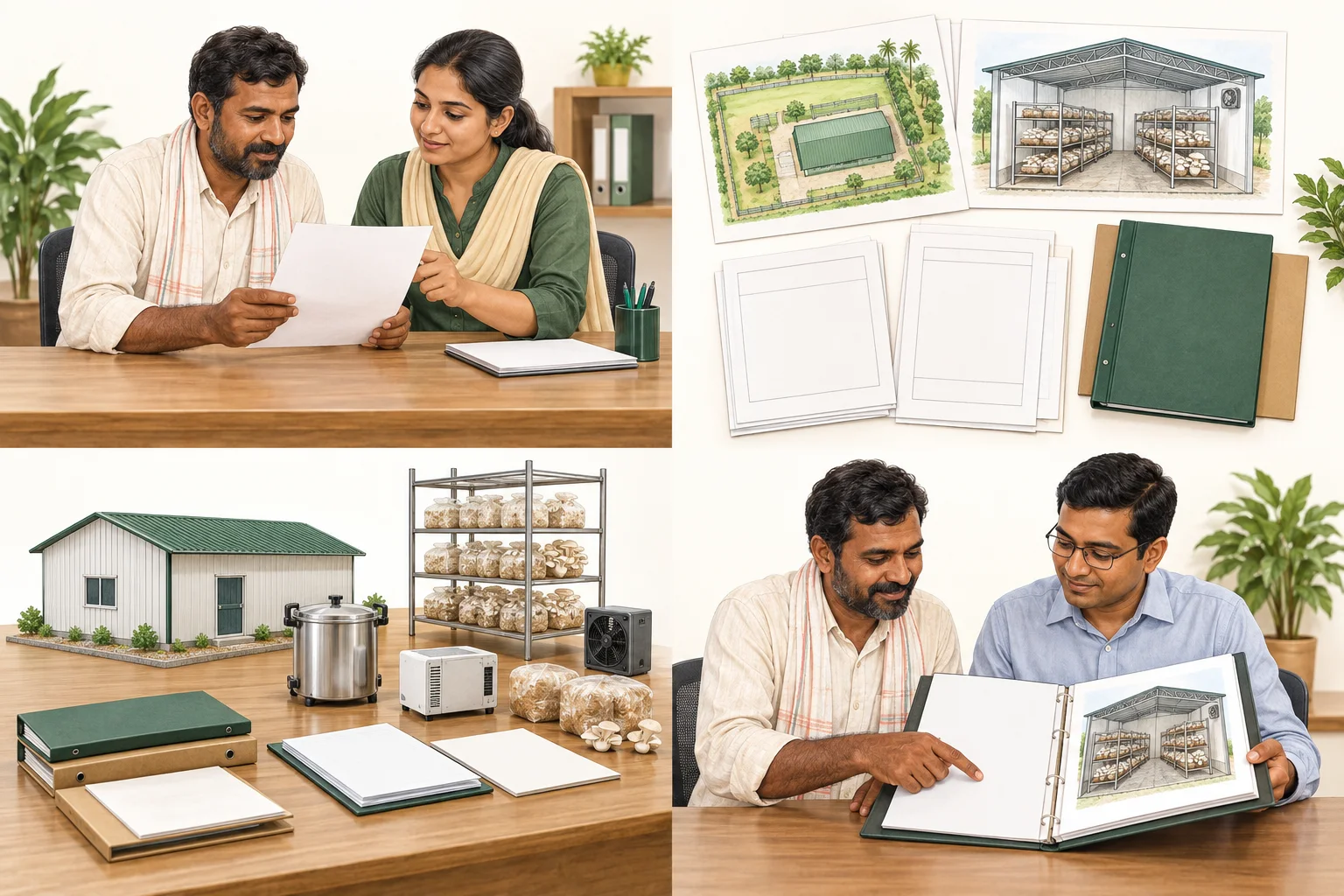
Conceptual illustration of building and equipment models with project folders.
AI illustration · details

AI teaching illustration. Total expenditure, eligible cost and available cash differ. Proposed assistance is not money already available to spend.

Open full image ↗

Assistance released after the work is done and verified.

Costs, sales and cash48

Market Validation

Chapter opening

Market Validation

A price you read on a website is not a buyer. The only price that counts is one a named person paid you, for a named grade, on a named day.

  • By the end you can name three real buyers and the grade each one wants.
  • By the end you can match a species to a selling radius using its published shelf life.
  • By the end you can keep a weekly price record a bank will accept as evidence.
Costs, sales and cash50

Market Validation

Field notes

From an assumption to a buyer

Market validation means replacing a guess with a written record. Begin with a list: the mandi commission agent, vegetable retailers, a hotel or caterer, a canteen, a processor, direct household sale.

For each one write the name, the phone number, the quantity per week they can absorb, and the pack they want. Then collect one piece of paper from each: a rate slip, a purchase order, or your own dated note with the buyer's name on it.

Costs, sales and cash51

Market Validation

Field notes

From an assumption to a buyer · continued

Three such records over three weeks beat any national market report, because they are about your town.

Costs, sales and cash52

Market Validation

Field notes

Grade and pack decide the price

Buyers pay for a grade, not for mushrooms. Cap size, a closed veil, cleanliness, even colour and correct pack weight decide which price band you land in.

ICAR-DMR records the packs actually used in Indian local markets: retail packs of 200 g or 400 g in thin polythene. TNAU's oyster practice is a 200 g bag. For fresh oyster, DMR specifies perforated bags with a vent area of about 5% of the surface.

Costs, sales and cash53

Market Validation

Field notes

Grade and pack decide the price · continued

Ask each buyer to show you an accepted lot and a rejected one, and photograph both. That photograph becomes your grading standard.

Costs, sales and cash54

Market Validation

Field notes

Shelf life draws your selling radius

How far you can sell is set by how long the mushroom lasts, not by the road.

ICAR-DMR's farmer folder gives button mushroom about 12 hours at ambient temperature and 2 to 3 days in a refrigerator. The 2011 manual gives fresh oyster 24 to 48 hours at room temperature and milky mushroom 3 to 4 days. Paddy straw mushroom is the trap: DMR's bulletin says it must not be held at 4 °C because it breaks down; hold it at 10 to 15 °C for about 3 days.

Costs, sales and cash55

Market Validation

Field notes

Shelf life draws your selling radius · continued

DMR also advises chilling button mushrooms at 4 °C for 6 to 8 hours before despatch.

Costs, sales and cash56

Market Validation

Field notes

Channel, price and payment

Every channel pays differently. A mandi agent takes volume and a commission, and pays on his own cycle. A retailer takes small daily lots and settles weekly. A hotel wants one fixed grade on fixed days and pays monthly. A processor takes seconds too, at a lower rate.

Old model prices are not a channel. ICAR-DMR's 2011 model used a wholesale price of Rs 45 to 60 per kg for milky mushroom and Rs 50 per kg for oyster. Those are the source's own 2011 planning figures.

Costs, sales and cash57

Market Validation

Field notes

Channel, price and payment · continued

Use their shape as a sense check, and your dated local record for the number.

Costs, sales and cash58

Market Validation

Compare the evidence

Read the numbers in context

These figures belong to the named source and method. Historical costs are not current quotations. A value without its stage, material basis or measurement location is not a farm instruction.

Source-specific reference figures
What is measuredValue and basisSource and limitation
Retail pack sizes used in India200 or 400 gICAR-DMR manual, 2011. Thin polythene, local markets.
Vent area in a fresh oyster pack5 % of bag surfaceICAR-DMR post-harvest bulletin, 2008. Perforated bags below 100 gauge.
Costs, sales and cash59

Market Validation

Compare the evidence

Read the numbers in context

These figures belong to the named source and method. Historical costs are not current quotations. A value without its stage, material basis or measurement location is not a farm instruction.

Source-specific reference figures
What is measuredValue and basisSource and limitation
Oyster shelf life at room temperature24-48 hoursICAR-DMR manual, 2011. Sets a short selling radius.
Paddy straw mushroom storage10-15 °C for about 3 daysICAR-DMR paddy straw bulletin, 2007. Never 4 °C; it breaks down.
Costs, sales and cash60

Market Validation

Compare the evidence

Read the numbers in context

These figures belong to the named source and method. Historical costs are not current quotations. A value without its stage, material basis or measurement location is not a farm instruction.

Source-specific reference figures
What is measuredValue and basisSource and limitation
Milky wholesale price in the 2011 model45-60 Rs per kgICAR-DMR manual, 2011. The source's 2011 model figure, not a current price.
Costs, sales and cash61

Market Validation

Practical workbook

Three weeks of buyer evidence

Record: Buyer name, date, rate, grade description, quantity promised, payment terms, distance in km.

  1. Visit five buyers and write name, phone, weekly quantity and the pack each wants.

  2. Ask each for the rate paid last week and write the date beside it.

  3. Photograph one accepted lot and one rejected lot at each buyer.

  4. Repeat on the same weekday for three weeks and mark which buyers lie inside your species' shelf life.

Costs, sales and cash62

Market Validation

Pause and recall

Avoid these mistakes

  • Planning on a price seen online, then meeting the local rate only after the crop is standing.
  • Sending every species down the same cold chain and losing paddy straw mushrooms on the way.
  • Agreeing a rate without agreeing a grade, so rejection becomes a monthly argument.
Costs, sales and cash63

Market Validation

Pause and recall

Check your understanding

Choose your answer before opening the explanation. This is a learning exercise, not a competency assessment.

Which mushroom must not be stored at 4 °C?

  1. Button
  2. Oyster
  3. Paddy straw
  4. Milky
See the answer and why

Paddy straw DMR's bulletin says it breaks down at that temperature; hold it at 10 to 15 °C.

Costs, sales and cash64

Market Validation

Pause and recall

Check your understanding

Choose your answer before opening the explanation. This is a learning exercise, not a competency assessment.

The strongest price evidence for a bank is:

  1. A national average online
  2. Three weeks of dated local rates
  3. A neighbour's opinion
  4. A scheme document
See the answer and why

Three weeks of dated local rates Dated rates from named local buyers can be checked by anyone.

Costs, sales and cash65

Market Validation

Pause and recall

Check your understanding

Choose your answer before opening the explanation. This is a learning exercise, not a competency assessment.

DMR advises chilling button mushrooms before despatch at:

  1. 4 °C for 6 to 8 hours
  2. Minus 18 °C for one hour
  3. Room temperature
  4. 10 to 15 °C for 3 days
See the answer and why

4 °C for 6 to 8 hours The manual asks for chilling at 4 °C for 6 to 8 hours before market.

Costs, sales and cash66

Market Validation

Visual glossary

Words used in this lesson

Grade
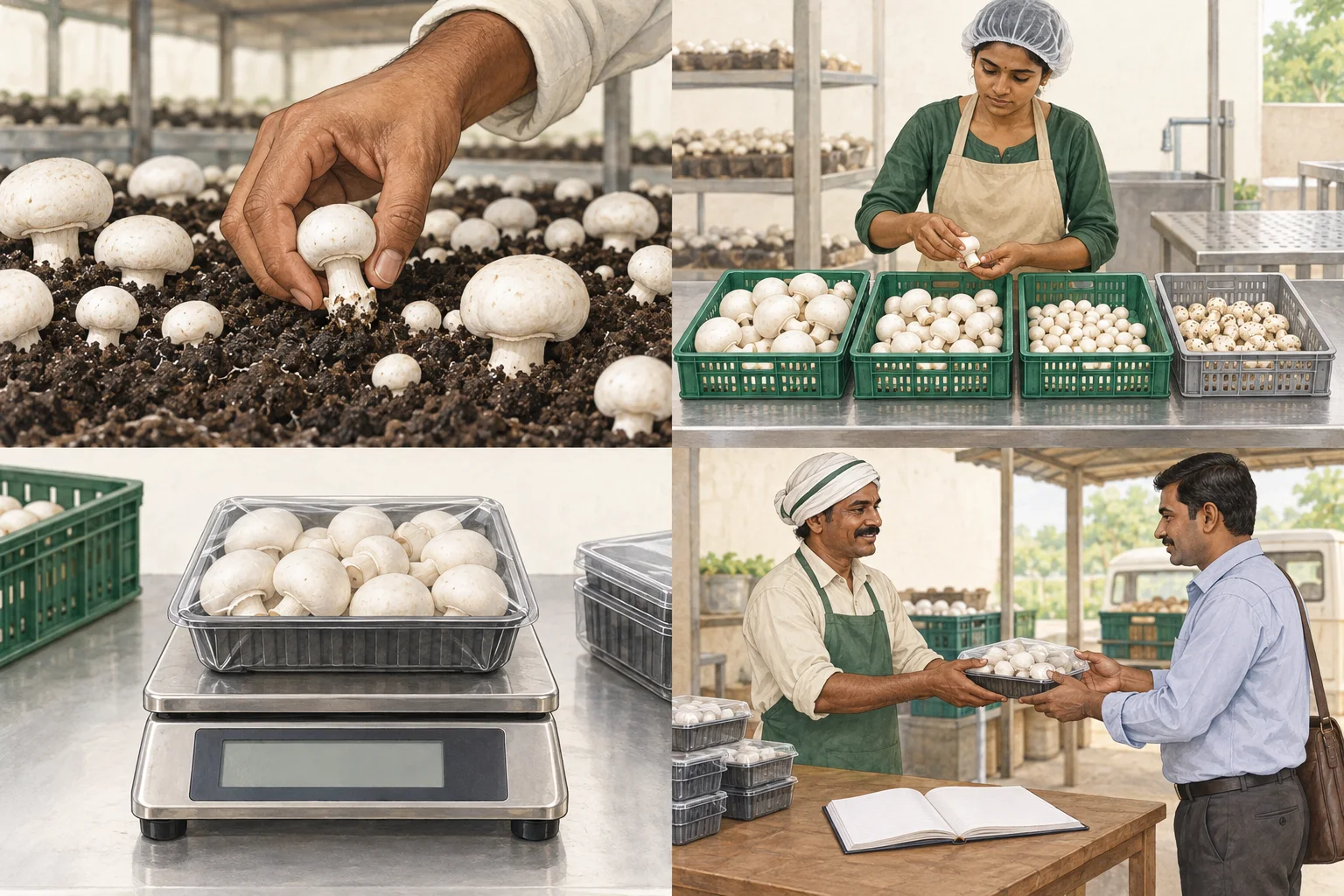
Generated illustration of a grower sorting Button mushrooms into different crates.
AI illustration · details

AI teaching illustration. The lot is divided before it is priced or packed. Buyer requirements determine accepted grades. The illustrated sizes are not a universal grading standard.

Open full image ↗

The agreed description of size, colour and cleanliness a buyer pays for.

Selling radius

The distance you can reach before quality falls below grade.

Channel
See related figure: Follow payment timing

The kind of buyer: mandi, retail, hotel or processor.

Costs, sales and cash67

Break-Even, Cash Flow & Risk

Chapter opening

Break-Even, Cash Flow & Risk

Every project looks profitable on its best day. The decision is made on the worst one: low yield, low price, and one cycle lost.

  • By the end you can say how many kilograms a cycle must sell to cover its costs.
  • By the end you can build a low case using the bottom of published yield ranges.
  • By the end you can write a risk list with an early warning sign for each risk.
Costs, sales and cash69

Break-Even, Cash Flow & Risk

Field notes

Break even in kilograms

Break even is where a cycle's receipts cover its costs. Work it in kilograms, because kilograms are what you count every morning.

Take the costs that do not change with output for one cycle: rent, depreciation, interest, permanent labour. Then take net price per kilogram and subtract the costs that do change: straw, spawn, casing, packing, commission. Divide the first by the second.

Costs, sales and cash70

Break-Even, Cash Flow & Risk

Field notes

Break even in kilograms · continued

The answer is how many kilograms that cycle must sell before it begins to earn. Write it on the room door. It turns an accounting idea into a daily target.

Costs, sales and cash71

Break-Even, Cash Flow & Risk

Field notes

Run the downside first

Published ranges exist because results vary. ICAR-DMR's Table 7.1 gives 10 to 15 kg per 100 kg for long method compost and 18 to 25 kg for short method. The NHB model DPR lists Indian strain yields from 14 to 16 kg per 100 kg for S-11 up to 22 to 27 kg for DMR-NBS-5.

A plan that only works at the top of a range is not a plan. Build three cases on one cost sheet: the bottom of the range, the middle, and one where a whole cycle is lost to contamination.

Costs, sales and cash72

Break-Even, Cash Flow & Risk

Field notes

Run the downside first · continued

If the bottom case still pays the loan instalment, the project can survive a bad season.

Costs, sales and cash73

Break-Even, Cash Flow & Risk

Field notes

Cash flow month by month

Annual profit hides the month you run out of money. Lay twelve months across a page. In each month write what leaves and what arrives, using real cycle dates, not an even spread.

Money leaves early: compost or straw, spawn, casing, fuel, wages. Money arrives late, after picking and after the buyer's credit period. In a six cycle year with rooms filled one after another, the next cycle's outflow lands before the last one's inflow clears.

Costs, sales and cash74

Break-Even, Cash Flow & Risk

Field notes

Cash flow month by month · continued

The lowest point on that page, not the yearly total, is the working capital the project truly needs.

Costs, sales and cash75

Break-Even, Cash Flow & Risk

Field notes

A risk list you will actually use

A risk list is not a paragraph about uncertainty. It is a table with four columns: the risk, its early warning sign, what you will do, and who does it.

Keep it short and specific to your site. A bad casing lot shows as uneven pinning within a week of casing. A power failure shows as room temperature drifting out of band. A buyer in trouble shows as payment slipping from seven days to twenty.

  • Crop risks: contamination, casing lot quality, spawn age.
  • Site risks: power, water, labour, cold chain.
  • Money risks: buyer default, price fall, instalment date.
Costs, sales and cash76

Break-Even, Cash Flow & Risk

Compare the evidence

Read the numbers in context

These figures belong to the named source and method. Historical costs are not current quotations. A value without its stage, material basis or measurement location is not a farm instruction.

Source-specific reference figures
What is measuredValue and basisSource and limitation
Long method compost yield10-15 kg per 100 kg compostICAR-DMR manual, 2011. Use the lower end in the downside case.
Short method compost yield18-25 kg per 100 kg compostICAR-DMR manual, 2011. Pasteurised compost.
Costs, sales and cash77

Break-Even, Cash Flow & Risk

Compare the evidence

Read the numbers in context

These figures belong to the named source and method. Historical costs are not current quotations. A value without its stage, material basis or measurement location is not a farm instruction.

Source-specific reference figures
What is measuredValue and basisSource and limitation
Lowest strain yield in the NHB table14-16 kg per 100 kg compostNHB DPR model, 2018. Strain S-11, under Indian conditions.
Highest strain yield in the NHB table22-27 kg per 100 kg compostNHB DPR model, 2018. Strain DMR-NBS-5, for fresh market.
Costs, sales and cash78

Break-Even, Cash Flow & Risk

Compare the evidence

Read the numbers in context

These figures belong to the named source and method. Historical costs are not current quotations. A value without its stage, material basis or measurement location is not a farm instruction.

Source-specific reference figures
What is measuredValue and basisSource and limitation
Crops per room per year6 crops of 60 daysICAR-DMR manual, 2011. Model assumption; try five in the downside case.
Costs, sales and cash79

Break-Even, Cash Flow & Risk

Practical workbook

Build three cases on one sheet

Record: Break even kg, planned kg, three case results, lowest cash month and its amount.

  1. Write one cost sheet for a single cycle, separating fixed costs from per kilogram costs.

  2. Calculate break even kilograms and compare it with your planned output.

  3. Repeat the sheet at the bottom of the yield range and at a price 20% lower.

  4. Lay twelve months of real inflows and outflows and mark the lowest point.

Costs, sales and cash80

Break-Even, Cash Flow & Risk

Pause and recall

Avoid these mistakes

  • Deciding on a single best case and calling the range optimism.
  • Reading an annual profit figure and never laying the months out.
  • Writing a risk list with no early warning sign, so nobody notices it arriving.
Costs, sales and cash81

Break-Even, Cash Flow & Risk

Pause and recall

Check your understanding

Choose your answer before opening the explanation. This is a learning exercise, not a competency assessment.

Break even kilograms are found by dividing fixed cost per cycle by:

  1. Net price per kg
  2. Net price minus variable cost per kg
  3. Total cost per kg
  4. Yield per 100 kg
See the answer and why

Net price minus variable cost per kg Only what is left from each kilogram after its own variable costs can pay fixed costs.

Costs, sales and cash82

Break-Even, Cash Flow & Risk

Pause and recall

Check your understanding

Choose your answer before opening the explanation. This is a learning exercise, not a competency assessment.

Which yield should a downside case use?

  1. 22 to 27 kg per 100 kg
  2. 14 to 16 kg per 100 kg
  3. The neighbour's best flush
  4. An imported benchmark
See the answer and why

14 to 16 kg per 100 kg The NHB table's lowest Indian strain figure tests a poor result.

Costs, sales and cash83

Break-Even, Cash Flow & Risk

Pause and recall

Check your understanding

Choose your answer before opening the explanation. This is a learning exercise, not a competency assessment.

The working capital need is best read from:

  1. Annual profit
  2. The lowest point of the monthly cash page
  3. The subsidy amount
  4. The loan sanction letter
See the answer and why

The lowest point of the monthly cash page That trough is the largest amount you must fund before money returns.

Costs, sales and cash84

Practise and review

Pause and recall

Mistakes to avoid

Revenue equals cash collected. Track receivables and receipts separately.

Payment status determines sold kilograms. Payment timing belongs in cash flow, not the physical sales denominator.

Costs, sales and cash87

Practise and review

Practical workbook

Make three linked sheets

Prepare a quantity reconciliation, an operating-result calculation and a weekly cash calendar for the same hypothetical batch. Explain every difference.

Costs, sales and cash88

Sources and next steps

Sources & further reading

Keep learning with the field guides

English editorial teaching material. Independent technical review and full Hindi translation remain pending. Reading or completing an exercise is not proof of practical competence.

Illustrations are not diagnostic evidence, construction drawings or operating specifications. Use species-, strain- and method-specific guidance for practical work.

Costs, sales and cash89

English learning edition · Independent technical review pending. Keyboard: focus the reading page and use ← / →. Page turning does not mark practical competence.