


A practical guide to growing mushrooms in IndiaA joint educational initiative by MushroomWale & DMR Solan
MushroomFarming.in

A joint educational initiative by

MushroomWale.com
ICAR–Directorate of Mushroom Research, Solan logoICAR–DMRSolan

Read · Observe · Practise · Check

Farm economics: separate output, sales and cash

Build a transparent business model from your own inputs. The worked arithmetic is for learning, not a current market quotation or yield forecast.

Begin the walkthrough ↓
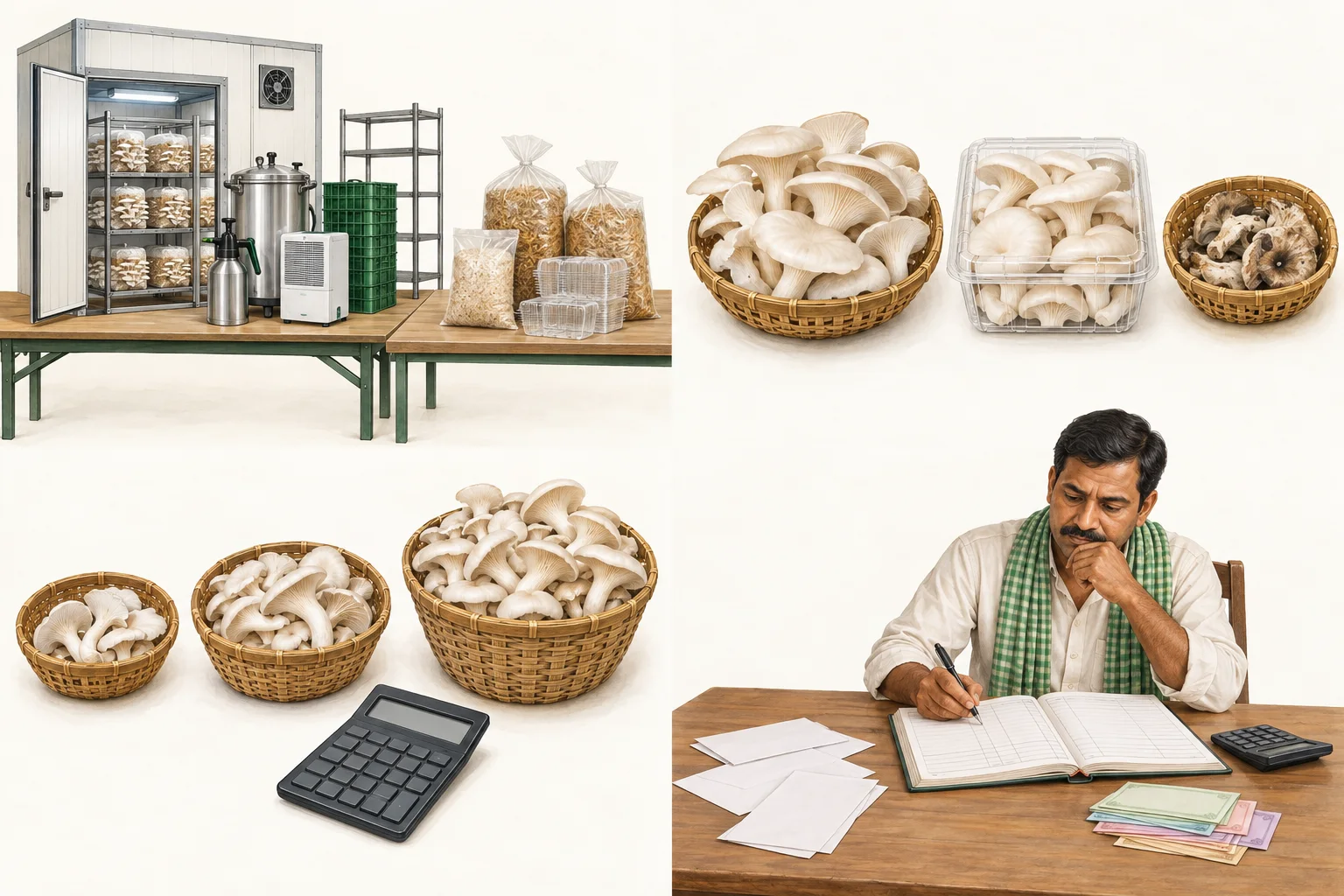
Conceptual illustration of farm structures and equipment beside consumable growing inputs.
AI-generated teaching illustrationConceptual learning scene, not a diagnostic photograph or construction specification.

Before you begin

  • A clearly defined crop and production boundary
  • Current written quotations and buyer terms
  • Separate harvest, accepted-sales and payment records

Use the linked crop and technical lessons for method-specific detail. Practical work involving chemicals, pressure, electrical equipment or uncertain crop health requires competent supervision; illustrations are not operating specifications.

Conceptual illustration of farm structures and equipment beside consumable growing inputs.

Conceptual AI teaching scene

Stage 1

Define what the budget includes

Separate long-lived assets, recurring production costs and working cash. Identify omitted items such as owner labour, repairs, packaging, transport or financing instead of hiding them inside a favourable margin.

Put it into practice
List each expense with its unit, quantity, price basis and payment date.
Check your work
Two proposals can be compared using the same scope and period.
Illustration of harvested mushrooms separated into packed and rejected lots.

Conceptual AI teaching scene

Stage 2

Reconcile quantities

Hypothetical example: 100 kg harvested minus 10 kg rejected or unsold leaves 90 kg sold. At an assumed ₹150/kg, sales are ₹13,500. The other 10 kg still consumed resources.

Put it into practice
Build the calculation with harvested, rejected, sold and returned quantities on separate lines.
Check your work
Cost per harvested kilogram and cost per sold kilogram are labelled as different measures.
Conceptual illustration of different basket quantities beside a calculator.

Conceptual AI teaching scene

Stage 3

Test a weaker result

Change one assumption at a time before combining risks. Lower accepted output, lower price, higher energy use or buyer deductions can change the outcome independently. Keep the original case visible for comparison.

Put it into practice
Use the same cost boundary for the base and weaker cases. Explain which inputs are measured and which are assumed.
Check your work
The model shows the consequences of uncertainty rather than only one attractive result.
Illustration of a grower reconciling invoices, a ledger and cash.

Conceptual AI teaching scene

Stage 4

Follow payment timing

If ₹11,000 of the example’s ₹13,500 sales is collected, ₹2,500 remains receivable. That does not change sold kilograms. A farm may have a positive operating result and still lack cash for its next input purchase.

Put it into practice
Place actual receipts and due payments on a weekly calendar. Mark any week when available cash cannot cover the planned input purchases.
Check your work
Working-cash needs follow payment timing; unpaid invoices are not counted as money already available.

Common mistakes—and the better question

Revenue equals cash collected
Track receivables and receipts separately.
Payment status determines sold kilograms
Payment timing belongs in cash flow, not the physical sales denominator.

A task to complete, not just a page to read

Make three linked sheets

Prepare a quantity reconciliation, an operating-result calculation and a weekly cash calendar for the same hypothetical batch. Explain every difference.

Bring back this evidence

Three consistent sheets with assumptions, units and omitted costs clearly labelled.

Completing this self-guided task is not verification of practical competence. Review it with a suitable instructor before relying on it for farm operation.

Study the detailed lessons in order

Mushroom Farming Business Fundamentals. Every lesson keeps its explanations, practical exercise, mistakes and self-checks.

  1. Revenue, Cost & Cost/kgSeparate receipts, cost layers and profit using explicit assumptions.
  2. CAPEX, OPEX & Working CapitalDistinguish investment, operating expense and timing gaps.
  3. Market ValidationReplace online price assumptions with buyer, grade and channel evidence.
  4. Break-Even, Cash Flow & RiskTest downside before deciding whether to proceed.

Keep the field guidance beside the lesson

Open the main subject guide →Mushroom cost per kg calculatorMushroom farm feasibility checkMushroom farm working-capital calculatorMushroom market validation

Sources, scope and review

Editorial learning material; no independent technical review is claimed. The tasks are original teaching exercises. Source-specific numerical schedules remain in the detailed lessons with their context, rather than being turned into universal instructions here.