


Log Cultivation
Log grown shiitake is farming at the speed of wood. What you decide in week one is locked in for years.
- By the end you can select and handle logs to the DMR specification.
- By the end you can describe how sawdust spawn is made and placed.
- By the end you can run a cold shock and a rest period between flushes.
Newly inoculated logs with the spawn holes sealed against drying.
- Select logsBroad leaved, 9 to 18 cm, bark intact.
- Inoculate and sealSawdust spawn into drilled holes, sealed over.
- Stack and waitShade, no drying, record weight and dates.
- Shock and cropCold water 4 to 6 C, pins in 5 to 8 days.
Read numerical examples with their source, method and crop context. They are not universal operating instructions. Historical prices are not current quotations.
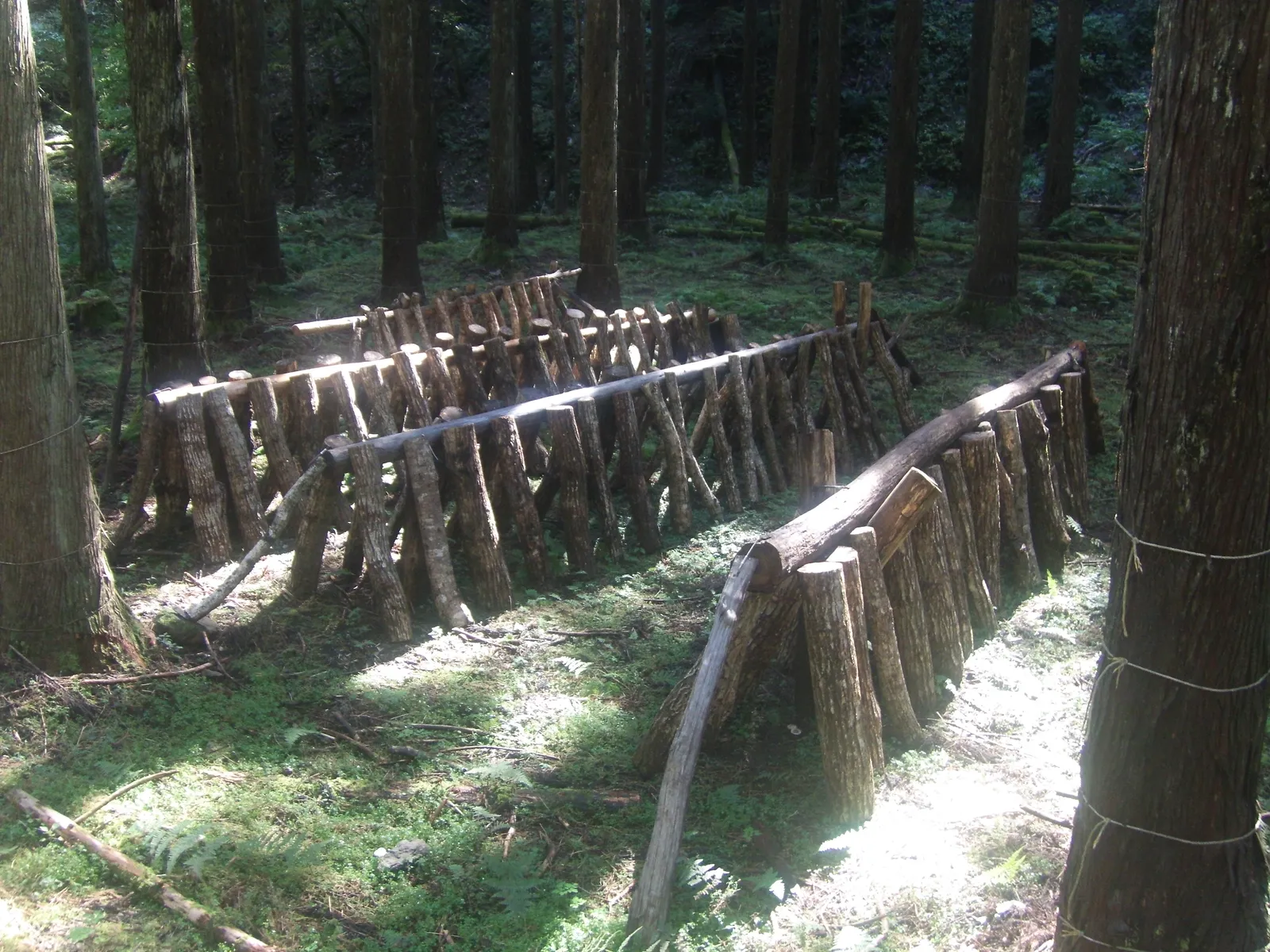
Logs are a separate production system
- Notice
- The hardwood logs, shaded location and arrangement are different from packaged sawdust blocks.
- Understand
- Tree species, log condition, inoculation, incubation and fruiting management belong to a log-specific method. A photograph does not establish readiness or a schedule.
- Try it
- Compare the material, space, time and water requirements of the log and block methods before choosing either.
01The log is the crop
ICAR-DMR says shiitake will grow on almost any size and age of log, then gives the working specification: 9 to 18 cm diameter, from trees 15 to 20 years old. The species named are broad leaved hardwoods, including oak, Castanopsis, Elaeocarpus, Lithocarpus, birch and Carpinus.
Age matters because a young tree has thin sapwood and an old one is often already rotting. Diameter matters because a thin log dries out and a thick one takes longer to colonise.
Use sound wood with the bark intact. Bark is the log's skin; where it is knocked off, other fungi enter first.
02Spawn for logs
Logs take sawdust spawn, not grain spawn. DMR publishes three sawdust spawn formulations built on sawdust with wheat or rice bran, sugar and calcium carbonate.
The process is a laboratory one. Containers are autoclaved at 20 psi for two hours, then inoculated and incubated for 30 days at 24 plus or minus 2 C. Unless you have that equipment and training, buy spawn from a recognised laboratory and check the date on it.
Spawn is placed into drilled holes and the hole is sealed, commonly with wax, so the spawn does not dry out and rain does not run in.
03The long wait, and what to record
After inoculation the logs are stacked in shade and kept from drying. This spawn run is measured in months, not weeks.
Here the honest position matters: the Indian documents used for this course give a full incubation figure for synthetic blocks, not for logs. So do not take a number on trust. Measure your own yard: log weight at stacking, the date, shade, watering, and the first sign of white mycelium at the cut ends.
Signs to watch are the ends going white, the bark loosening slightly, and the log sounding duller when tapped. Photograph the stack monthly with a date.
04Cold shock, fruiting and rest
Shiitake is induced, not simply waited for. DMR's method is a cold water shock at 4 to 6 C for 10 to 20 minutes. Primordia begin 5 to 8 days later, and fruit bodies are ready 5 to 7 days after that.
Harvest by taking the stalk and breaking it away from the wood. DMR is explicit: do not tear mushrooms off the surface, and harvest early rather than late.
Then rest the logs. The published rest stage is 7 to 21 days at 22 to 26 C with no light and 65 to 70 percent humidity. A dry period after harvest helps prevent contamination before the next induction.
Set up and label one trial stack
- Select ten logs of 9 to 18 cm with bark intact.
- Weigh and number each log and note the felling date.
- Inoculate with laboratory spawn and seal each hole.
- Stack in shade and photograph the stack every month.
- Reweigh three logs monthly to track how much water is lost.
Write in your farm diary: Log number, species, diameter, felling and inoculation dates, monthly weights, first white.
Mistakes that cost a crop
- Using logs with the bark knocked off, which lets other fungi colonise first.
- Letting the stack dry in sun, which kills mycelium you cannot see.
- Keeping no weights or dates, so a slow log looks like a dead one.
Check yourself
Three questions, instant answersWhich spawn type is used for logs?
What does DMR use to induce fruiting?
How should a shiitake mushroom be removed?
An editorial self-check, not a certificate. Answers are not stored, not even on this device.
Words used in this lesson
- Sawdust spawn
- Spawn grown on sawdust, used to fill holes drilled in logs.
- Primordium
- The first tiny mushroom body to appear.
- Cold shock
- A sudden chilling used to trigger fruiting.
References & further reading
Species, strain, climate and production method must remain explicit.
Open current reference