A practical guide to growing mushrooms in IndiaA joint educational initiative by MushroomWale & DMR Solan
MushroomFarming.in

A joint educational initiative by

MushroomWale.com
ICAR–Directorate of Mushroom Research, Solan logoICAR–DMRSolan
← All books

Shiitake mushrooms

Contents · choose a chapter or topic
Start here
  1. 01Shiitake mushrooms
  2. 02What you need before starting
The process
  1. 03Define the production boundary
  2. 04Recognise maturation as a stage
  3. 05Use the appropriate fruiting method
  4. 06Count space and saleable output
In the field
  1. 07Start with the block supply model
  2. 08White colonisation is not the final readiness test
  3. 09Ask what stage a purchased block has actually reached
  4. 10Use a strain-specific induction and recovery programme
  5. 11Write it in your farm notebook
  6. 12Include long occupancy and buyer specifications in the plan
  7. 13Track space as well as kilograms
  8. 14Where the field guidance comes from
Choose the Cultivation Method
  1. 15Choose the Cultivation Method
  2. 16One fungus, two production systems
  3. 17One fungus, two production systems · continued
  4. 18Where in India each one fits
  5. 19Where in India each one fits · continued
  6. 20The numbers depend on which document you read
  7. 21The numbers depend on which document you read · continued
  8. 22Choosing between them
  9. 23Choosing between them · continued
  10. 24Read the numbers in context
  11. 25Read the numbers in context
  12. 26Read the numbers in context
  13. 27Decide your system on paper this week
  14. 28Avoid these mistakes
  15. 29Check your understanding
  16. 30Check your understanding
  17. 31Check your understanding
  18. 32Words used in this lesson
  19. 33Sources and field reference
Log Cultivation
  1. 34Log Cultivation
  2. 35The log is the crop
  3. 36The log is the crop · continued
  4. 37Spawn for logs
  5. 38Spawn for logs · continued
  6. 39The long wait, and what to record
  7. 40The long wait, and what to record · continued
  8. 41Cold shock, fruiting and rest
  9. 42Cold shock, fruiting and rest · continued
  10. 43Read the numbers in context
  11. 44Read the numbers in context
  12. 45Read the numbers in context
  13. 46Set up and label one trial stack
  14. 47Avoid these mistakes
  15. 48Check your understanding
  16. 49Check your understanding
  17. 50Check your understanding
  18. 51Words used in this lesson
  19. 52Sources and field reference
Synthetic Block Cultivation
  1. 53Synthetic Block Cultivation
  2. 54The formula, and why it is acidic
  3. 55The formula, and why it is acidic · continued
  4. 56Soak, fill and sterilise
  5. 57Soak, fill and sterilise · continued
  6. 58A long incubation with visible stages
  7. 59Induction, fruiting and rest
  8. 60Induction, fruiting and rest · continued
  9. 61Read the numbers in context
  10. 62Read the numbers in context
  11. 63Read the numbers in context
  12. 64Run a first batch of ten blocks
  13. 65Avoid these mistakes
  14. 66Check your understanding
  15. 67Check your understanding
  16. 68Check your understanding
  17. 69Words used in this lesson
  18. 70Sources and field reference
Practise and review
  1. 71Mistakes to avoid
  2. 72Compare two supplier offers
Sources and next steps
  1. 73Keep learning with the field guides

Start here

Chapter opening

Shiitake mushrooms

Understand which production stages you operate. Log culture, block manufacture and fruiting purchased blocks have different inputs, facilities, waiting periods and risks.

Read one page, study its picture, then turn to the next. Use Contents whenever you want a particular topic.

Shiitake mushrooms01

Start here

Practical workbook

What you need before starting

Keep these beside you while you learn. You do not need to buy equipment just to read this book.

  1. Chosen method: logs, manufactured blocks or purchased blocks

  2. Strain and supplied-stage information

  3. An occupancy plan covering incubation and rest as well as harvest

Shiitake mushrooms02

The process

Practical workbook

Define the production boundary

A sealed purchased block may be recently inoculated, colonising or mature. Ready is too vague for a production schedule. Laboratory block manufacture also requires facilities and skills that a fruiting room alone does not provide.

Shiitake mushrooms03

The process

Practical workbook

Recognise maturation as a stage

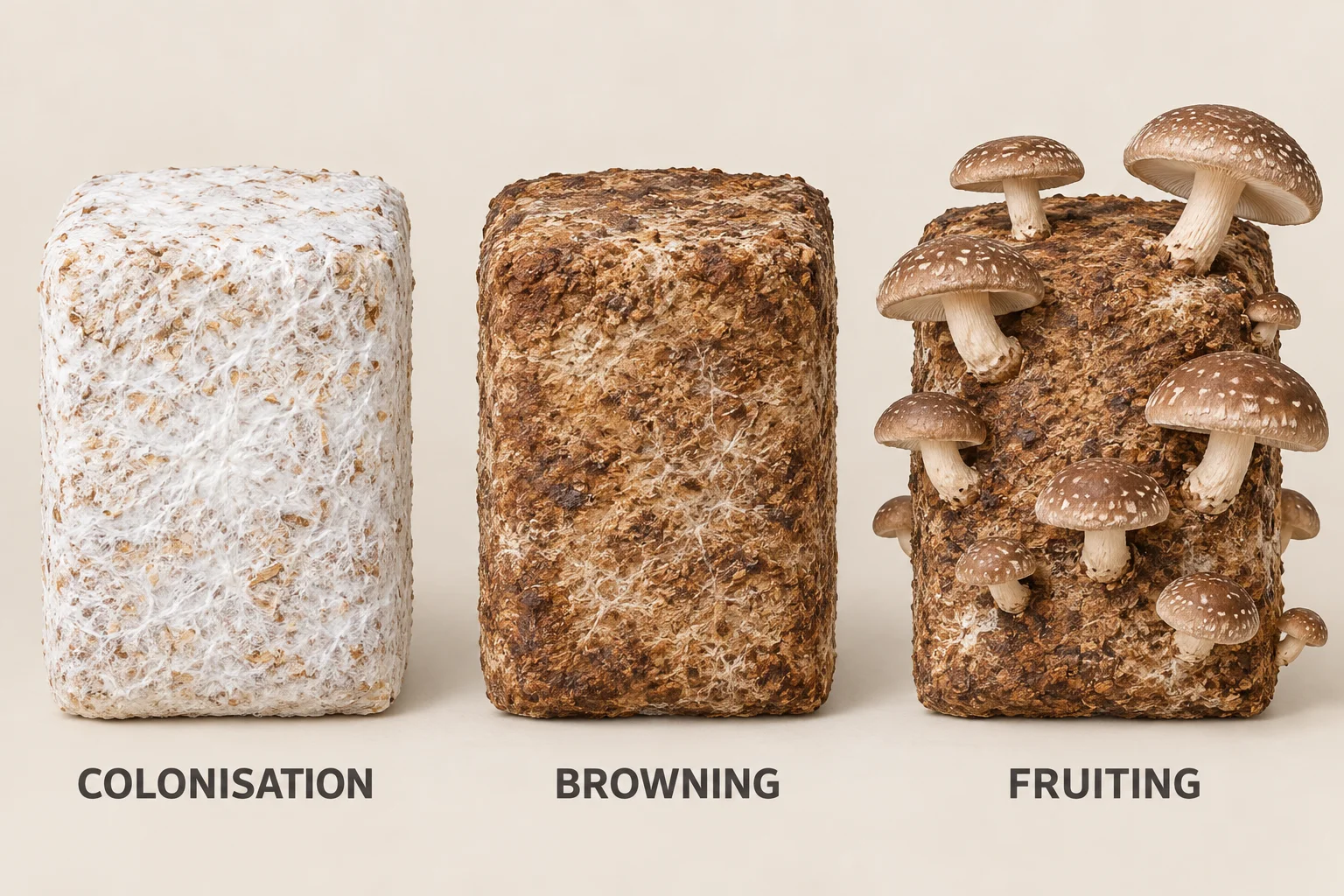
In the illustrated block method, surface development and browning follow white colonisation before fruiting. Appearance, handling history and the strain’s criteria must be read together; the illustration is not a date-based release test.

Shiitake mushrooms04

The process

Practical workbook

Use the appropriate fruiting method

Do not transfer a log-soaking instruction directly to a sawdust-block crop. Induction and handling must suit the material, strain and stage. Track the response and any recovery period in the same batch record.

Shiitake mushrooms05

The process

Practical workbook

Count space and saleable output

Incubation, maturation, fruiting and recovery all occupy resources. A calculation based only on harvesting days overstates available room capacity. Record accepted harvest alongside the full occupancy history.

Shiitake mushrooms06

In the field

Field notes

Start with the block supply model

A farm that buys prepared shiitake blocks has different equipment and skills from a farm manufacturing supplemented wood-based blocks. List what the supplier completes and what you must complete. Ask for strain identity, inoculation date, developmental stage, transport conditions and a written handover protocol. The phrase ready block is too vague for a production schedule.

For in-house manufacture, review substrate sourcing, formulation, treatment equipment, clean inoculation and incubation as a whole process with a qualified trainer. Material suitability includes its identity and contamination history; unknown treated wood is not a mushroom substrate. Begin with a controlled pilot and traceable inputs before buying equipment around an assumed output.


Shiitake mushrooms07

In the field

Field notes

White colonisation is not the final readiness test

Shiitake block systems include development beyond initial colonisation, including a maturation and browning sequence. Learn the appearance and handling criteria for your strain and block process. A block that looks colonised is not automatically ready for the next fruiting intervention. Readiness depends on its developmental history as well as appearance.

Record bag opening, browning progress and any treatment dates for each lot. Compare representative blocks across shelves and note damaged packaging or abnormal patches. Where a supplier's instructions and a general guide differ, identify whether they refer to the same strain, substrate and production stage before deciding which method applies.

Shiitake mushrooms08

In the field

Compare the evidence

Ask what stage a purchased block has actually reached

Ask what stage a purchased block has actually reached
StageInformation neededPlanning consequence
ColonisingInoculation date and incubation guidanceIncubation space and time still needed
Maturing or browningStage criteria and handling methodDo not schedule immediate harvest
Ready for inductionStrain-specific readiness and induction instructionsFruiting room and harvest team must be available
Shiitake mushrooms09

In the field

Field notes

Use a strain-specific induction and recovery programme

Fruiting induction, block handling and any soaking or temperature treatment must follow the validated block and strain protocol. Do not apply an arbitrary cold-water duration from a different production system. Record the treatment actually used, the block condition before and after it, and the subsequent pinning response.

Manage fruiting air, moisture and light with observations at crop level. After harvest, follow the programme for block recovery and later flushes rather than assuming the next treatment can begin immediately. Keep later-flush output and losses separate from the first flush so that total block performance is visible.

Shiitake mushrooms10

In the field

Field notes

Write it in your farm notebook

Lot • received stage • browning observations • induction method and date • fruiting conditions • harvest by flush • recovery interval • rejects • final disposal date.

Shiitake mushrooms11

In the field

Field notes

Include long occupancy and buyer specifications in the plan

A block occupies space before, during and between harvests. Calculate capacity from that entire occupancy, including handling and room reset, rather than from the visible picking period alone. Include blocks that fail, become unsaleable or are retired early when assessing a supplier or your own block process.

Discuss fresh cap size, stem trimming, packaging and acceptance criteria with buyers. Drying introduces an additional food-processing workflow, moisture-control requirement and market; it is not an automatic rescue for rejected fresh produce. Keep fresh and processed enterprise assumptions separate and verify applicable food-business requirements before commercial processing.

Shiitake mushrooms12

In the field

Field notes

Track space as well as kilograms

Compare two lots using saleable kilograms per received block and the number of days each lot occupied the growing system. A higher total yield with much longer occupancy may not create higher annual output. Use actual lot records to decide, not a single harvest photograph.

Shiitake mushrooms13

In the field

Sources & further reading

Where the field guidance comes from

ICAR-IIHR cultivation publications: Crop-specific Indian training publications; obtain the protocol for your species, strain and method.

Cornell: seven stages of cultivation: Shiitake maturation and the distinction between colonisation and fruiting; exact protocols are strain-specific.

Shiitake mushrooms14

Choose the Cultivation Method

Chapter opening

Choose the Cultivation Method

Shiitake is really two crops. On wood logs it takes years; on a sterile block, months. Mixing their numbers loses a season.

  • By the end you can describe the log system and the block system separately.
  • By the end you can say where in India each one fits.
  • By the end you can quote a shiitake figure with the document it came from.
Shiitake mushrooms15

Choose the Cultivation Method

Field notes

One fungus, two production systems · continued

In the synthetic block system the wood is broken down first. DMR mixes sawdust 80 kg, wheat bran 19 kg and calcium carbonate 1 kg per 100 kg, fills 1.5 to 2 kg bags and sterilises them. The fungus gets the same food in a form it can eat faster.

Shiitake mushrooms17

Choose the Cultivation Method

Field notes

Where in India each one fits

Shiitake is a cool weather crop. The DMR seasonal folder puts it in the mid hills from October to February and in the high hills from December to April, and lists it among the species for the north eastern states.

No DMR month is given for shiitake on the plains, and that absence is the answer: on the plains this crop needs a cooled room, not a season.

Shiitake mushrooms18

Choose the Cultivation Method

Field notes

Where in India each one fits · continued

Logs also need something the plains rarely have: legal hardwood of the right age, shade, and water through a long wait. Blocks need an autoclave, a clean inoculation space and steady power. Pick the constraint you can actually meet.

Shiitake mushrooms19

Choose the Cultivation Method

Field notes

The numbers depend on which document you read

Shiitake is where ICAR-DMR disagrees with itself, and a grower should see it rather than be protected from it.

Yield: the shiitake folder reports 35 to 45 percent of the wet weight of the substrate. The 2011 manual, same method, reports 15 to 30 percent. That is a factor of two.

Shiitake mushrooms20

Choose the Cultivation Method

Field notes

The numbers depend on which document you read · continued

Incubation: the folder gives 60 to 80 days at 22 to 26 C; the manual's table gives 50 to 120 days at 20 to 30 C. Fruiting temperature has three published values: 12 to 25 C, 12 to 18 C and 15 to 20 C.

So publish a range, name the document, and measure your own house.

Shiitake mushrooms21

Choose the Cultivation Method

Field notes

Choosing between them

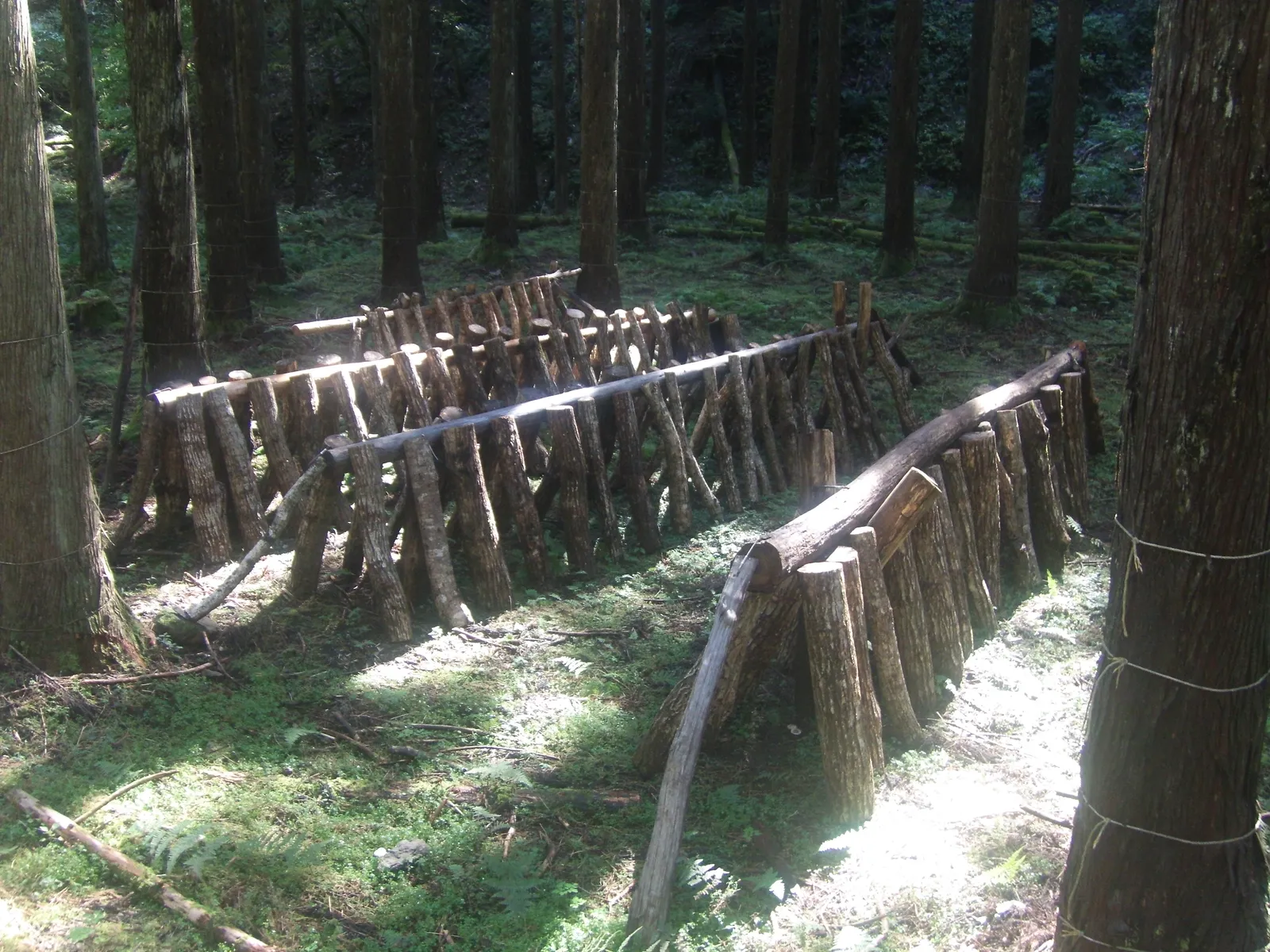
The log system is cheap in cash and expensive in time. You buy logs and spawn, then wait through a spawn run measured in seasons, with shade, watering and theft to manage. It suits hill farms with their own trees and patience.

The block system is the opposite. It needs an autoclave, heat resistant polypropylene bags, clean hands and reliable electricity, and it repays that with a defined 60 to 80 day incubation and repeated flushes on demand.

Shiitake mushrooms22

Choose the Cultivation Method

Field notes

Choosing between them · continued

One rule holds for both. Never carry a block number into a log yard or a log number into a block room. They are different crops that happen to share a name.

Shiitake mushrooms23

Choose the Cultivation Method

Compare the evidence

Read the numbers in context

These figures belong to the named source and method. Historical costs are not current quotations. A value without its stage, material basis or measurement location is not a farm instruction.

Source-specific reference figures
What is measuredValue and basisSource and limitation
Log diameter9-18 cmICAR-DMR manual, 2011. From trees of 15 to 20 years
Block spawn run60-80 daysICAR-DMR shiitake folder. The manual table says 50 to 120 days
Shiitake mushrooms24

Choose the Cultivation Method

Compare the evidence

Read the numbers in context

These figures belong to the named source and method. Historical costs are not current quotations. A value without its stage, material basis or measurement location is not a farm instruction.

Source-specific reference figures
What is measuredValue and basisSource and limitation
Fruiting temperature12-25 °CICAR-DMR shiitake folder. Manual gives 12 to 18; species table 15 to 20
Yield, folder35-45 % of wet substrateICAR-DMR shiitake folder. Reported, not a promise
Shiitake mushrooms25

Choose the Cultivation Method

Compare the evidence

Read the numbers in context

These figures belong to the named source and method. Historical costs are not current quotations. A value without its stage, material basis or measurement location is not a farm instruction.

Source-specific reference figures
What is measuredValue and basisSource and limitation
Yield, manual15-30 % of wet substrateICAR-DMR manual, 2011. Same method; do not average the two
Season, mid hillsOctober to February monthsICAR-DMR seasonal folder. High hills December to April
Shiitake mushrooms26

Choose the Cultivation Method

Practical workbook

Decide your system on paper this week

Record: Monthly temperatures, wood and permissions, equipment quotes, chosen system and reason.

  1. Write down your coldest three months and their night temperatures.

  2. List hardwood you can legally obtain, with species, diameter and age.

  3. Price an autoclave, bags and a clean inoculation table.

  4. Ask whether you can wait seasons or need a crop this year.

  5. Write one line naming the system you chose and why.

Shiitake mushrooms27

Choose the Cultivation Method

Pause and recall

Avoid these mistakes

  • Quoting a block yield for a log yard, so the plan never matches reality.
  • Planning shiitake on the plains without a cooled room for fruiting.
  • Averaging the two DMR yield figures into one number that no document supports.
Shiitake mushrooms28

Choose the Cultivation Method

Pause and recall

Check your understanding

Choose your answer before opening the explanation. This is a learning exercise, not a competency assessment.

Why do two DMR documents give different shiitake yields?

  1. One is a typing error
  2. They describe different species
  3. Both are published for the same method
  4. One is not from DMR
See the answer and why

Both are published for the same method Folder says 35 to 45 percent, manual 15 to 30.

Shiitake mushrooms29

Choose the Cultivation Method

Pause and recall

Check your understanding

Choose your answer before opening the explanation. This is a learning exercise, not a competency assessment.

What log does DMR specify for shiitake?

  1. Any softwood
  2. Broad leaved, 9 to 18 cm
  3. Bamboo poles
  4. Sawn timber
See the answer and why

Broad leaved, 9 to 18 cm Broad leaved hardwood of 9 to 18 cm from trees 15 to 20 years old.

Shiitake mushrooms30

Choose the Cultivation Method

Pause and recall

Check your understanding

Choose your answer before opening the explanation. This is a learning exercise, not a competency assessment.

Where does the DMR calendar place shiitake?

  1. Plains, November to February
  2. Mid hills, October to February
  3. Coastal states, all year
  4. Plains, all year
See the answer and why

Mid hills, October to February Mid hills October to February; high hills December to April.

Shiitake mushrooms31

Choose the Cultivation Method

Visual glossary

Words used in this lesson

Lentinula edodes
See related figure: Shiitake mushrooms

The scientific name of shiitake mushroom.

Synthetic block
See related figure: What you need before starting

A sterilised sawdust and bran bag used instead of a wood log.

Inoculation
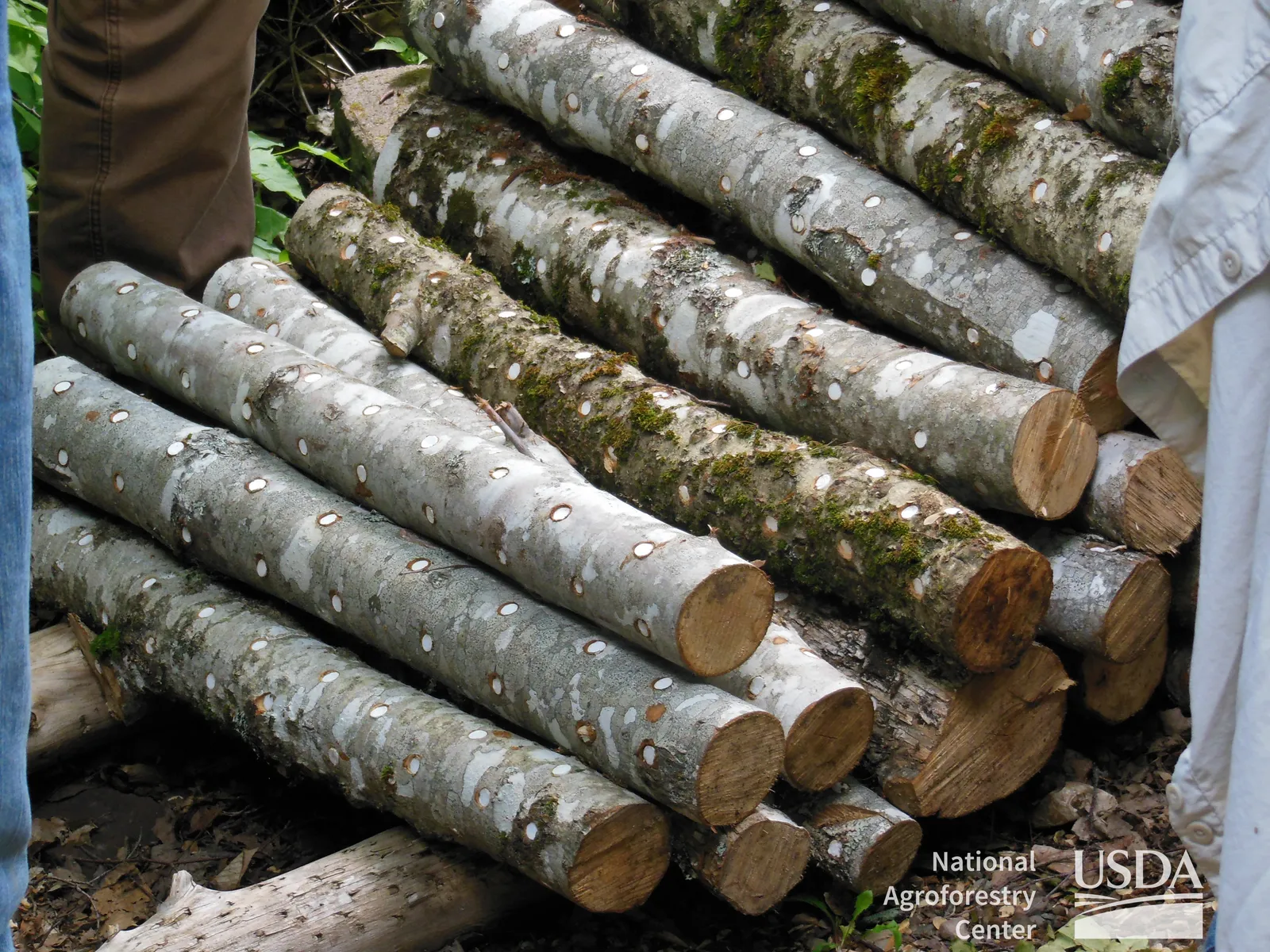
Freshly inoculated beech logs for shiitake, each drilled spawn hole sealed with wax, stacked outdoors (USDA National Agroforestry Center).
Photo credit & full view

Newly inoculated shiitake logs with wax-sealed spawn holes (USA). Context photograph, not a prescribed layout, diagnostic result or performance standard.

National Agroforestry Center · CC BY 2.0

Open full image ↗

Putting spawn into a log or a sterilised bag.

Shiitake mushrooms32

Log Cultivation

Chapter opening

Log Cultivation

Log grown shiitake is farming at the speed of wood. What you decide in week one is locked in for years.

  • By the end you can select and handle logs to the DMR specification.
  • By the end you can describe how sawdust spawn is made and placed.
  • By the end you can run a cold shock and a rest period between flushes.
Shiitake mushrooms34

Log Cultivation

Field notes

The log is the crop

ICAR-DMR says shiitake will grow on almost any size and age of log, then gives the working specification: 9 to 18 cm diameter, from trees 15 to 20 years old. The species named are broad leaved hardwoods, including oak, Castanopsis, Elaeocarpus, Lithocarpus, birch and Carpinus.

Age matters because a young tree has thin sapwood and an old one is often already rotting. Diameter matters because a thin log dries out and a thick one takes longer to colonise.

Shiitake mushrooms35

Log Cultivation

Field notes

The log is the crop · continued

Use sound wood with the bark intact. Bark is the log's skin; where it is knocked off, other fungi enter first.

Shiitake mushrooms36

Log Cultivation

Field notes

Spawn for logs

Logs take sawdust spawn, not grain spawn. DMR publishes three sawdust spawn formulations built on sawdust with wheat or rice bran, sugar and calcium carbonate.

The process is a laboratory one. Containers are autoclaved at 20 psi for two hours, then inoculated and incubated for 30 days at 24 plus or minus 2 C. Unless you have that equipment and training, buy spawn from a recognised laboratory and check the date on it.

Shiitake mushrooms37

Log Cultivation

Field notes

Spawn for logs · continued

Spawn is placed into drilled holes and the hole is sealed, commonly with wax, so the spawn does not dry out and rain does not run in.

Shiitake mushrooms38

Log Cultivation

Field notes

The long wait, and what to record

After inoculation the logs are stacked in shade and kept from drying. This spawn run is measured in months, not weeks.

Here the honest position matters: the Indian documents used for this course give a full incubation figure for synthetic blocks, not for logs. So do not take a number on trust. Measure your own yard: log weight at stacking, the date, shade, watering, and the first sign of white mycelium at the cut ends.

Shiitake mushrooms39

Log Cultivation

Field notes

The long wait, and what to record · continued

Signs to watch are the ends going white, the bark loosening slightly, and the log sounding duller when tapped. Photograph the stack monthly with a date.

Shiitake mushrooms40

Log Cultivation

Field notes

Cold shock, fruiting and rest

Shiitake is induced, not simply waited for. DMR's method is a cold water shock at 4 to 6 C for 10 to 20 minutes. Primordia begin 5 to 8 days later, and fruit bodies are ready 5 to 7 days after that.

Harvest by taking the stalk and breaking it away from the wood. DMR is explicit: do not tear mushrooms off the surface, and harvest early rather than late.

Shiitake mushrooms41

Log Cultivation

Field notes

Cold shock, fruiting and rest · continued

Then rest the logs. The published rest stage is 7 to 21 days at 22 to 26 C with no light and 65 to 70 percent humidity. A dry period after harvest helps prevent contamination before the next induction.

Shiitake mushrooms42

Log Cultivation

Compare the evidence

Read the numbers in context

These figures belong to the named source and method. Historical costs are not current quotations. A value without its stage, material basis or measurement location is not a farm instruction.

Source-specific reference figures
What is measuredValue and basisSource and limitation
Log diameter9-18 cmICAR-DMR manual, 2011. Trees of 15 to 20 years
Sawdust spawn incubation30 daysICAR-DMR manual, 2011. At 24 plus or minus 2 C after autoclaving
Shiitake mushrooms43

Log Cultivation

Compare the evidence

Read the numbers in context

These figures belong to the named source and method. Historical costs are not current quotations. A value without its stage, material basis or measurement location is not a farm instruction.

Source-specific reference figures
What is measuredValue and basisSource and limitation
Cold water shock4-6 °CICAR-DMR shiitake folder. Immersion for 10 to 20 minutes
Shock to primordia5-8 daysICAR-DMR shiitake folder. Then 5 to 7 days to harvest
Shiitake mushrooms44

Log Cultivation

Compare the evidence

Read the numbers in context

These figures belong to the named source and method. Historical costs are not current quotations. A value without its stage, material basis or measurement location is not a farm instruction.

Source-specific reference figures
What is measuredValue and basisSource and limitation
Rest between flushes7-21 daysICAR-DMR shiitake folder. 22 to 26 C, no light, 65 to 70 percent
Season, high hillsDecember to April monthsICAR-DMR seasonal folder. Mid hills October to February
Shiitake mushrooms45

Log Cultivation

Practical workbook

Set up and label one trial stack

Record: Log number, species, diameter, felling and inoculation dates, monthly weights, first white.

  1. Select ten logs of 9 to 18 cm with bark intact.

  2. Weigh and number each log and note the felling date.

  3. Inoculate with laboratory spawn and seal each hole.

  4. Stack in shade and photograph the stack every month.

  5. Reweigh three logs monthly to track how much water is lost.

Shiitake mushrooms46

Log Cultivation

Pause and recall

Avoid these mistakes

  • Using logs with the bark knocked off, which lets other fungi colonise first.
  • Letting the stack dry in sun, which kills mycelium you cannot see.
  • Keeping no weights or dates, so a slow log looks like a dead one.
Shiitake mushrooms47

Log Cultivation

Pause and recall

Check your understanding

Choose your answer before opening the explanation. This is a learning exercise, not a competency assessment.

Which spawn type is used for logs?

  1. Grain spawn
  2. Sawdust spawn
  3. Liquid culture
  4. Spore print
See the answer and why

Sawdust spawn Sawdust spawn packs into drilled holes and is then sealed.

Shiitake mushrooms48

Log Cultivation

Pause and recall

Check your understanding

Choose your answer before opening the explanation. This is a learning exercise, not a competency assessment.

What does DMR use to induce fruiting?

  1. A dry period only
  2. Cold water at 4 to 6 C
  3. Extra bran
  4. Bright sunlight
See the answer and why

Cold water at 4 to 6 C A cold water shock of 10 to 20 minutes starts pinning.

Shiitake mushrooms49

Log Cultivation

Pause and recall

Check your understanding

Choose your answer before opening the explanation. This is a learning exercise, not a competency assessment.

How should a shiitake mushroom be removed?

  1. Cut at ground level
  2. Torn from the surface
  3. Broken away by the stalk
  4. Pulled with the bark
See the answer and why

Broken away by the stalk DMR says break by the stalk and never tear from the surface.

Shiitake mushrooms50

Log Cultivation

Visual glossary

Words used in this lesson

Sawdust spawn

Spawn grown on sawdust, used to fill holes drilled in logs.

Primordium
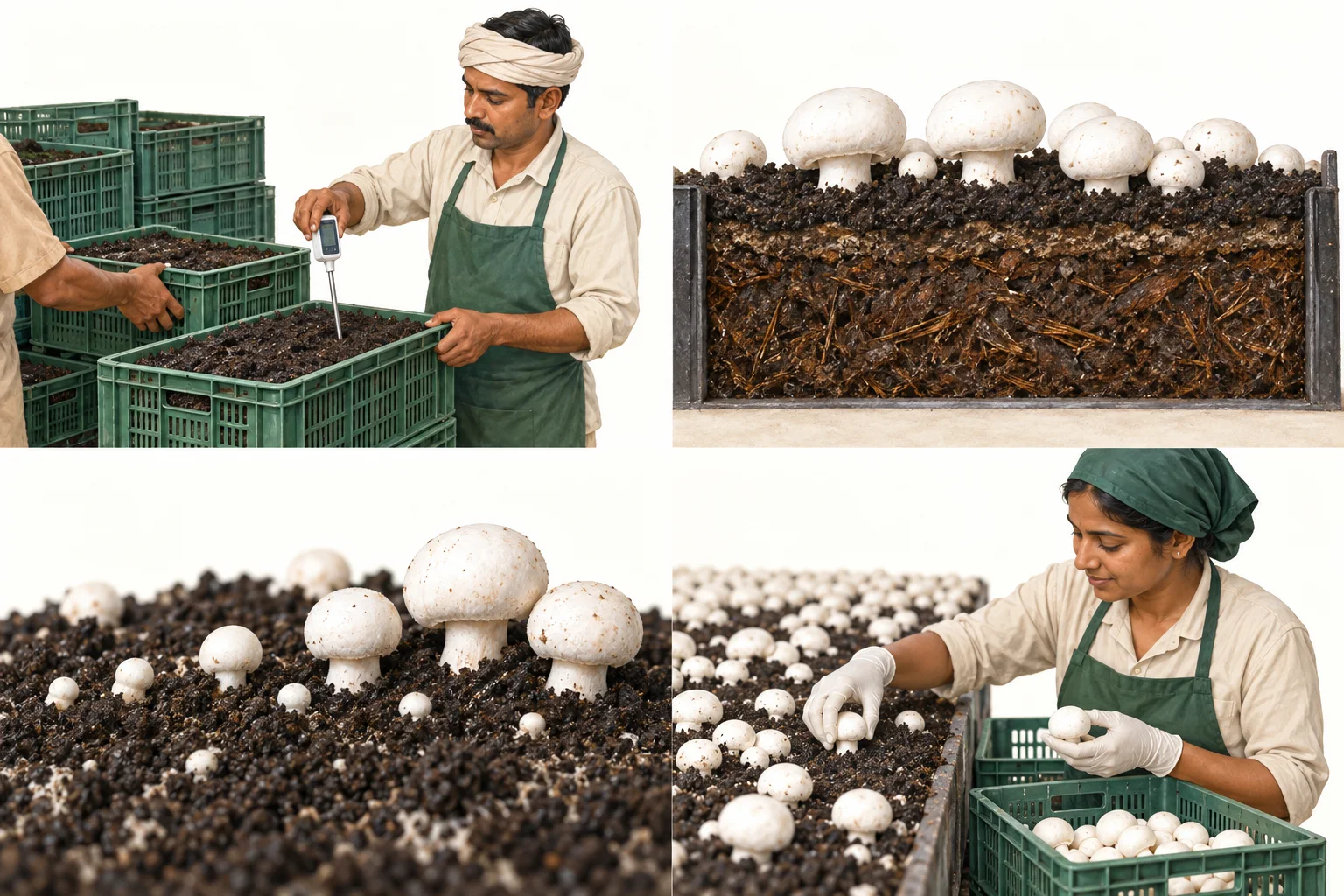
Illustrated Button mushroom pins at different sizes on a casing surface.
AI illustration · details

AI teaching illustration. Tiny pins develop at the casing surface before visible mushrooms enlarge. The condition of the crop matters alongside the planned transition date.

Open full image ↗

The first tiny mushroom body to appear.

Cold shock

A sudden chilling used to trigger fruiting.

Shiitake mushrooms51

Synthetic Block Cultivation

Chapter opening

Synthetic Block Cultivation

A synthetic block is a small clean factory. One unsterile bag can spoil the batch beside it.

  • By the end you can mix a shiitake block substrate to the DMR formula.
  • By the end you can follow the sterilisation and spawning sequence.
  • By the end you can read the block through browning to fruiting.
Shiitake mushrooms53

Synthetic Block Cultivation

Field notes

The formula, and why it is acidic

DMR's folder formula is sawdust 80 kg, wheat bran 19 kg and calcium carbonate 1 kg per 100 kg of mix. The 2011 manual notes that the institute commonly uses a second formula with sawdust 80 kg, wheat bran 20 kg, cane sugar, calcium carbonate, citric acid and calcium sulphate.

Use broad leaved sawdust. DMR names tuni, mango, safeda or eucalyptus, oak, maple and poplar.

Shiitake mushrooms54

Synthetic Block Cultivation

Field notes

The formula, and why it is acidic · continued

Water is adjusted to 60 to 65 percent and pH to 5.5 to 6.0 using gypsum. Note how different that is from button mushroom compost at pH 7.2 to 7.8. Shiitake wants an acidic substrate.

Shiitake mushrooms55

Synthetic Block Cultivation

Field notes

Soak, fill and sterilise

Sawdust is soaked first. The folder gives 16 to 18 hours; the 2011 manual says at least two days. Wheat bran soaks for about three hours. Mix all ingredients thoroughly.

Then move fast. DMR says fill the bags at 1.5 to 2 kg immediately after mixing, because fermentation and contamination start otherwise, and the manual keeps the gap between mixing and sterilising under six hours. Use heat resistant polypropylene bags.

Shiitake mushrooms56

Synthetic Block Cultivation

Field notes

Soak, fill and sterilise · continued

Sterilisation is in an autoclave at 22 psi for 1.5 to 2 hours. After cooling, grain spawn goes in at 3 percent on a dry weight basis under aseptic conditions.

Shiitake mushrooms57

Synthetic Block Cultivation

Field notes

A long incubation with visible stages

Shiitake blocks incubate far longer than oyster bags. The folder gives 60 to 80 days at 22 to 26 C, 500 to 1000 lux and 65 to 70 percent humidity, on a cycle of 4 hours light and 20 hours dark. The manual's table stretches this to 50 to 120 days at 20 to 30 C.

The block passes through visible stages. A thick mycelial coat forms at 6 to 8 weeks. Bumps, which are clumps of mycelium, appear at 9 to 10 weeks. Then the surface browns and the coat hardens. The bag is removed once the block is a third to half browned, with core moisture near 80 percent.

Shiitake mushrooms58

Synthetic Block Cultivation

Field notes

Induction, fruiting and rest

Induction is a short, deliberate change: 2 to 4 days at 10 to 20 C with 500 to 1000 lux and 85 to 95 percent humidity. DMR's alternative is the cold water shock at 4 to 6 C for 10 to 20 minutes.

Fruiting runs 7 to 14 days. The folder gives 12 to 25 C at 60 to 80 percent humidity and notes that the band is strain dependent; the manual narrows it to 12 to 18 C.

Shiitake mushrooms59

Synthetic Block Cultivation

Field notes

Induction, fruiting and rest · continued

Then rest the blocks 7 to 21 days at 22 to 26 C in darkness. A dry spell after harvest prevents contamination, and a water bath restores the moisture the block lost.

Shiitake mushrooms60

Synthetic Block Cultivation

Compare the evidence

Read the numbers in context

These figures belong to the named source and method. Historical costs are not current quotations. A value without its stage, material basis or measurement location is not a farm instruction.

Source-specific reference figures
What is measuredValue and basisSource and limitation
Substrate moisture60-65 %ICAR-DMR shiitake folder. Adjusted before filling bags
Substrate pH5.5-6.0 pHICAR-DMR shiitake folder. Button compost sits at 7.2 to 7.8
Shiitake mushrooms61

Synthetic Block Cultivation

Compare the evidence

Read the numbers in context

These figures belong to the named source and method. Historical costs are not current quotations. A value without its stage, material basis or measurement location is not a farm instruction.

Source-specific reference figures
What is measuredValue and basisSource and limitation
Sterilisation22 psiICAR-DMR shiitake folder. For 1.5 to 2 hours in an autoclave
Grain spawn rate3 % of dry weightICAR-DMR shiitake folder. Added under aseptic conditions
Shiitake mushrooms62

Synthetic Block Cultivation

Compare the evidence

Read the numbers in context

These figures belong to the named source and method. Historical costs are not current quotations. A value without its stage, material basis or measurement location is not a farm instruction.

Source-specific reference figures
What is measuredValue and basisSource and limitation
Incubation60-80 daysICAR-DMR shiitake folder. 22 to 26 C, 500 to 1000 lux
Fruiting stage7-14 daysICAR-DMR shiitake folder. 12 to 25 C; the manual says 12 to 18 C
Shiitake mushrooms63

Synthetic Block Cultivation

Practical workbook

Run a first batch of ten blocks

Record: Sawdust species, mix weights, moisture and pH, sterilising pressure and time, spawn date.

  1. Weigh sawdust, bran and calcium carbonate to the DMR ratio.

  2. Check moisture by the squeeze test and note the pH.

  3. Fill ten bags within six hours of mixing and sterilise them.

  4. Spawn after cooling and label each bag with the date.

  5. Photograph the blocks weekly to track coat, bumps and browning.

Shiitake mushrooms64

Synthetic Block Cultivation

Pause and recall

Avoid these mistakes

  • Using softwood or resinous sawdust, which the fungus cannot break down well.
  • Leaving mixed substrate overnight before sterilising, which sours the batch.
  • Calling a block dead at 60 days when the manual allows 120.
Shiitake mushrooms65

Synthetic Block Cultivation

Pause and recall

Check your understanding

Choose your answer before opening the explanation. This is a learning exercise, not a competency assessment.

What pH does DMR set for shiitake block substrate?

  1. 5.5 to 6.0
  2. 6.8 to 7.0
  3. 7.2 to 7.8
  4. 7.8 to 7.9
See the answer and why

5.5 to 6.0 Shiitake wants an acidic substrate, unlike button compost.

Shiitake mushrooms66

Synthetic Block Cultivation

Pause and recall

Check your understanding

Choose your answer before opening the explanation. This is a learning exercise, not a competency assessment.

Why must bags be filled immediately after mixing?

  1. The bran swells
  2. Fermentation and contamination start
  3. The sawdust dries
  4. The pH rises
See the answer and why

Fermentation and contamination start DMR keeps the gap between mixing and sterilising under six hours.

Shiitake mushrooms67

Synthetic Block Cultivation

Pause and recall

Check your understanding

Choose your answer before opening the explanation. This is a learning exercise, not a competency assessment.

When is the bag removed from the block?

  1. At spawning
  2. After the first week
  3. When a third to half browned
  4. Never
See the answer and why

When a third to half browned The coat hardens and browns before the block is exposed.

Shiitake mushrooms68

Practise and review

Pause and recall

Mistakes to avoid

White colonisation means ready to fruit. Check the block-specific maturation criteria.

Logs and blocks use the same induction. Follow the selected system and applicable strain guidance.

Shiitake mushrooms71

Practise and review

Practical workbook

Compare two supplier offers

One offer is for inoculated blocks and the other for mature fruiting blocks. List the facilities, waiting time and work remaining for each without assuming equal harvest.

Shiitake mushrooms72

Sources and next steps

Sources & further reading

Keep learning with the field guides

English editorial teaching material. Independent technical review and full Hindi translation remain pending. Reading or completing an exercise is not proof of practical competence.

Illustrations are not diagnostic evidence, construction drawings or operating specifications. Use species-, strain- and method-specific guidance for practical work.

Shiitake mushrooms73

English learning edition · Independent technical review pending. Keyboard: focus the reading page and use ← / →. Page turning does not mark practical competence.