A practical guide to growing mushrooms in IndiaA joint educational initiative by MushroomWale & DMR Solan
MushroomFarming.in

A joint educational initiative by

MushroomWale.com
ICAR–Directorate of Mushroom Research, Solan logoICAR–DMRSolan
← All books

Paddy Straw mushrooms

Contents · choose a chapter or topic
Start here
  1. 01Paddy Straw mushrooms
  2. 02What you need before starting
Understand the basics
  1. 03Three mushrooms, three different crop arrangements
  2. 04Preparation is not finished when heating stops
When something goes wrong
  1. 05Describe the problem before naming a disease
The process
  1. 06Select the system
  2. 07Build a traceable bed
  3. 08Observe without losing the context
  4. 09Coordinate harvest and dispatch
In the field
  1. 10Choose one complete cultivation method
  2. 11Build traceability into each bed
  3. 12Write it in your farm notebook
  4. 13Inspect development without turning every symptom into watering advice
  5. 14Organise an observation before seeking advice
  6. 15Arrange the harvest route before mushrooms mature
  7. 16A harvest log that reveals the bottleneck
  8. 17Where the field guidance comes from
Paddy Straw System
  1. 18Paddy Straw System
  2. 19A mushroom built for heat
  3. 20Why rice straw suits it
  4. 21The four to five week clock
  5. 22The rules that make or break sales
  6. 23The rules that make or break sales · continued
  7. 24Read the numbers in context
  8. 25Read the numbers in context
  9. 26Read the numbers in context
  10. 27Check your season and your buyer before you buy spawn
  11. 28Avoid these mistakes
  12. 29Check your understanding
  13. 30Check your understanding
  14. 31Check your understanding
  15. 32Words used in this lesson
  16. 33Sources and field reference
Straw Preparation
  1. 34Straw Preparation
  2. 35Choosing the straw
  3. 36Soaking and draining
  4. 37Laying and spawning the bed
  5. 38Under the sheet
  6. 39Other DMR methods, briefly
  7. 40Read the numbers in context
  8. 41Read the numbers in context
  9. 42Read the numbers in context
  10. 43Build one trial bed this week
  11. 44Avoid these mistakes
  12. 45Check your understanding
  13. 46Check your understanding
  14. 47Check your understanding
  15. 48Words used in this lesson
  16. 49Sources and field reference
Fruiting & Harvest
  1. 50Fruiting & Harvest
  2. 51After the sheet comes off
  3. 52Reading the stages
  4. 53The picking rhythm
  5. 54Holding and selling the same day
  6. 55Read the numbers in context
  7. 56Read the numbers in context
  8. 57Read the numbers in context
  9. 58Keep a three-day picking log on one bed
  10. 59Avoid these mistakes
  11. 60Check your understanding
  12. 61Check your understanding
  13. 62Check your understanding
  14. 63Words used in this lesson
  15. 64Sources and field reference
Practise and review
  1. 65Mistakes to avoid
  2. 66Rehearse a harvest day
Sources and next steps
  1. 67Keep learning with the field guides

Start here

Chapter opening

Paddy Straw mushrooms

Learn a complete selected bed method and organise the work around a time-sensitive harvest. Traditional straw-bundle systems and controlled indoor methods must not be combined as if they were identical.

Read one page, study its picture, then turn to the next. Use Contents whenever you want a particular topic.

Paddy Straw mushrooms01

Start here

Practical workbook

What you need before starting

Keep these beside you while you learn. You do not need to buy equipment just to read this book.

  1. A complete locally applicable cultivation method

  2. Traceable spawn and input materials

  3. A buyer who has specified maturity, packing and collection

Paddy Straw mushrooms02

Understand the basics

Look closely

Three mushrooms, three different crop arrangements

The picture compares cultivation arrangements, not three versions of the same recipe. Oyster clusters can develop from openings in colonised bags. A common Milky method adds a casing layer after straw colonisation. Paddy Straw methods can use prepared straw beds. Each requires its own material preparation and crop management.

Before following an instruction, write its crop and method at the top of your notes. A direction about casing a Milky bed is not automatically a direction for an Oyster bag. Equally, a Button compost schedule does not describe every straw-based method.

Confirm the scientific species and supplied strain with the supplier. Common market names may cover different production choices. The illustration helps you compare arrangements; it cannot identify an unknown or wild specimen.

Paddy Straw mushrooms03

Understand the basics

Look closely

Preparation is not finished when heating stops

A preparation method includes what happens after treatment: cooling, moisture adjustment where applicable, handling, inoculation and containment. Treated material placed back beside dirty tools or raw inputs can be exposed again before the intended fungus establishes.

Plan the next container, work surface, tools and staff movements before starting. Follow the selected method for release and handling conditions; a container that is covered is not necessarily sterile, cool enough or suitable for inoculation.

Pasteurisation and sterilisation describe different process objectives. Neither word supplies a complete operating procedure. Do not improvise a pressure vessel or borrow a heating schedule from another load size, material or crop.

Paddy Straw mushrooms04

When something goes wrong

Look closely

Describe the problem before naming a disease

Start with what you can show: crop and stage, date first noticed, number or area affected, location, recent operations and whether the pattern is spreading. Photograph a whole-room view, an affected area, an unaffected comparison and a close detail.

A brown mark, slow patch or unusual shape can have more than one explanation. Record relevant material lots, watering, environment and insect observations. Keep the distinction between “I saw this” and “I think this caused it”.

Follow the farm’s containment procedure while seeking qualified advice. Do not open suspect material just to smell it, move it through clean work, or choose a pesticide from a photograph. A specialist may require samples, records or testing before recommending action.

Paddy Straw mushrooms05

The process

Practical workbook

Select the system

Begin with the actual production method: materials, bed form, location and environmental management. A picture of a traditional bed cannot specify every layer, treatment or operating condition.

Paddy Straw mushrooms06

The process

Practical workbook

Build a traceable bed

Input preparation and bed assembly should be repeatable enough to compare batches. Record material lots, preparation and sowing operations instead of relying on a bed photograph alone.

Paddy Straw mushrooms07

The process

Practical workbook

Observe without losing the context

Record crop development, the condition of the bed and relevant room or shelter observations. Compare the same places over time. Do not treat unfamiliar mushrooms in an outdoor setting as safe cultivated harvest.

Paddy Straw mushrooms08

The process

Practical workbook

Coordinate harvest and dispatch

Agree the required maturity before the crop is ready. Harvest attendance, clean containers and collection arrangements must match the selected method and product. Handling advice for another mushroom is not automatically suitable.

Paddy Straw mushrooms09

In the field

Field notes

Choose one complete cultivation method

Paddy straw mushroom, commonly Volvariella volvacea, is a warm-condition mushroom. Traditional straw-bundle beds and more controlled indoor substrate systems have different preparation and management steps. Obtain training in one complete method. Mixing a bed layout from one system, treatment from another and a third system's watering advice makes the outcome difficult to interpret.

Inspect the growing location for shade, protection from rain, drainage, contamination sources and access during harvest. Measure conditions at the bed as well as nearby air. Before preparing material, agree how the crop will be sold and who will inspect it when the main operator is absent. A short crop cycle still demands timely attention.

Paddy Straw mushrooms10

In the field

Field notes

Build traceability into each bed

Use clean, suitable substrate and traceable spawn. Keep the material source and preparation record with the bed identity. Follow the trained method for wetting, treatment, draining, bed arrangement and spawning. Extra supplements or extra water are not harmless shortcuts; they change the growing environment and potential competitor growth.

Label the bed with its preparation date, method and spawn lot. Keep a sketch of the arrangement and locations checked. If one group of beds receives a different material batch, record it explicitly. This allows you to compare performance without relying on memory after several beds have already been removed.

Paddy Straw mushrooms11

In the field

Field notes

Write it in your farm notebook

Bed ID • substrate source • preparation and treatment log • spawn batch • inoculation date • local conditions • observations • harvest weights • buyer and dispatch time.

Paddy Straw mushrooms12

In the field

Field notes

Inspect development without turning every symptom into watering advice

Watch both the bed and the crop. Record delayed development, competitor growth, insects, excess wetness and differences between exposed and sheltered areas. Compare these with preparation, rain or watering events and local measurements. If a crop changes rapidly, increase observation rather than assuming the next routine inspection will be soon enough.

When a problem appears, prevent unnecessary movement of suspect material through clean areas and obtain a crop-specific assessment. Do not transfer pesticide or substrate-treatment doses from old training documents directly into a current operating instruction. Safety, current registration, crop use and the exact problem must be checked independently.

Paddy Straw mushrooms13

In the field

Compare the evidence

Organise an observation before seeking advice

Organise an observation before seeking advice
ObservationRecords to compareQuestion for the adviser
Several beds start poorlySubstrate preparation and spawn lotIs the problem linked to inputs or preparation?
Exposed edges differ from centresBed position, weather and wateringCould the local bed environment explain the pattern?
A different fungus appearsPhotos, first occurrence and affected bedsWhat evidence is needed for identification and containment?
Paddy Straw mushrooms14

In the field

Field notes

Arrange the harvest route before mushrooms mature

Agree the development stage and quality your buyer will accept, then organise picking, clean containers and dispatch around that specification. Use a species-specific post-harvest plan; storage conditions suitable for another mushroom must not be assumed suitable here. Ask your trainer or post-harvest specialist for the handling and storage protocol for your product and route.

Reconcile harvested, dispatched, accepted, rejected and paid quantities. Older extension publications include illustrative prices and earnings; those figures describe their historical examples, not your present market. Test a real buyer route and record actual preparation costs, labour, losses and payment delays before treating the enterprise as repeatable.

Paddy Straw mushrooms15

In the field

Field notes

A harvest log that reveals the bottleneck

For each picking, record the time, grade and weight, dispatch time, arrival condition, accepted weight and eventual payment. If acceptable mushrooms leave the farm but arrive damaged, the next investigation belongs in packing and transport rather than in the bed recipe.

Paddy Straw mushrooms16

In the field

Sources & further reading

Where the field guidance comes from

ICAR-DMR Paddy straw cultivation FAQ: Species and cultivation-system background. Historical financial and chemical examples are not adopted.

ICAR-DMR technical bulletins: Primary cultivation references. Older prices and chemical recommendations are not current operating advice.

Paddy Straw mushrooms17

Paddy Straw System

Chapter opening

Paddy Straw System

Paddy straw mushroom is the fastest crop in Indian mushroom farming: a bed spawned today can be picked within two weeks and the whole cycle is over in about a month. That speed is its strength and its trap.

  • By the end you can explain why Volvariella volvacea grows in heat that would stall other mushrooms.
  • By the end you can lay the 4 to 5 week cycle on a calendar and fit it to your region's season.
  • By the end you can state the three rules that decide whether the crop sells: harvest stage, flush timing and the no-fridge rule.
Paddy Straw mushrooms18

Paddy Straw System

Field notes

A mushroom built for heat

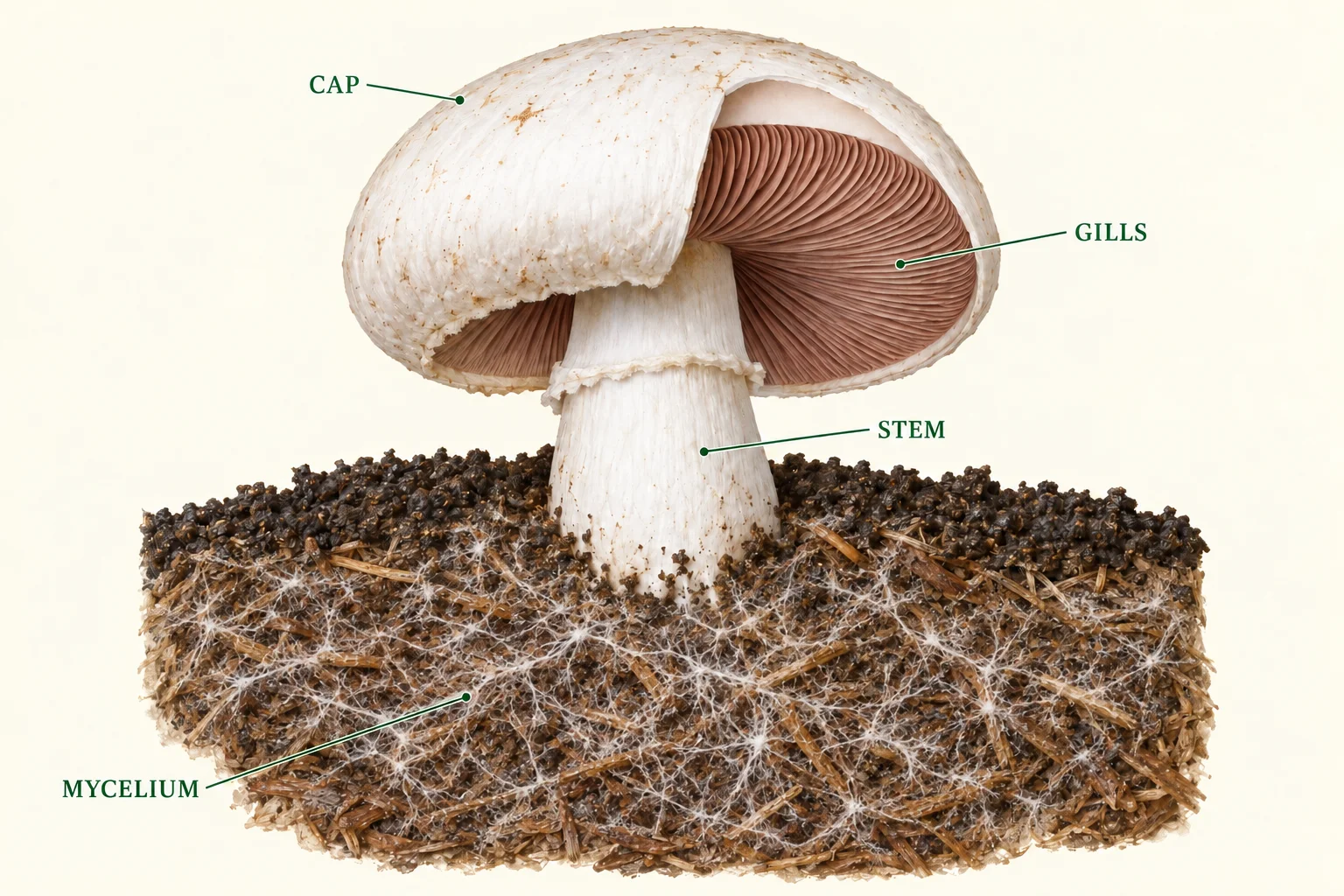
Paddy straw mushroom is Volvariella volvacea. Growers in Odisha and Bengal call it parali or chhatu. It is a warm-climate fungus. Its mycelium, the white thread network that is the living body of the fungus, runs fastest in heat that would kill button mushroom mycelium. The ICAR-DMR species table gives spawn run, the days when mycelium spreads through the straw, at 32 to 34 °C and fruiting at 28 to 32 °C.

DMR reports it is most popular in the coastal states: Odisha, Andhra Pradesh, Tamil Nadu, Kerala and West Bengal. On the north Indian plains the natural window is July to September, the humid monsoon months. In the hills it needs artificial heat and is rarely worth the cost.

Paddy Straw mushrooms19

Paddy Straw System

Field notes

Why rice straw suits it

Every substrate, the material a mushroom feeds on, has a carbon to nitrogen ratio, written C:N. Straw is mostly carbon; nitrogen is the scarce part. DMR states that this mushroom needs a C:N ratio of 40 to 60, far higher than other cultivated mushrooms. In plain words, it is happy on poor, woody material that button mushroom could not use without weeks of composting.

That is why plain paddy straw, soaked and drained, is enough. Indoor growers use cotton waste, which DMR calls the preferred material for that method. Either way the wet substrate should hold 60 to 65 percent moisture: squeezed hard, it should not drip.


Paddy Straw mushrooms20

Paddy Straw System

Field notes

The four to five week clock

DMR calls it a fast-growing mushroom: under favourable conditions the total crop cycle finishes in 4 to 5 weeks. First harvest comes 9 to 10 days after spawning, the day you mix spawn into the bed. Spawn is the grain or straw carrier that holds live mycelium; think of it as the seed, though it is not a seed.

The first flush, the first wave of mushrooms, lasts about 3 days and gives 70 to 90 percent of the whole crop. The second flush, a week or so later, adds only 10 to 30 percent. So the calendar is short and lopsided. Labour, packing and buyers must all be ready for three heavy days.

Paddy Straw mushrooms21

Paddy Straw System

Field notes

The rules that make or break sales

Three rules follow from the biology. First, harvest at the button or egg stage, before the volva breaks. The volva is the skin that wraps the young mushroom like an egg shell. Once it tears and the cap opens, the mushroom turns fibrous and the price drops.

Second, this mushroom cannot go into a fridge. At 4 °C it undergoes autolysis, meaning its own enzymes digest it into a wet mess. DMR gives 10 to 15 °C for about 3 days, and says most is sold on the day of harvest.

Paddy Straw mushrooms22

Paddy Straw System

Field notes

The rules that make or break sales · continued

Third, yield evidence is thin. The only Indian figure in our fact base is TNAU's 1 to 2 kg per 10 kg straw. One source. Measure your own beds.

Paddy Straw mushrooms23

Paddy Straw System

Compare the evidence

Read the numbers in context

These figures belong to the named source and method. Historical costs are not current quotations. A value without its stage, material basis or measurement location is not a farm instruction.

Source-specific reference figures
What is measuredValue and basisSource and limitation
Spawn run temperature32-34 °CICAR-DMR seasonal folder. DMR species table; the bed under its sheet is held at 30-35 °C in the DMR bulletin
Fruiting temperature28-32 °CICAR-DMR seasonal folder. After the sheet comes off; TNAU gives 30-35 °C as optimum for buttons
Paddy Straw mushrooms24

Paddy Straw System

Compare the evidence

Read the numbers in context

These figures belong to the named source and method. Historical costs are not current quotations. A value without its stage, material basis or measurement location is not a farm instruction.

Source-specific reference figures
What is measuredValue and basisSource and limitation
Total crop cycle4-5 weeksICAR-DMR paddy straw bulletin, 2007. Under favourable conditions, spawning to spent bed
Share of yield in the first flush70-90 %ICAR-DMR paddy straw bulletin, 2007. First flush lasts about 3 days; the second flush adds 10-30%
Paddy Straw mushrooms25

Paddy Straw System

Compare the evidence

Read the numbers in context

These figures belong to the named source and method. Historical costs are not current quotations. A value without its stage, material basis or measurement location is not a farm instruction.

Source-specific reference figures
What is measuredValue and basisSource and limitation
Holding temperature after harvest10-15 °CICAR-DMR paddy straw bulletin, 2007. About 3 days; never 4 °C, the mushroom self-digests
Yield per bed1-2 kg per 10 kg strawTNAU Agritech portal. The only Indian yield figure in the fact base; one source, measure your own
Paddy Straw mushrooms26

Paddy Straw System

Practical workbook

Check your season and your buyer before you buy spawn

Record: Shed temperatures morning and evening, straw source and price, buyer names and the days each can take produce.

  1. Hang a thermometer in the intended shed. Note morning and evening readings for a week and compare them with the 28 to 35 °C band.

  2. Find out when hand-threshed paddy straw is available near you and what a bundle costs.

  3. Name two buyers who can take mushrooms on the day of picking, and ask if they can take a three-day peak.

  4. Work a 35 day calendar backwards from a market day so the first flush lands on it.

  5. Decide how you will hold produce at 10 to 15 °C without a fridge: a shaded, ventilated room or an evaporative cooler.

Paddy Straw mushrooms27

Paddy Straw System

Pause and recall

Avoid these mistakes

  • Starting beds in a cool month because straw was cheap: the mycelium stalls below its band and moulds take the bed.
  • Handling it like oyster mushroom and chilling it in a fridge: the crop turns to liquid overnight.
  • Spawning before a buyer is fixed: 70 to 90 percent of the crop arrives in three days and cannot wait.
Paddy Straw mushrooms28

Paddy Straw System

Pause and recall

Check your understanding

Choose your answer before opening the explanation. This is a learning exercise, not a competency assessment.

Where must fresh paddy straw mushrooms never be held?

  1. In a fridge at 4 °C
  2. In a shaded room at 10 to 15 °C
  3. In perforated bags at 20 °C for a few hours
  4. On the buyer's counter on the day of harvest
See the answer and why

In a fridge at 4 °C At 4 °C the mushroom undergoes autolysis and collapses; DMR gives 10 to 15 °C for about 3 days.

Paddy Straw mushrooms29

Paddy Straw System

Pause and recall

Check your understanding

Choose your answer before opening the explanation. This is a learning exercise, not a competency assessment.

How much of the crop arrives in the first flush?

  1. 70 to 90 percent
  2. 10 to 30 percent
  3. About a quarter
  4. Roughly equal in each flush
See the answer and why

70 to 90 percent DMR reports 70 to 90 percent in a first flush of about 3 days; the second flush adds only 10 to 30 percent.

Paddy Straw mushrooms30

Paddy Straw System

Pause and recall

Check your understanding

Choose your answer before opening the explanation. This is a learning exercise, not a competency assessment.

Why does plain rice straw suit this mushroom?

  1. It needs a high carbon to nitrogen ratio of 40 to 60
  2. It needs very rich nitrogen
  3. It grows best on dry material
  4. It prefers acidic soil
See the answer and why

It needs a high carbon to nitrogen ratio of 40 to 60 DMR gives a required C:N ratio of 40 to 60, much higher than other cultivated mushrooms, so poor, woody straw is enough.

Paddy Straw mushrooms31

Paddy Straw System

Visual glossary

Words used in this lesson

Mycelium
Generated Button mushroom anatomy cutaway.
AI illustration · details

AI teaching illustration. Use the drawing to locate the fruit body and mycelium; not a scale drawing or species-identification key.

Open full image ↗

The white network of threads that is the living body of the fungus; the mushroom is only its fruit.

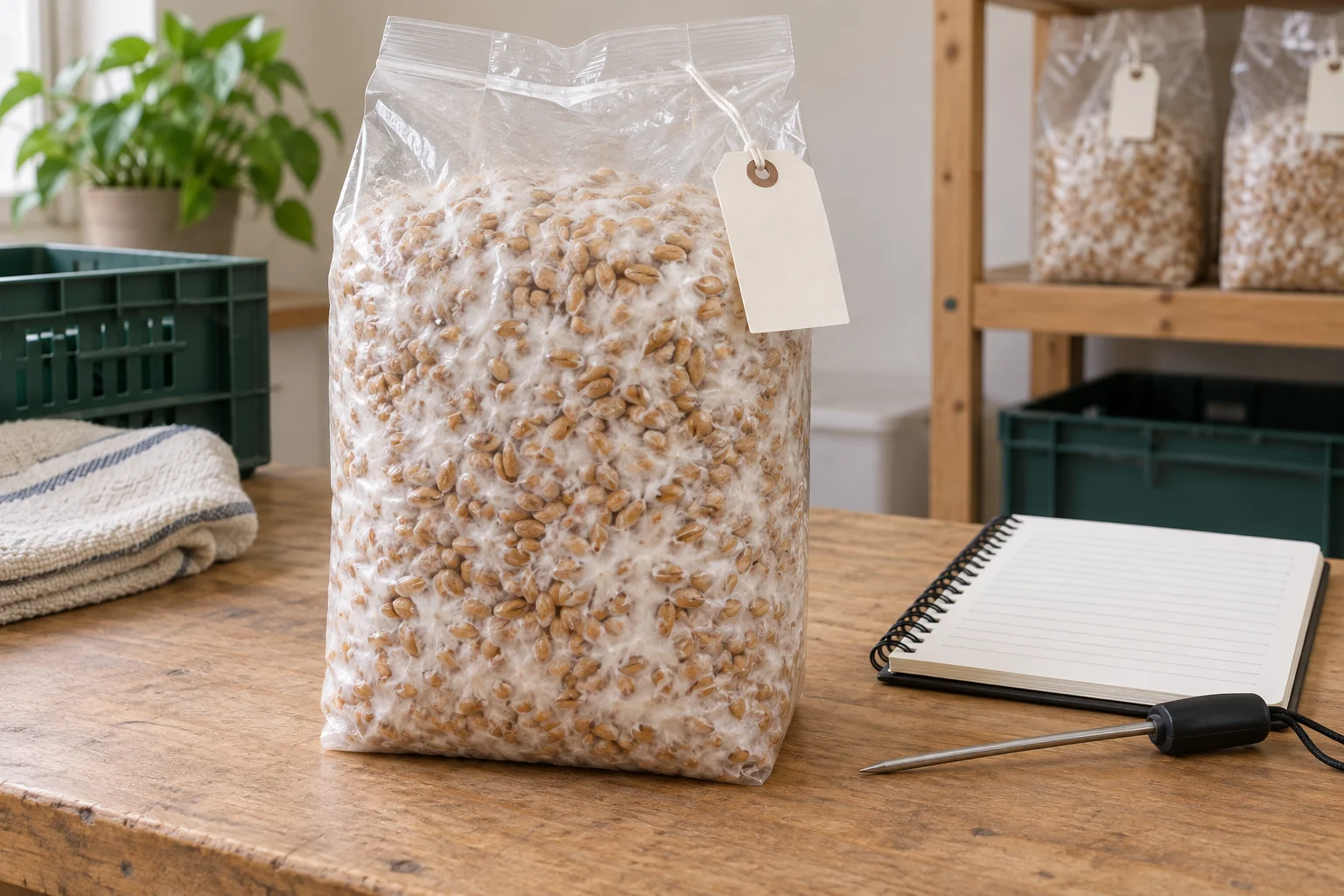
Spawn
Generated sealed grain-spawn bag and receiving record.
AI illustration · details

AI teaching illustration. Receiving concept; not proof of purity or spawn quality.

Open full image ↗

Grain or straw carrying live mycelium, used to seed the bed; it is not a true seed.

C:N ratio

Carbon compared with nitrogen in a substrate; a high ratio means poor, woody material.

Volva

The skin that wraps the young mushroom like an egg shell; harvest before it breaks.

Autolysis

Self-digestion; at fridge temperature this mushroom's own enzymes turn it to liquid.

Paddy Straw mushrooms32

Straw Preparation

Chapter opening

Straw Preparation

A paddy straw bed is won or lost before the spawn packet is opened. Bundle size, soaking time and the way the layers are laid decide whether heat and moisture stay where the mycelium needs them.

  • By the end you can choose and bundle straw the way the ICAR-DMR bulletin describes.
  • By the end you can soak, drain and judge moisture by hand.
  • By the end you can build a layered bed, place spawn correctly and cover it.
  • By the end you can name the other DMR methods and say when to look at them.
Paddy Straw mushrooms34

Straw Preparation

Field notes

Choosing the straw

Use fresh, dry, golden paddy straw stored under cover since harvest. Straw that got wet in the rain or has turned grey carries mould spores and is not worth the spawn. DMR prefers hand-threshed paddy: the stems stay long and whole, so bundles hold together. Machine-threshed straw is crushed and short and makes loose beds that dry out.

Make bundles of 0.75 to 1.0 kg, about 80 to 95 cm long and 12 to 16 cm thick, tied at both ends. A DMR conventional bed uses 30 to 40 kg of dry straw. TNAU's smaller bed uses 10 to 15 kg. Start small: a first bed of 10 to 15 kg teaches the same lessons.

Paddy Straw mushrooms35

Straw Preparation

Field notes

Soaking and draining

Immerse the bundles in clean water in a cemented tank for 12 to 18 hours. DMR describes soaking in plain water or a weak lime solution; use plain clean water unless a specialist advises otherwise. Muddy pond water brings bacteria and insects into the bed.

Lift the bundles out and stand them on a slope until water stops dripping. DMR's key practice list asks for 60 to 65 percent moisture in the substrate. Test by hand: squeeze a fistful hard. A few drops at most should appear and your palm should feel damp, not wet. Spawn as soon as the straw has settled at about 35 °C, not before.

Paddy Straw mushrooms36

Straw Preparation

Field notes

Laying and spawning the bed

Build the bed on a raised platform of bamboo or bricks in a shaded, closed shed, never on bare soil. Lay the first layer of bundles side by side, then the next layer across them, so the bed stays firm. DMR lists bed sizes of 100 by 100 by 100 cm, 60 by 60 by 30 cm and 60 by 60 by 120 cm.

Break the spawn into small pieces. Place them along the edges of every layer, 5 cm apart, leaving a margin of 12 to 15 cm from the edge. DMR uses 500 g of spawn and 150 g of red gram (arhar) powder for a 30 to 40 kg bed; the powder is a nitrogen supplement dusted over the spawn. Press the finished bed down from the top.

Paddy Straw mushrooms37

Straw Preparation

Field notes

Under the sheet

Cover the pressed bed with a clean plastic sheet. The sheet traps heat and humidity so the bed sits at 30 to 35 °C and 80 to 85 percent relative humidity, the share of moisture the air is holding. Give no ventilation for the first 3 days.

DMR's bed method removes the sheet 7 to 8 days after spawning; its key practice list says 4 to 6 days. Both are DMR, so watch the bed: when white mycelium covers the surface, take the sheet off. Then hold 28 to 32 °C and about 80 percent humidity. Mushrooms start 4 to 5 days after the sheet comes off.

Paddy Straw mushrooms38

Straw Preparation

Field notes

Other DMR methods, briefly

The bulletin describes five more methods. The cage method packs 60 short bundles, treated in boiling water for 20 to 30 minutes, into a wooden cage with 2 bottles of spawn; pinheads come in 10 to 15 days. The box method uses chopped straw in shallow boxes. The outdoor method lays 4 layers of bundles in summer and 7 in the rains. The indoor method composts cotton waste or straw with lime, steam-pasteurises it and spawns at 1.4 percent; colonisation takes 4 to 6 days at 32 to 34 °C. The circular method winds soaked bundles around poles. Master the bed first; every other method reuses its logic.

Paddy Straw mushrooms39

Straw Preparation

Compare the evidence

Read the numbers in context

These figures belong to the named source and method. Historical costs are not current quotations. A value without its stage, material basis or measurement location is not a farm instruction.

Source-specific reference figures
What is measuredValue and basisSource and limitation
Bundle weight0.75-1 kgICAR-DMR paddy straw bulletin, 2007. 80-95 cm long, 12-16 cm thick, hand-threshed straw preferred
Soaking time12-18 hoursICAR-DMR paddy straw bulletin, 2007. Clean water in a cemented tank; TNAU gives the same
Paddy Straw mushrooms40

Straw Preparation

Compare the evidence

Read the numbers in context

These figures belong to the named source and method. Historical costs are not current quotations. A value without its stage, material basis or measurement location is not a farm instruction.

Source-specific reference figures
What is measuredValue and basisSource and limitation
Spawn per bed500 gICAR-DMR paddy straw bulletin, 2007. For 30-40 kg dry straw, with 150 g red gram powder
Substrate moisture60-65 %ICAR-DMR paddy straw bulletin, 2007. Key practice list; squeeze test, a few drops at most
Paddy Straw mushrooms41

Straw Preparation

Compare the evidence

Read the numbers in context

These figures belong to the named source and method. Historical costs are not current quotations. A value without its stage, material basis or measurement location is not a farm instruction.

Source-specific reference figures
What is measuredValue and basisSource and limitation
Bed under the sheet30-35 °CICAR-DMR paddy straw bulletin, 2007. 80-85% humidity; no ventilation for the first 3 days
Sheet removal7-8 days after spawningICAR-DMR paddy straw bulletin, 2007. Bed method; the same bulletin's key practice list says 4-6 days
Paddy Straw mushrooms42

Straw Preparation

Practical workbook

Build one trial bed this week

Record: Straw weight, soak hours, squeeze test result, spawn weight, sheet-on and sheet-off dates, bed temperature twice daily.

  1. Set aside 10 to 15 kg of clean, hand-threshed straw and tie it into bundles; weigh two bundles.

  2. Soak for 12 to 18 hours in clean water, drain, and do the squeeze test; note what you felt.

  3. Lay cross-wise layers on a raised platform in a closed shed; spawn along the edges with a 12 to 15 cm margin.

  4. Cover with a clean sheet and put a thermometer under it; read morning and evening.

  5. Note the day white mycelium reaches the surface and remove the sheet.

Paddy Straw mushrooms43

Straw Preparation

Pause and recall

Avoid these mistakes

  • Using machine-threshed, broken straw: bundles fall apart and the bed dries and cools unevenly.
  • Laying the bed on bare wet ground: soil moulds and insects move in from below.
  • Lifting the sheet on day two to look: heat and humidity escape before the mycelium has taken.
Paddy Straw mushrooms44

Straw Preparation

Pause and recall

Check your understanding

Choose your answer before opening the explanation. This is a learning exercise, not a competency assessment.

How long are straw bundles soaked in the DMR bed method?

  1. 12 to 18 hours
  2. 1 to 2 hours
  3. 3 days
  4. Until they float
See the answer and why

12 to 18 hours DMR immerses bundles in clean water for 12 to 18 hours in a cemented tank.

Paddy Straw mushrooms45

Straw Preparation

Pause and recall

Check your understanding

Choose your answer before opening the explanation. This is a learning exercise, not a competency assessment.

Where does spawn go on each layer?

  1. Along the edges, 5 cm apart, with a 12 to 15 cm margin
  2. Only in the centre of the bed
  3. Scattered loosely over the top layer
  4. Mixed through all the straw
See the answer and why

Along the edges, 5 cm apart, with a 12 to 15 cm margin DMR spawns the edges of every layer at 5 cm spacing, 12 to 15 cm in from the edge; mushrooms then emerge from the sides.

Paddy Straw mushrooms46

Straw Preparation

Pause and recall

Check your understanding

Choose your answer before opening the explanation. This is a learning exercise, not a competency assessment.

What do you check just before spawning a drained bed?

  1. Straw at about 35 °C with 60 to 65 percent moisture
  2. That the sheet is transparent
  3. That the bed stands in direct sun
  4. That the straw is bone dry
See the answer and why

Straw at about 35 °C with 60 to 65 percent moisture DMR's key practices: spawn immediately when the substrate reaches 35 °C, with 60 to 65 percent moisture.

Paddy Straw mushrooms47

Straw Preparation

Visual glossary

Words used in this lesson

Substrate

The material the mushroom feeds on; here soaked paddy straw.

Supplement

A small nitrogen-rich addition such as red gram powder that feeds early mycelium.

Platform

A raised bamboo or brick base that keeps the bed off wet soil.

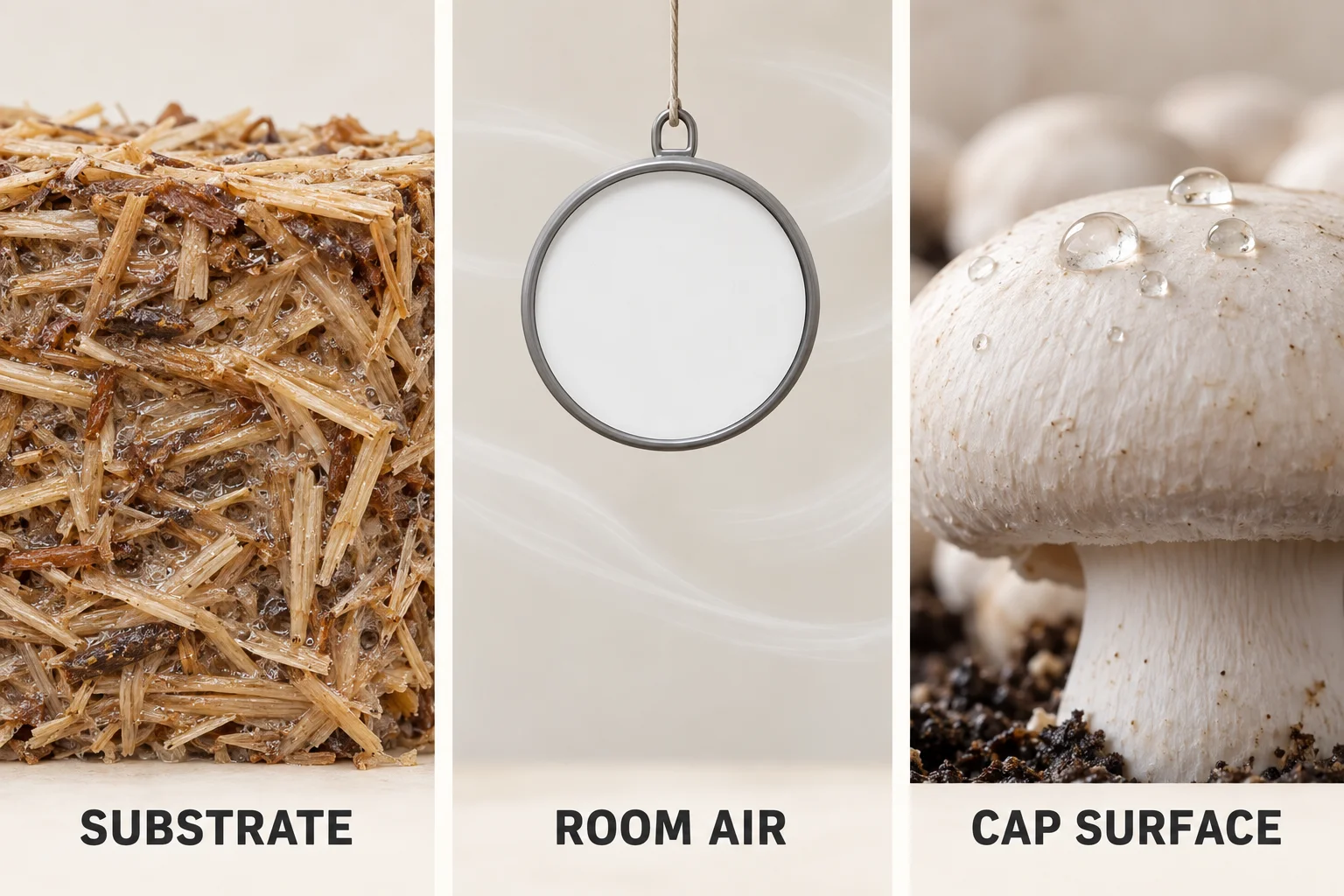
Relative humidity
Generated comparison of growing-material moisture, room-air measurement and cap-surface water.
AI illustration · details

AI teaching illustration. These are different observations, not moisture targets or an instruction to wet the crop.

Open full image ↗

The share of moisture the air holds; 80 to 85 percent keeps the bed from drying.

Paddy Straw mushrooms48

Fruiting & Harvest

Chapter opening

Fruiting & Harvest

With paddy straw mushroom the picking window is measured in hours. The egg you leave for tomorrow is an open, fibrous umbrella by afternoon, and the whole first flush arrives in three days.

  • By the end you can manage the bed after the sheet comes off: temperature, humidity, water, air and light.
  • By the end you can tell pinhead, button, egg and open stages apart and pick at the right one.
  • By the end you can pack, hold and move the crop the same day at 10 to 15 °C.
Paddy Straw mushrooms50

Fruiting & Harvest

Field notes

After the sheet comes off

Once white mycelium covers the bed, the sheet is removed and the bed changes from growing to fruiting. DMR now asks for 28 to 32 °C and about 80 percent relative humidity. Keep humidity with a fine mist on the floor and walls, never a direct spray on the bed, which rots the pins.

Give the bed light and a little fresh air. For indoor beds DMR lists fluorescent light and intermittent fresh air. In a film house TNAU works at 25 to 35 °C and 75 to 80 percent humidity. Expect the first mushrooms 4 to 5 days after the sheet comes off; TNAU sees tiny buttons in 6 to 10 days and picks 4 to 5 days later.

Paddy Straw mushrooms51

Fruiting & Harvest

Field notes

Reading the stages

Pinheads appear as tiny white dots along the sides of the bed. They swell into buttons, small round bodies fully wrapped in the volva, the egg-shell skin. The egg stage is a larger, oval body with the volva stretched tight, about to split. Then the stem pushes up, the volva tears and the cap opens.

DMR says harvest before the volva breaks or just after: the button and egg stages. TNAU adds that an opened sporocarp, the technical word for the whole mushroom body, is fibrous and worth less. This is the opposite of oyster, where a fully opened cap is normal.

Paddy Straw mushrooms52

Fruiting & Harvest

Field notes

The picking rhythm

Because the stages pass so quickly, DMR asks growers to harvest two or three times a day: morning, noon and afternoon. Twist each egg out gently, holding the base, without pulling up the pins next to it. The first flush lasts about 3 days and gives 70 to 90 percent of the crop. A second flush follows about a week later and adds only 10 to 30 percent; the bed method continues for about 20 days in all.

After the second flush the bed is spent. Dry the used straw and compost it away from the shed. DMR cites Chinese practice of reusing it for oyster mushroom, but that is not an Indian recommendation.

Paddy Straw mushrooms53

Fruiting & Harvest

Field notes

Holding and selling the same day

DMR states plainly that this mushroom is sold on the day of harvest. It cannot go into a fridge: at 4 °C it undergoes autolysis and collapses. DMR gives 10 to 15 °C for 3 days in perforated polythene bags, and a little longer at 20 °C.

Packing matters even for a few hours. Unpacked mushrooms lose 40 to 50 percent of their moisture in 4 days; in perforated bags the loss is about 10 percent. Let picked eggs cool in shade before bagging. If you must store, DMR gives drying at 60 °C for 7 hours to 5 percent moisture, after blanching 3 to 4 minutes in hot water to keep colour. Price is only real once the buyer has paid.

Paddy Straw mushrooms54

Fruiting & Harvest

Compare the evidence

Read the numbers in context

These figures belong to the named source and method. Historical costs are not current quotations. A value without its stage, material basis or measurement location is not a farm instruction.

Source-specific reference figures
What is measuredValue and basisSource and limitation
Cropping temperature after sheet removal28-32 °CICAR-DMR paddy straw bulletin, 2007. About 80% humidity; TNAU gives 30-35 °C as optimum for buttons
Days from spawning to first harvest9-10 daysICAR-DMR paddy straw bulletin, 2007. The first flush then lasts about 3 days
Paddy Straw mushrooms55

Fruiting & Harvest

Compare the evidence

Read the numbers in context

These figures belong to the named source and method. Historical costs are not current quotations. A value without its stage, material basis or measurement location is not a farm instruction.

Source-specific reference figures
What is measuredValue and basisSource and limitation
Picks per day2-3 picksICAR-DMR paddy straw bulletin, 2007. Morning, noon and afternoon, at button or egg stage
Holding temperature10-15 °CICAR-DMR paddy straw bulletin, 2007. 3 days in perforated polythene; never 4 °C; the 2011 manual repeats this
Paddy Straw mushrooms56

Fruiting & Harvest

Compare the evidence

Read the numbers in context

These figures belong to the named source and method. Historical costs are not current quotations. A value without its stage, material basis or measurement location is not a farm instruction.

Source-specific reference figures
What is measuredValue and basisSource and limitation
Moisture loss in 4 days40-50 unpacked, about 10 packed %ICAR-DMR paddy straw bulletin, 2007. Perforated polythene bags
Drying60 °C for 7 hoursICAR-DMR paddy straw bulletin, 2007. To 5% moisture after 3-4 minutes blanching in hot water
Paddy Straw mushrooms57

Fruiting & Harvest

Practical workbook

Keep a three-day picking log on one bed

Record: Pick time, count by stage, weight per pick, opened mushrooms missed, holding-room temperature, dispatch time.

  1. Set three fixed picking times and keep to them for the whole first flush.

  2. At each pick, count eggs, buttons and any opened mushrooms you missed.

  3. Weigh each pick separately and write the weight against the time.

  4. Bag in perforated polythene only after the mushrooms have cooled in shade.

  5. Note the temperature of the room where packed produce waits and the hour it left the farm.

Paddy Straw mushrooms58

Fruiting & Harvest

Pause and recall

Avoid these mistakes

  • Spraying water straight onto the bed after pinning: pins abort and rot; mist floor and walls instead.
  • Picking once a day: half the flush opens and turns fibrous before you return.
  • Bagging warm mushrooms in a sealed bag: they sweat, heat and spoil within hours.
Paddy Straw mushrooms59

Fruiting & Harvest

Pause and recall

Check your understanding

Choose your answer before opening the explanation. This is a learning exercise, not a competency assessment.

Which stage should be on the buyer's scale?

  1. Button or egg, before the volva breaks
  2. Fully opened cap
  3. Stem stretched, cap half open
  4. Any stage, the price is the same
See the answer and why

Button or egg, before the volva breaks DMR harvests at button and egg stage; TNAU notes an opened mushroom is fibrous.

Paddy Straw mushrooms60

Fruiting & Harvest

Pause and recall

Check your understanding

Choose your answer before opening the explanation. This is a learning exercise, not a competency assessment.

How often does DMR pick a paddy straw bed in flush?

  1. Two or three times a day
  2. Once every morning
  3. Once every two days
  4. Only when the cap opens
See the answer and why

Two or three times a day The stages pass within hours, so DMR picks morning, noon and afternoon.

Paddy Straw mushrooms61

Fruiting & Harvest

Pause and recall

Check your understanding

Choose your answer before opening the explanation. This is a learning exercise, not a competency assessment.

What happens to this mushroom at 4 °C?

  1. It self-digests and collapses
  2. It keeps for a week
  3. It turns brown but stays firm
  4. It stops respiring
See the answer and why

It self-digests and collapses DMR: it cannot be stored at 4 °C because it undergoes autolysis; hold at 10 to 15 °C.

Paddy Straw mushrooms62

Fruiting & Harvest

Visual glossary

Words used in this lesson

Egg stage

The oval, unopened body wrapped in a tight volva; the top grade for sale.

Sporocarp
See related figure: Mycelium · glossary figure 1

The scientific word for the whole mushroom body.

Flush
See related figure: Observe without losing the context

One wave of mushrooms; the first flush here gives most of the crop.

Perforated pack

A polythene bag with small holes that slows drying and lets the mushroom breathe.

Paddy Straw mushrooms63

Practise and review

Pause and recall

Mistakes to avoid

Mixing bundle-bed and indoor instructions. Choose and learn one complete method first.

Using the same storage rule for every mushroom. Use species-specific post-harvest guidance.

Paddy Straw mushrooms65

Practise and review

Practical workbook

Rehearse a harvest day

Map who checks maturity, who harvests, where containers wait and what happens if collection is delayed.

Paddy Straw mushrooms66

Sources and next steps

Sources & further reading

Keep learning with the field guides

English editorial teaching material. Independent technical review and full Hindi translation remain pending. Reading or completing an exercise is not proof of practical competence.

Illustrations are not diagnostic evidence, construction drawings or operating specifications. Use species-, strain- and method-specific guidance for practical work.

Paddy Straw mushrooms67

English learning edition · Independent technical review pending. Keyboard: focus the reading page and use ← / →. Page turning does not mark practical competence.