


A practical guide to growing mushrooms in IndiaA joint educational initiative by MushroomWale & DMR Solan
MushroomFarming.in

A joint educational initiative by

MushroomWale.com
ICAR–Directorate of Mushroom Research, Solan logoICAR–DMRSolan

Read · Observe · Practise · Check

Production-room engineering: understand the connected system

Learn to discuss a room with a qualified designer and inspect its handover intelligently. This route explains requirements and verification; it is not permission to size, wire or commission specialist equipment without competence.

Begin the walkthrough ↓
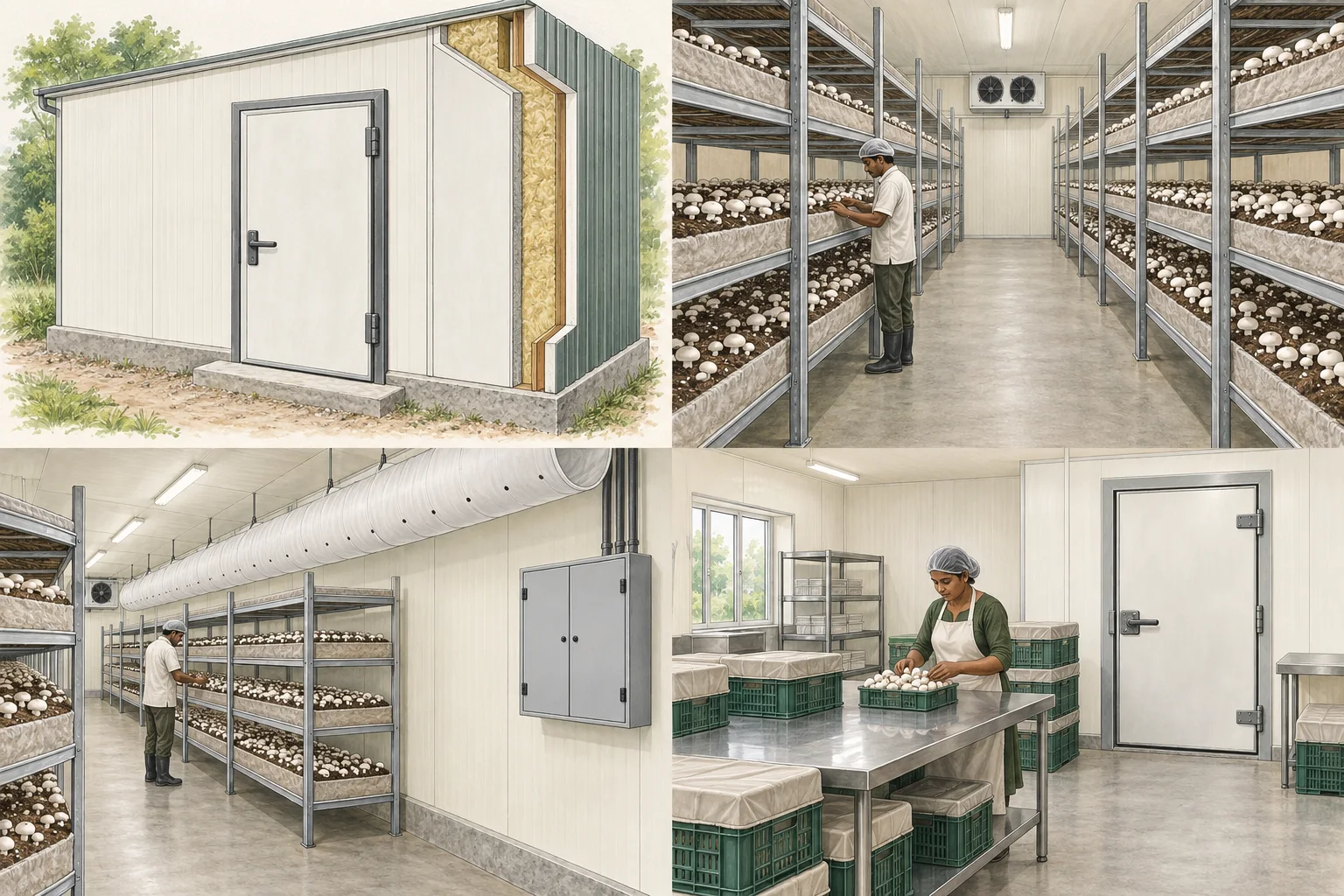
Generated conceptual cutaway of an insulated mushroom-room wall and closed door.
AI-generated teaching illustrationConceptual learning scene, not a diagnostic photograph or construction specification.

Before you begin

  • Crop, incoming material stage and proposed loading
  • Site conditions, utility information and working routes
  • An operating brief and qualified design support

Use the linked crop and technical lessons for method-specific detail. Practical work involving chemicals, pressure, electrical equipment or uncertain crop health requires competent supervision; illustrations are not operating specifications.

Generated conceptual cutaway of an insulated mushroom-room wall and closed door.

Conceptual AI teaching scene

Stage 1

Define the operating brief

Equipment selection follows the crop and operating duty. Record the intended stages, loading pattern, outdoor design context and working schedule. Floor area alone does not describe the heat, moisture or ventilation duty.

Put it into practice
Make a requirements sheet and mark each assumption that needs measurement or engineering confirmation.
Check your work
The designer is solving a stated operating problem, not selecting a machine from floor area only.
Generated illustration of mushroom racks with a central access aisle and a worker.

Conceptual AI teaching scene

Stage 2

Read the layout

Racks, access, enclosure, doors and drainage influence everyday work and maintenance. Insulation limits heat transfer but does not create cooling. The layout must accommodate people as well as the growing area.

Put it into practice
Trace filling, inspection, picking, service and emptying routes on the room plan.
Check your work
Access and maintenance tasks remain possible at the planned crop loading.
Generated illustration of an overhead fabric air-distribution duct and a closed control cabinet.

Conceptual AI teaching scene

Stage 3

Follow air and services

Identify supply, return, outside-air entry, exhaust, cooling, moisture-control and drainage paths. A list of components does not show how they work together or how a failure is detected.

Put it into practice
Ask the designer to explain the system sequence and control responsibilities in ordinary language.
Check your work
Each major job has a component, a measurement and a defined response when performance is inadequate.
Generated illustration of covered mushroom crates, a clean packing bench and a storage-room door.

Conceptual AI teaching scene

Stage 4

Agree acceptance and maintenance

A handover should compare measured performance with the agreed brief under stated test conditions. Keep defects, corrective work and retests visible. Include documentation and operator training, not only equipment delivery.

Put it into practice
Create a witness-test checklist with responsibility, evidence and acceptance basis for each item.
Check your work
The farm can operate and maintain the system, and unresolved defects are not described as completed work.

Common mistakes—and the better question

Insulated walls cool the crop
Cooling duty must be provided and verified separately.
One wall sensor proves uniformity
Compare representative loaded-room locations.

A task to complete, not just a page to read

Read a quotation as an operating proposal

Choose one quoted component and trace its purpose, capacity basis, installation scope, control, service access and acceptance test.

Bring back this evidence

A component responsibility sheet and list of unanswered design questions.

Completing this self-guided task is not verification of practical competence. Review it with a suitable instructor before relying on it for farm operation.

Keep the field guidance beside the lesson

Open the main subject guide →Production Room SystemCrop-Level Air DistributionCooling Load ModelProduction Room Commissioning

Sources, scope and review

Editorial learning material; no independent technical review is claimed. The tasks are original teaching exercises. Source-specific numerical schedules remain in the detailed lessons with their context, rather than being turned into universal instructions here.