


टनल संचालन
टनल एक पूरा वायु परिपथ है, इसलिए गहराई, प्लेनम, फर्श और पंखे को एक साथ पढ़ें और हवा, कम्पोस्ट तथा प्लेनम के तापमान का अंतर 3 डिग्री सेल्सियस से अधिक न होने दें।
- By the end you can name the parts of the tunnel air circuit and their jobs.
- By the end you can say why the fill decides how the batch will run.
- By the end you can compare air, compost and plenum temperatures correctly.
नियंत्रित कमरा: हवा कैसे चलती है
ठंडी, नम हवा ऊपर की नली से बेड के ऊपर गिरती है, कमरे से लौटती है, 20 से 30 प्रतिशत ताज़ी हवा मिलती है, बेड पर हवा की चाल लगभग 15 सेमी/सेकंड। स्रोत: ICAR-DMR मैनुअल।
ये आंकड़े संबंधित स्रोत और विधि के संदर्भ में हैं। इन्हें हर प्रजाति या फार्म का सार्वभौमिक निर्देश न मानें। पुराने मूल्य वर्तमान बाज़ार भाव नहीं हैं।
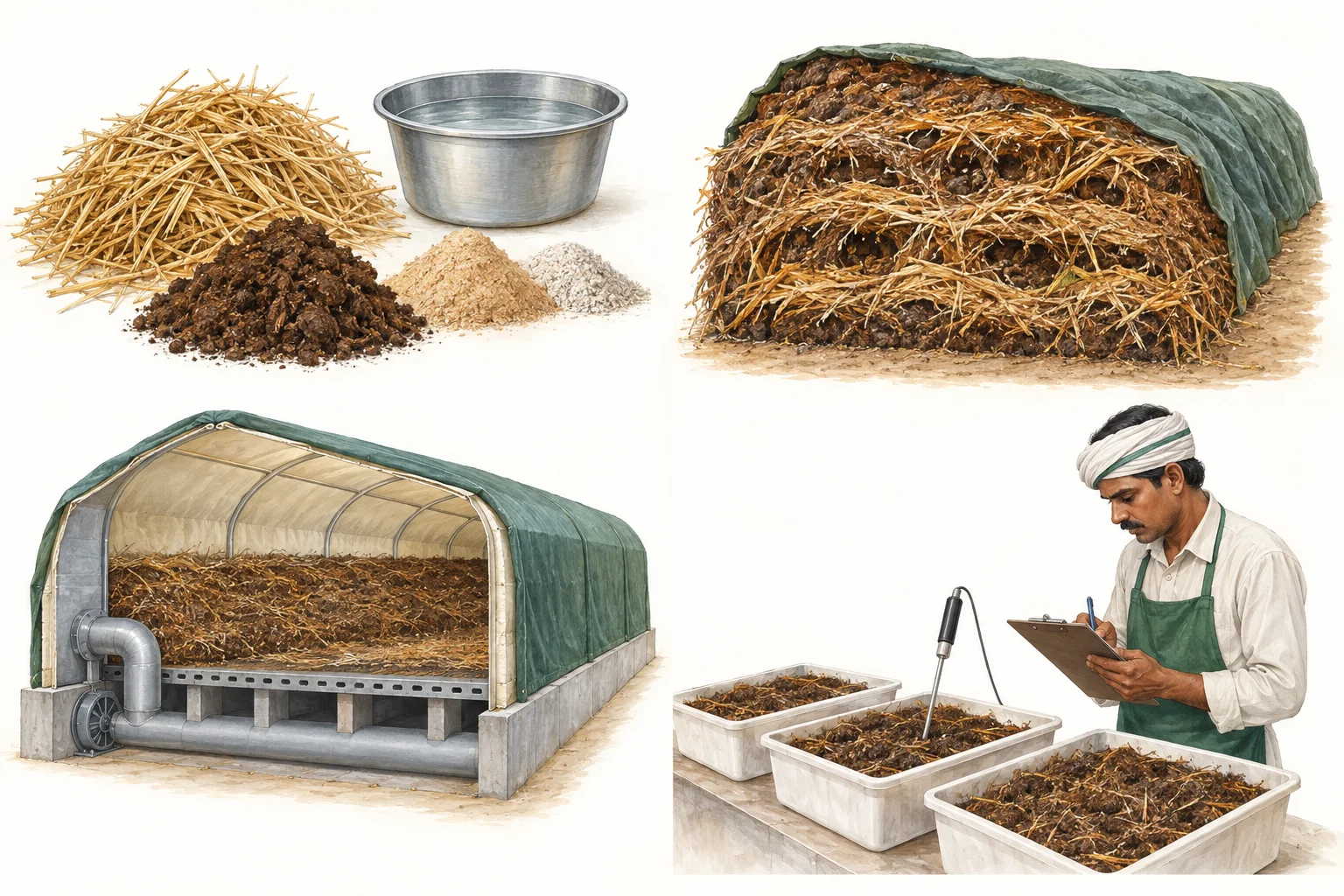
Understand the tunnel
- Notice
- Air must pass through the loaded material.
- Understand
- Pasteurisation, conditioning and cooling have distinct purposes.
- Try it
- Use the validated process and release criteria, not an odour test.
01One circuit, not one box
Air leaves the fan into the plenum, the sealed space under the floor. It passes up through the perforated air floor, through the compost, into the space above, and back to the mixing section where fresh, return and exhaust dampers decide what the fan sends round again.
Every part fails quietly. A blocked floor outlet leaves a dead zone no probe may sit in. A worn door seal pulls untreated air into a pasteurised batch. A choked plenum drain holds water that cools the air from below. Inspect all of them before you fill, because once compost is in you see none of it.
02The fill decides the batch
DMR fills a bulk chamber to 2 to 2.2 metres, loaded so that one square metre of floor carries roughly 900 to 1,000 kg of compost. Depth is the point. Air takes the easiest path, so a shallow patch or a wheel-compacted loader track pulls air away from the rest of the mass.
Once filled, the blower brings plenum, compost and the air above to one temperature, around 45 to 48 °C. DMR describes this levelling off as a job of four to five hours. Until it is done, no tunnel reading means much.
03The three temperatures
A tunnel has three temperatures: the air above the compost, the compost itself, and the plenum below. DMR says the difference should be as small as possible and must not exceed 3 °C. A wider gap means air is not passing evenly through the mass.
During peak heating the compost rises at roughly 1 °C per hour and holds at 58 to 59 °C for 4 to 6 hours. Above 60 °C the process turns: DMR warns this kills the thermophilic fungi Phase II depends on, and lists it as a trigger for olive green mould.
04What the nameplate cannot tell you
A fan rated in kilowatts tells you what the motor draws, not what air reaches the compost. Resistance rises with fill depth, with moisture and with any compaction, so the same fan delivers different airflow on different batches.
So judge the fan by the mass, not the label. Watch plenum pressure, watch how quickly the three temperatures converge, and watch whether the far end of the tunnel behaves like the near end. Advance a batch on verified compost condition, not because one air sensor touched a set point while the compost stayed cold.
Inspect the tunnel before the next fill
- Sweep and open every floor outlet, then note how many were blocked.
- Check the door seal and clear the plenum drain until water runs freely.
- Mark a depth reference at three points along the tunnel length.
- Run the fan empty and record the plenum pressure for comparison later.
डायरी में लिखें: Outlets cleared, door seal, depth at three points after filling, plenum pressure empty and loaded.
ये गलतियां न करें
- Certifying a batch from one probe when the tunnel is metres long.
- Overfilling or filling unevenly, which sends air around the heavy zones instead of through them.
- Choosing a fan by motor power, with no airflow figure at the pressure a loaded tunnel creates.
खुद को जांचें
तीन सवाल, तुरंत जवाबDMR fills a bulk chamber to about:
The gap between air, compost and plenum temperature should not exceed:
Compost above 60 °C at the peak is harmful because it:
यह संपादकीय स्व-जांच है, प्रमाणपत्र नहीं। जवाब इस डिवाइस पर भी सहेजे नहीं जाते।
शब्दावली
- Plenum
- The sealed air space under the tunnel floor that feeds air into the compost.
- Air floor
- The perforated floor that spreads plenum air evenly across the load.
- Damper
- An adjustable flap that sets how much fresh, return or exhaust air passes.
संदर्भ और आगे पढ़ें
A lesson cannot replace batch measurements or plant-specific procedures.
संदर्भ खोलें