


सेंसर और उन पर भरोसा
किसी भी रीडिंग का अर्थ तभी है जब उसका स्थान, अंशांकन, इकाई और पंखे की स्थिति दर्ज हो, और दो सेंसरों का अंतर स्वयं वायु वितरण का प्रमाण है।
- By the end you can state what a reading needs before it means anything.
- By the end you can plan where probes go in a loaded tunnel.
- By the end you can treat sensor disagreement as useful evidence.
Four steps that turn a displayed value into evidence.
- Name itGive every probe an identity and a mapped location.
- Check itCompare against a reference monthly and log it.
- Read itRecord fan and damper state with the value.
- Compare itTest zone against zone before trusting one figure.
ये आंकड़े संबंधित स्रोत और विधि के संदर्भ में हैं। इन्हें हर प्रजाति या फार्म का सार्वभौमिक निर्देश न मानें। पुराने मूल्य वर्तमान बाज़ार भाव नहीं हैं।
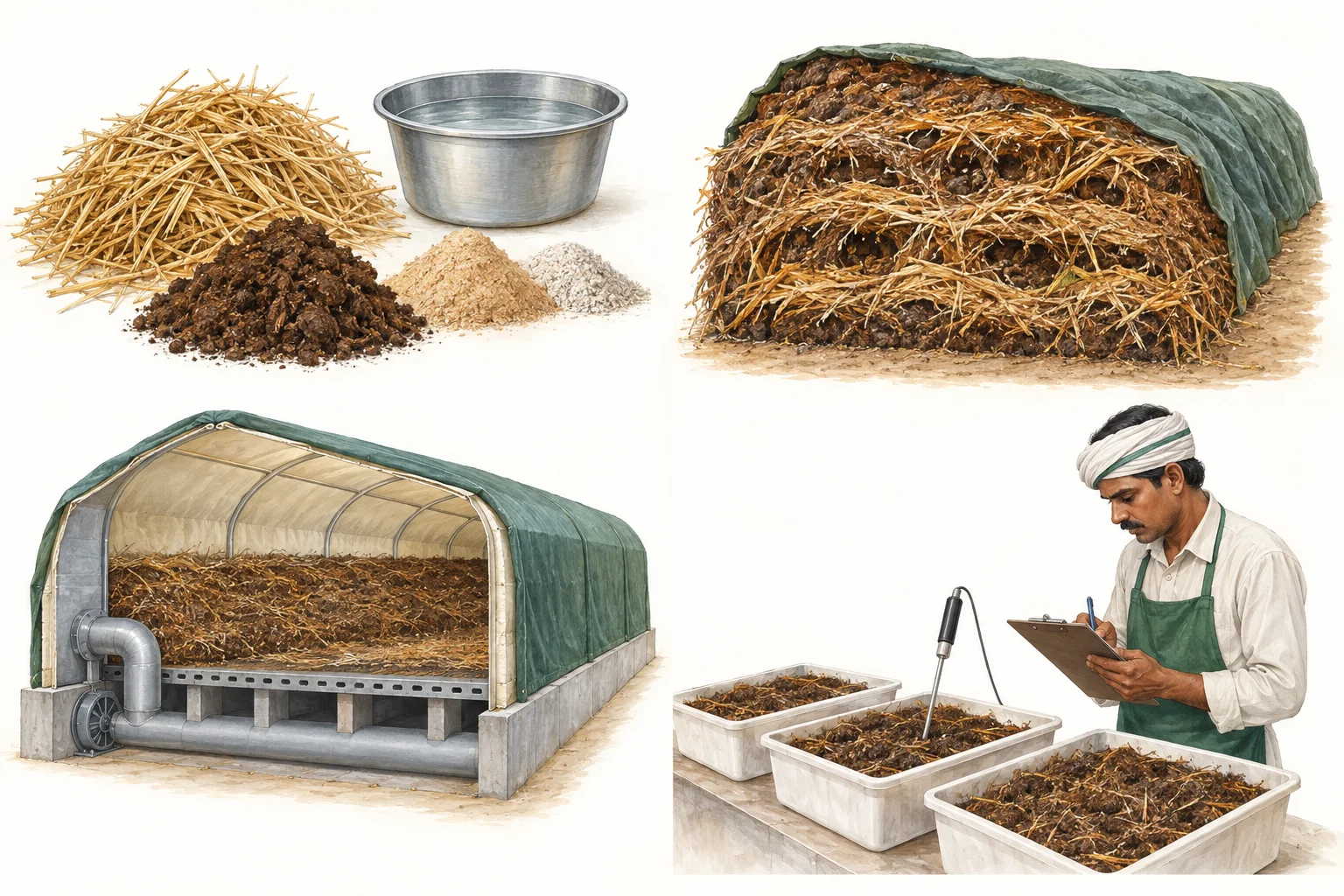
Release with evidence
- Notice
- The batch record brings measurements and observations together.
- Understand
- The calendar alone cannot prove compost is ready for spawning.
- Try it
- Hold unresolved batches for a competent release assessment.
01What a reading actually is
Four facts travel with every value: where the sensor sits, when it was last checked against a reference, what unit it reports, and what the machinery was doing at that moment. Strip one away and the number becomes an opinion.
Fan state matters more than most operators expect. Compost temperature with the fan running, and the same probe ten minutes after it stopped, are not the same measurement. Write the process state beside the value every time, so the batch record can be read a month later by somebody who was not standing there.
02Where probes go
A loaded tunnel varies in three directions. DMR fills to 2 to 2.2 metres, so the top of the mass and the layer near the floor differ, and the far end differs from the door end.
No Indian source publishes how many probes a tunnel needs. The count follows your geometry and the zones you know go wrong, so measure it on your farm rather than copy a number. Use the DMR rule that the spread must not exceed 3 °C to test whether your coverage is enough.
- Front and back
- Top, middle and bottom
- Zones with a bad history
03The boring checks
Check probes against a known reference on a fixed day each month, and write the check down even when nothing has drifted. A probe that is never checked is one you will eventually argue with.
Four failures hide behind a tidy screen. A value that has not moved for hours is usually a dead channel, not a stable tunnel. A jump of several degrees in a minute is usually a loose connection. A wet or bent probe reads its own condition. A probe moved at unloading and never relabelled reports the wrong end forever.
04Disagreement is information
When the air sensor shows 48 °C and the compost probe at the far end shows 43 °C, that gap is not a nuisance. It measures your air distribution, and it is the evidence DMR asks for when it limits the spread to 3 °C.
Do not average the two and move on, and do not quietly disable the awkward channel. Investigate the load, the floor and the dampers, write what you found, then decide. Nobody should certify compost from a screen in another room, because a screen cannot see a blocked floor outlet.
Draw your tunnel probe map
- Sketch the tunnel from above and mark door end, far end, floor zones.
- Number every probe on the sketch and paint it on the cable.
- Note the depth each probe sits at below the compost surface.
- Run one batch and mark the zone that stayed coldest throughout.
डायरी में लिखें: The probe map, each monthly calibration check, and the coldest zone per batch.
ये गलतियां न करें
- Running the tunnel from one probe near the door, the easiest zone to heat.
- Fitting a spare probe without checking it and without updating the map.
- Judging a batch from the control screen without walking the tunnel.
खुद को जांचें
तीन सवाल, तुरंत जवाबA compost probe has read exactly 47 °C for six hours. The likeliest reason is:
How many probes does a Phase II tunnel need?
Air at 48 °C with compost at 43 °C should be treated as:
यह संपादकीय स्व-जांच है, प्रमाणपत्र नहीं। जवाब इस डिवाइस पर भी सहेजे नहीं जाते।
शब्दावली
- Calibration check
- Comparing an instrument with a known reference to see its drift.
- Process state
- What the fan, dampers and heating were doing at the reading.
- Flat line
- A value that stops changing, usually a failed channel.
संदर्भ और आगे पढ़ें
A lesson cannot replace batch measurements or plant-specific procedures.
संदर्भ खोलें