


कम्पोस्ट गुणवत्ता जाँच
अच्छी कम्पोस्ट रंग या गंध से नहीं, बल्कि नमी, पीएच, अमोनिया, नाइट्रोजन और तापमान की माप तथा पूरे प्रक्रिया रिकॉर्ड को एक साथ देखकर ही स्पॉनिंग के लिए स्वीकृत की जाती है।
- By the end you can list the checks that stand behind a release decision.
- By the end you can name which moisture figure applies to your compost.
- By the end you can record a missing check honestly instead of hiding it.
ये आंकड़े संबंधित स्रोत और विधि के संदर्भ में हैं। इन्हें हर प्रजाति या फार्म का सार्वभौमिक निर्देश न मानें। पुराने मूल्य वर्तमान बाज़ार भाव नहीं हैं।
Release with evidence
- Notice
- The batch record brings measurements and observations together.
- Understand
- The calendar alone cannot prove compost is ready for spawning.
- Try it
- Hold unresolved batches for a competent release assessment.
01Release is a decision with a name on it
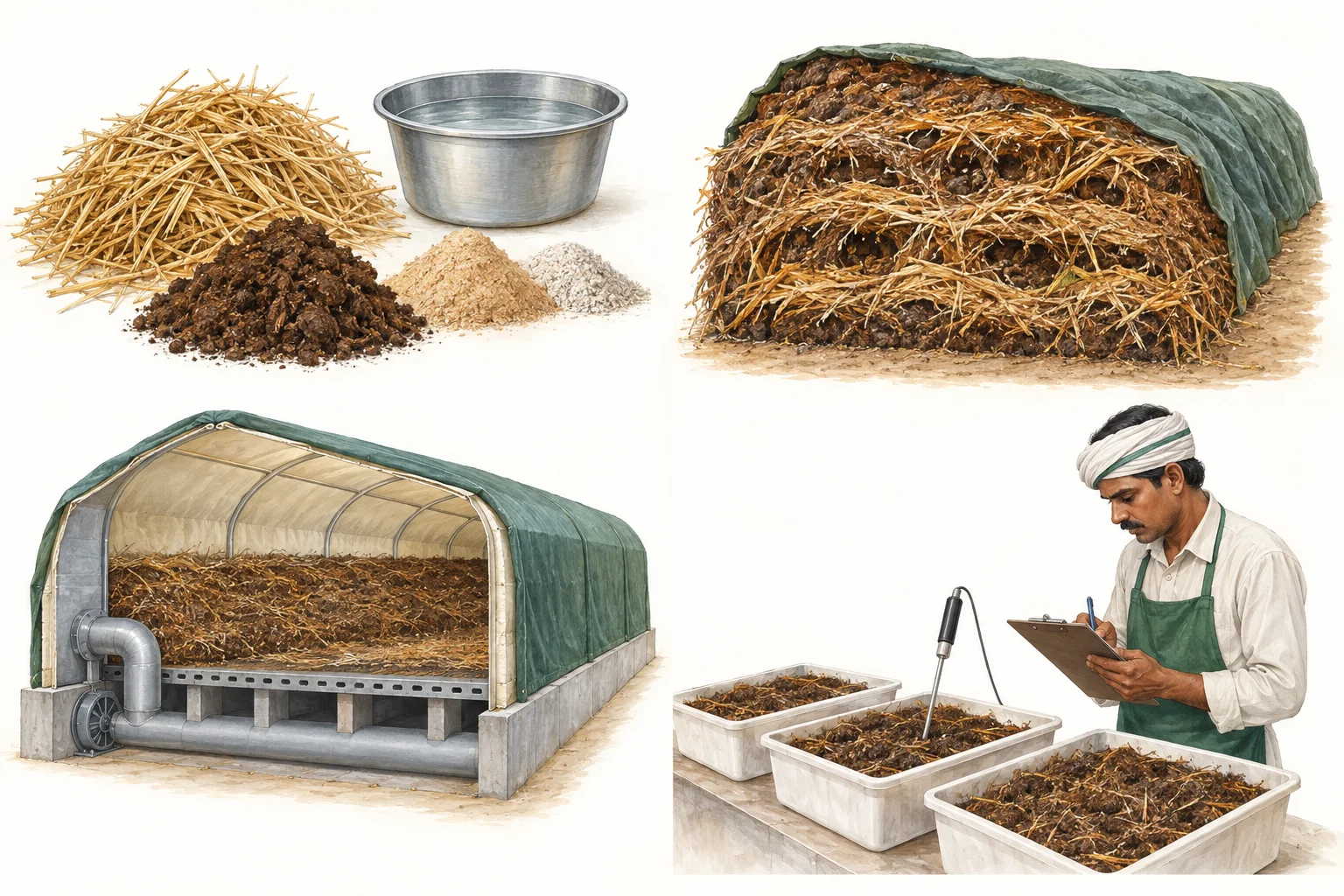
Somebody has to say that this batch may be spawned. That decision rests on four kinds of evidence: what you saw, what you measured, what the process record shows, and what a laboratory confirmed.
Any one of them alone will mislead you. Colour tells you about heat history but nothing about ammonia. A squeeze tells you roughly about water but nothing about pH. The batch curve tells you what the tunnel did but not what the compost became. Decide on the set, and write the name of whoever decided beside the batch number.
02The checks DMR puts numbers on
DMR describes compost after Phase II as holding 64 to 66 percent moisture, with no liquid oozing when it is squeezed firmly, and free ammonia below 10 ppm. The pH that suits Agaricus bisporus mycelium is 7.2 to 7.8, and compost is cooled to 25 to 30 °C before spawning.
Final nitrogen depends on the method used: DMR gives 1.75 to 2.0 percent for long method compost, 2.0 to 2.2 percent for short method, and 2.2 to 2.5 percent for indoor bunker compost. Judge your batch by the figure for the method you ran.
- Moisture
- Ammonia
- pH
- Nitrogen
- Temperature
03The moisture figure that has two answers
Two DMR moisture figures circulate and growers mix them up. The manual says good synthetic long method compost should hold 68 to 72 percent moisture at spawning. The same manual describes compost after Phase II as 64 to 66 percent. Both are DMR figures and both are correct, because they describe different compost.
So name your compost before you name your target. Above 72 percent, DMR warns that aeration fails, conditions turn airless and plaster moulds appear. NHB links compost below 64 percent, with wet casing, to weeper mushrooms. Neither end is small.
04Write down what you did not check
The most damaging line in a release sheet is the one left silently blank. If you did not test pH this batch, write not tested. If the ammonia reading came from one point rather than three, write one point. A record that hides its gaps will be trusted more than it deserves.
Small units can run this with a printed checklist and an outside laboratory a few times a season. Larger plants need a named release role, batch trends, and a written rule for a batch that fails one check but passes the rest.
Write a one page release sheet
- List the five checks with the DMR figure for the method you run.
- Add a line for the sample points used for moisture and for ammonia.
- Add a not tested box beside every check so gaps cannot hide.
- Sign it by name and staple it to the batch record before spawning.
डायरी में लिखें: Batch number, each check with its result and method, gaps, and who released it.
ये गलतियां न करें
- Quoting 68 to 72 percent moisture for tunnel compost DMR puts at 64 to 66 percent.
- Treating the hand squeeze as a measurement rather than a quick screen before measuring.
- Releasing on colour and smell when nobody recorded pH, ammonia or moisture at all.
खुद को जांचें
तीन सवाल, तुरंत जवाबDMR describes compost after Phase II as holding:
The 68 to 72 percent moisture figure applies to:
A check you could not run this batch should be:
यह संपादकीय स्व-जांच है, प्रमाणपत्र नहीं। जवाब इस डिवाइस पर भी सहेजे नहीं जाते।
शब्दावली
- Release
- The named decision that a batch may go forward to spawning.
- Weeper
- A mushroom that leaks liquid, linked to dry compost under wet casing.
- Plaster mould
- White or brown powdery moulds that follow wrong moisture or pH.
संदर्भ और आगे पढ़ें
A lesson cannot replace batch measurements or plant-specific procedures.
संदर्भ खोलें