


कम्पोस्ट में अमोनिया
अमोनिया की गंध केवल उसकी उपस्थिति बताती है, मात्रा नहीं, इसलिए स्पॉनिंग से पहले चरण, विधि, नमूने का स्थान और ठंडा होने की स्थिति जानना आवश्यक है।
- By the end you can say where the ammonia in a batch came from.
- By the end you can explain why smell is not a measurement.
- By the end you can ask the four questions before calling compost ready.
लक्षण से कारण तक
पहली नज़र, निदान नहीं। स्रोत: ICAR-DMR मैनुअल और रोग बुलेटिन।
| क्या दिखता है | संभावित कारण | पहला कदम |
|---|---|---|
| लंबी डंडी, छोटे कैप | CO₂ ज़्यादा (1,500 ppm से ऊपर) | ताज़ी हवा बढ़ाएं |
| कम्पोस्ट पर हरे धब्बे | ट्राइकोडर्मा; कम pH या बची अमोनिया | अलग करें, हटाएं; अगला बैच जांचें |
| केसिंग के बाद पिन नहीं | ठंडा और हवादार नहीं किया | 16 से 18 °C, हवा दें |
| कैप पर भूरे धंसे धब्बे | बैक्टीरियल ब्लॉच; गीले कैप | सतह सुखाएं, नमी 85% से कम |
| सफेद गीली गांठें | वेट बबल, केसिंग से | नमक से ढकें, हटाएं; केसिंग को भाप दें |
| छोटी मक्खियां | सियारिड/फोरिड | जाली, लाइट ट्रैप, स्वच्छता |
ये आंकड़े संबंधित स्रोत और विधि के संदर्भ में हैं। इन्हें हर प्रजाति या फार्म का सार्वभौमिक निर्देश न मानें। पुराने मूल्य वर्तमान बाज़ार भाव नहीं हैं।
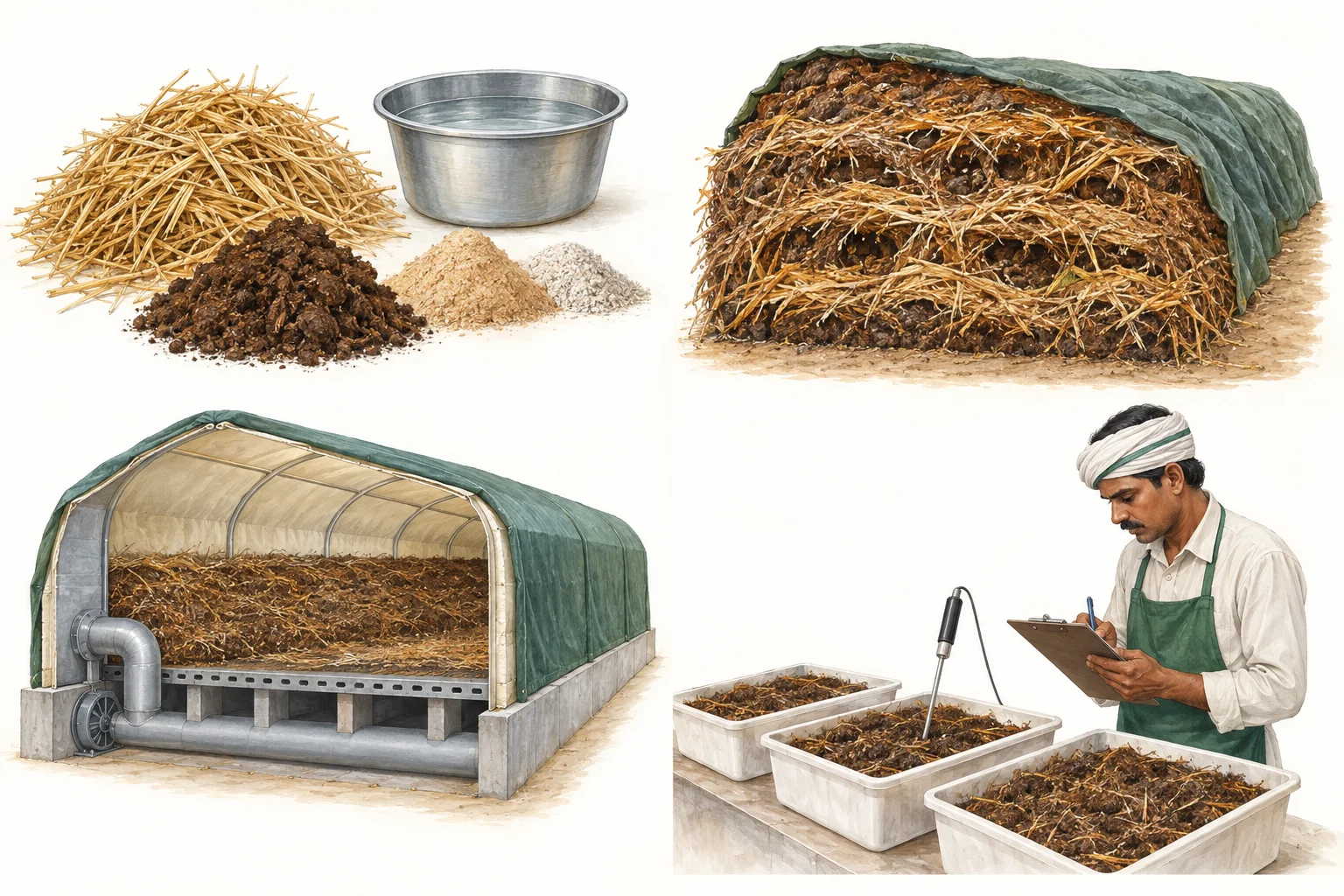
Understand the tunnel
- Notice
- Air must pass through the loaded material.
- Understand
- Pasteurisation, conditioning and cooling have distinct purposes.
- Try it
- Use the validated process and release criteria, not an odour test.
01Where it comes from
Ammonia is nitrogen on the move. Urea, chicken manure, cotton seed cake and every other nitrogen source breaks down during Phase I, and the nitrogen leaves the material as ammonia. This is normal. DMR reports compost at the end of Phase I holding about 800 to 1,000 ppm, with pH pushed up to roughly 8.2 to 8.5.
The size of your ammonia problem is therefore decided long before the tunnel. DMR notes that a mix carrying more than 1.75 percent nitrogen loses more of it as ammonia, and that such compost attracts yellow moulds, ink caps and olive green mould.
02Smell is not concentration
DMR states plainly that we generally cannot smell ammonia below 10 ppm. Read that carefully. Your nose can tell you ammonia is present. It can never tell you the level is low enough. Those are different statements, and crops are lost on the difference.
A nose also tires. After a few minutes in the corridor you stop noticing a smell that has not changed. That is olfactory fatigue, and it makes the second sniff less reliable than the first. Never deliberately breathe compost air to test a batch. Ammonia is an irritant gas and a tunnel is a confined space.
03Four questions before you decide
When someone reports that the compost still smells of ammonia, do not reach for a chemical and do not add a day. Ask four questions first, because each one changes the answer.
Which stage is this: end of Phase I, mid conditioning or after cooling? What method produced the reading: an instrument, a detector tube or a nose? Where was the sample taken: front, back, top, middle or plenum? Has cooling started, since a warm mass releases ammonia that a cooled mass holds back? A reading without those four facts cannot support a spawning decision.
- Stage
- Method
- Sample location
- Cooling status
04What it looks like after spawning
If ammonia is still there at spawning, the compost tells you within days. Spawn runs slowly or stops in patches. DMR lists ink caps, the black inky Coprinus mushrooms, under presence of ammonia and high nitrogen in compost. It ties Oedocephalum mould to ammonia and amines that were not eliminated during pasteurisation and conditioning.
By then nothing in that batch can be repaired, so the lesson belongs to the next one. Check the formulation nitrogen you actually stacked, the oxygen supply during conditioning, and whether your ammonia evidence was honest or convenient.
Build an honest ammonia record
- Write down the nitrogen sources and weights you actually stacked, not the recipe.
- Fix three sampling points in the tunnel and use the same three every batch.
- Record the test method by name and keep it unchanged across batches.
- Note compost temperature and whether cooling had started at each test.
डायरी में लिखें: Date, stage, method, the three points with their readings, and the decision taken on that evidence.
ये गलतियां न करें
- Treating the nose as an instrument, when DMR uses it only to say ammonia is present.
- Sampling the one convenient point near the door and calling the whole tunnel clear.
- Adding a fixed extra day of conditioning instead of finding why ammonia is not clearing.
खुद को जांचें
तीन सवाल, तुरंत जवाबA worker says the tunnel smells clean, so ammonia is below 10 ppm. This is:
Ink caps after spawning point mainly to:
Besides stage, method and cooling status, a reading needs:
यह संपादकीय स्व-जांच है, प्रमाणपत्र नहीं। जवाब इस डिवाइस पर भी सहेजे नहीं जाते।
शब्दावली
- ppm
- Parts per million. Ten ppm is ten parts of ammonia in a million parts of air.
- Olfactory fatigue
- The nose stops noticing a steady smell after a few minutes.
- Ink cap
- Coprinus, a fast black weed mushroom that signals ammonia in compost.
संदर्भ और आगे पढ़ें
A lesson cannot replace batch measurements or plant-specific procedures.
संदर्भ खोलें