


कंडीशनिंग: अमोनिया साफ करने वाले दिन
पाश्चुरीकरण के बाद कम्पोस्ट को 45 से 48 डिग्री सेल्सियस पर तब तक रखा जाता है जब तक अमोनिया 10 पीपीएम से नीचे न आ जाए, और यह निर्णय समय से नहीं बल्कि प्रमाण से लिया जाता है।
- By the end you can separate the conditioning before pasteurisation from the one after it.
- By the end you can explain in plain words what happens to the ammonia.
- By the end you can list the evidence that lets you end the hold.
कम्पोस्ट का तापमान, दिन 0 से स्पॉनिंग तक
लंबी विधि की ढेरी 65 से 70 °C, फिर पाश्चुरीकरण 58 से 59 °C (4 से 6 घंटे), कंडीशनिंग 45 से 52 °C, स्पॉनिंग 25 से 30 °C। स्रोत: ICAR-DMR मैनुअल 2011।
ये आंकड़े संबंधित स्रोत और विधि के संदर्भ में हैं। इन्हें हर प्रजाति या फार्म का सार्वभौमिक निर्देश न मानें। पुराने मूल्य वर्तमान बाज़ार भाव नहीं हैं।
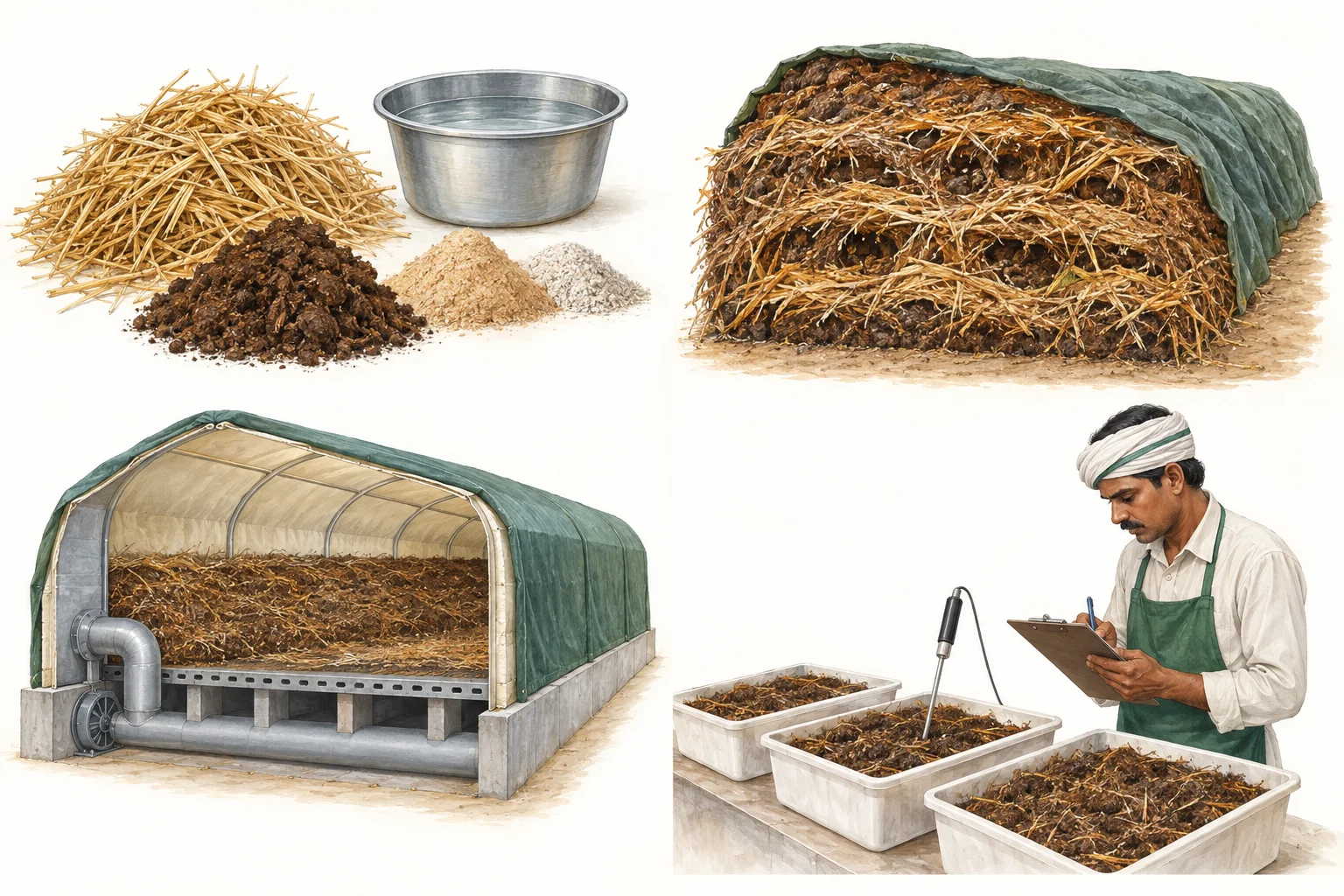
Understand the tunnel
- Notice
- Air must pass through the loaded material.
- Understand
- Pasteurisation, conditioning and cooling have distinct purposes.
- Try it
- Use the validated process and release criteria, not an odour test.
01Two conditionings, one purpose
Phase II is not one event. Before the peak the whole mass is held at 45 to 52 °C for about two days. ICAR-DMR calls this pre-pasteurisation conditioning, or PPC. Its job is to grow the thermophilic flora, the heat loving bacteria and actinomycetes that later do the ammonia work.
After pasteurisation the compost is brought down at about 1.5 °C per hour and held at 45 to 48 °C. This is post-pasteurisation conditioning, or POPC. DMR gives 3 to 4 days for a bulk tunnel above 15 tonnes, and 4 to 5 days for a smaller one, or as long as the ammonia takes.
02Where the ammonia goes
Compost leaving Phase I carries roughly 800 to 1,000 ppm of ammonia and sits at pH 8.2 to 8.5. That ammonia is nitrogen, and it is not thrown away. During conditioning the thermophilic community takes it up and locks it into microbial bodies, which the mushroom later digests. Some also leaves with the exhaust air.
Do not call this one single pathway. Uptake, chemistry and gas loss act together, in shares set by air supply, temperature and the nitrogen the formulation put in. A mix stacked above 1.75 percent nitrogen leaves more ammonia for these days to clear.
03Oxygen is the quiet input
Conditioning is aerobic work. DMR asks for oxygen above 10 percent inside the compost mass throughout, and notes that demand during PPC can climb higher still. Starve the mass of air and the microbes that eat ammonia slow down while wet airless pockets form.
There is also a floor. Below 40 °C mesophilic fungi, the ordinary moulds of a warm room, move in and the compost becomes unsuitable for mushroom growth. Low and slow is not a safe way to stretch conditioning. If the mass is drifting down, correct the air circuit rather than add days.
04Knowing when it is finished
The end point is a condition, not a date. DMR ends POPC when there is no detectable ammonia, which it places below 10 ppm. Collect that evidence at several points while the compost is still in the band, using a declared safe method, never by breathing tunnel air.
Read it with everything else: compost temperature steady in the band and not drifting, white actinomycete flecks through the whole mass rather than one layer, a sweet smell in place of a sharp one, and no wet airless pockets. If two of those disagree with the ammonia test, investigate before release.
Map one conditioning hold
- Write down tunnel size and expected batch output in tonnes before filling.
- Log compost temperature at three depths, three times a day, through the hold.
- Test ammonia at three fixed points with a declared safe method, not by smell.
- Mark each hour the mass leaves the 45 to 48 °C band and what you changed.
डायरी में लिखें: Batch number, hold hours, every reading with its point, and why you ended the hold.
ये गलतियां न करें
- Adding days when ammonia will not clear, instead of checking oxygen and air distribution.
- Ending conditioning on smell alone, when the nose cannot read below 10 ppm.
- Letting the mass drift under 40 °C overnight, which invites moulds into a finished batch.
खुद को जांचें
तीन सवाल, तुरंत जवाबConditioning is kept above 40 °C mainly because:
Ammonia at the end of Phase I is about:
You may end POPC when:
यह संपादकीय स्व-जांच है, प्रमाणपत्र नहीं। जवाब इस डिवाइस पर भी सहेजे नहीं जाते।
शब्दावली
- PPC
- Pre-pasteurisation conditioning, the hold at 45 to 52 °C before the peak.
- POPC
- Post-pasteurisation conditioning, the hold at 45 to 48 °C after the peak.
- Thermophilic
- Heat loving. Microbes that work best between 45 and 60 °C.
संदर्भ और आगे पढ़ें
A lesson cannot replace batch measurements or plant-specific procedures.
संदर्भ खोलें