


पानी और नमी का नियंत्रण
इस पाठ में भूसा भिगोने से लेकर बीजाई तक हर चरण की नमी मापने और सुधारने का तरीका बताया गया है।
- By the end you can say how much water pre-wetting takes and how long.
- By the end you can name the moisture target at each stage.
- By the end you can test moisture by squeeze and by drying.
Water goes in at three points: pre-wetting, stacking and every turning, never as a late rescue.
- Pre-wetSoak 24 to 48 hours, recycling the leachate.
- Check before stackingSqueeze samples from inside bales, not the surface.
- Correct at turningsAdd water while the mass is open.
- Verify by dryingWeigh, dry and reweigh to get a percentage.
ये आंकड़े संबंधित स्रोत और विधि के संदर्भ में हैं। इन्हें हर प्रजाति या फार्म का सार्वभौमिक निर्देश न मानें। पुराने मूल्य वर्तमान बाज़ार भाव नहीं हैं।
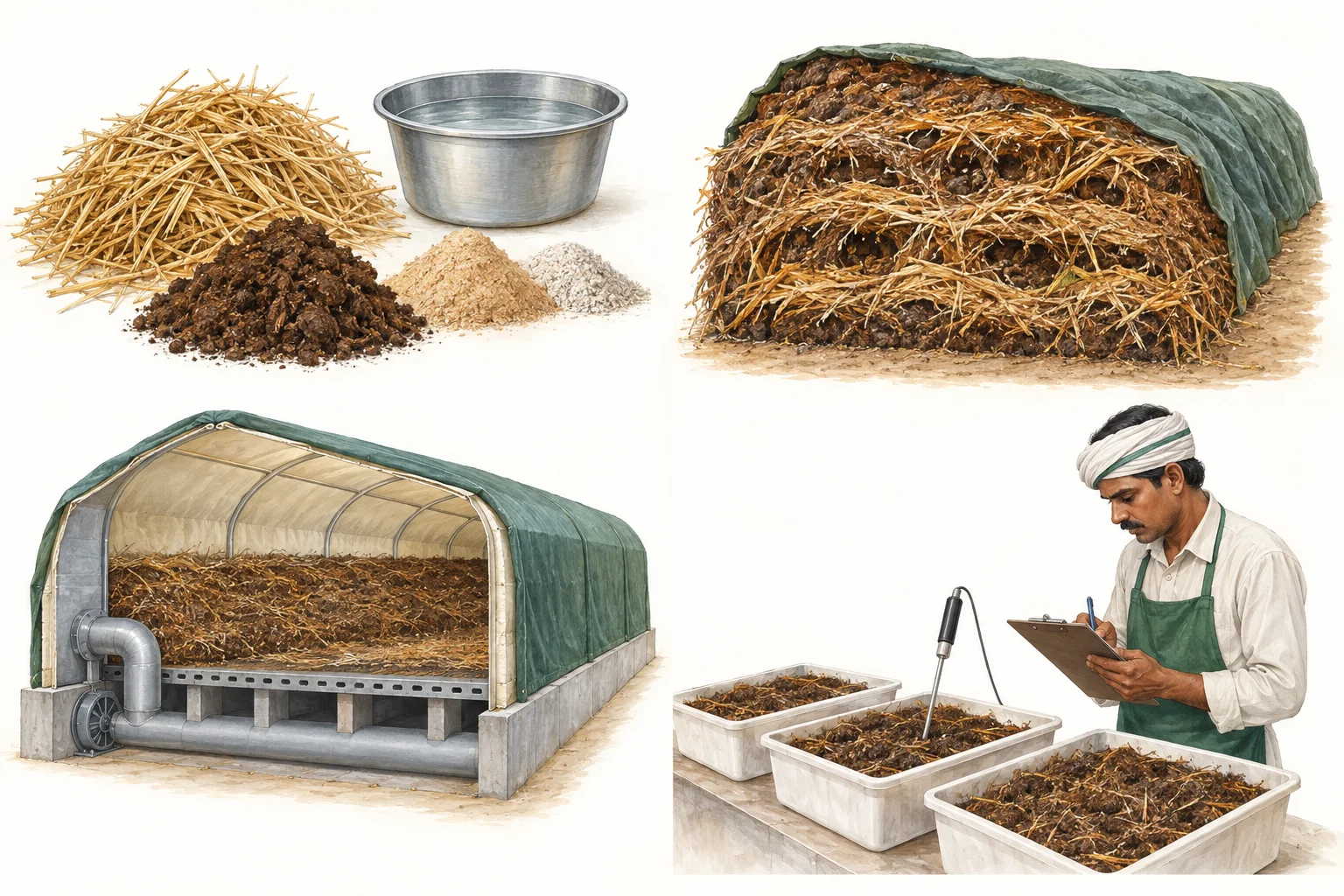
Structure and air
- Notice
- The heap has structure, depth and internal variation.
- Understand
- One central reading does not describe every part of the material.
- Try it
- Record representative readings and the actual preparation sequence.
01Pre-wetting is the first control point
Dry straw will not ferment. DMR wets straw on a platform for 24 to 48 hours until it reaches about 75 per cent moisture, and puts the water requirement at around 4000 litres per tonne of raw material. Run the leachate back over the heap instead of letting it drain away, because it carries nutrients with it.
Straw takes water slowly. A single soaking on the morning of stacking wets the outside and leaves the middle of each bale dry, and that dry core never joins the process. Give pre-wetting its own day in the schedule.
02One number per stage
Moisture is not a single target. DMR reports about 72 to 75 per cent at the end of Phase I, when drops appear between the fingers on squeezing, and 64 to 66 per cent after Phase II, when no liquid oozes even on firm squeezing.
Long method compost at spawning is different again: 68 to 72 per cent for synthetic compost and 65 to 67 per cent where horse manure was used. The farmer folder gives 68 to 70 per cent on the squeeze test on day 28. Always say which compost and which stage before quoting a moisture figure.
03How to measure it
The squeeze test is quick. Take a fistful, close the hand hard and read what happens: free running water means too wet, several drops between the fingers is Phase I level, a damp mass with no liquid is Phase II level.
If you have a balance, dry a known weight of compost until it stops losing weight and calculate the loss as a percentage. That is a real number, and it is the one to write down.
- Sample five points: both ends, both sides, centre.
- Take each sample from inside, not the dry surface.
- Use the same points every batch so readings compare.
04Too wet and too dry
Above 72 per cent at spawning, DMR reports that aeration fails, anaerobic conditions can kill the mushroom mycelium, and brown and white plaster moulds appear. Wet compost is also heavy and packs down, which blocks the air a blower is paid to deliver.
Dry compost fails the other way. NHB, reproducing ICAR guidance, links compost below 64 per cent moisture, under a wet casing layer, to weeper mushrooms. Correct water at a turning, where it can be mixed in, rather than pouring it on a filled bed later. Both faults cost the crop, and both are cheaper to prevent than to repair.
Build a moisture log for one batch
- Mark five fixed sampling points on the stack and number them.
- Squeeze test each point at stacking and at every turning.
- Dry one combined sample per turning and record the percentage.
- Compare each reading with that stage target before adding water.
- Note how much water you added and where.
डायरी में लिखें: Date, stage, reading at each point, dried sample percentage, litres added and the position.
ये गलतियां न करें
- Quoting one moisture figure for the whole crop; the target changes every stage.
- Sampling the dry outer skin, then adding water the inside did not need.
- Watering a filled bed; it runs down the sides instead of mixing.
खुद को जांचें
तीन सवाल, तुरंत जवाबNo liquid oozes on a firm squeeze. This matches:
Compost at 75 per cent moisture at spawning is likely to:
The safest time to correct low moisture is:
यह संपादकीय स्व-जांच है, प्रमाणपत्र नहीं। जवाब इस डिवाइस पर भी सहेजे नहीं जाते।
शब्दावली
- Pre-wetting
- Soaking straw before stacking so water reaches inside every bale.
- Leachate
- Brown water draining from a wet heap; recycling it returns nutrients.
- Squeeze test
- Judging moisture by the water appearing when a fistful is pressed.
संदर्भ और आगे पढ़ें
A lesson cannot replace batch measurements or plant-specific procedures.
संदर्भ खोलें