


कम्पोस्ट के सूक्ष्मजीव और ताप
इस पाठ में बताया गया है कि ढेर की गर्मी सूक्ष्मजीवों के काम का संकेत है और चयनात्मक कम्पोस्ट कैसे बनती है।
- By the end you can explain heat in a heap as microbial output, not input.
- By the end you can say what selective compost means and which stage builds it.
- By the end you can read temperature, smell and weight loss as evidence.
कम्पोस्ट का तापमान, दिन 0 से स्पॉनिंग तक
लंबी विधि की ढेरी 65 से 70 °C, फिर पाश्चुरीकरण 58 से 59 °C (4 से 6 घंटे), कंडीशनिंग 45 से 52 °C, स्पॉनिंग 25 से 30 °C। स्रोत: ICAR-DMR मैनुअल 2011।
ये आंकड़े संबंधित स्रोत और विधि के संदर्भ में हैं। इन्हें हर प्रजाति या फार्म का सार्वभौमिक निर्देश न मानें। पुराने मूल्य वर्तमान बाज़ार भाव नहीं हैं।
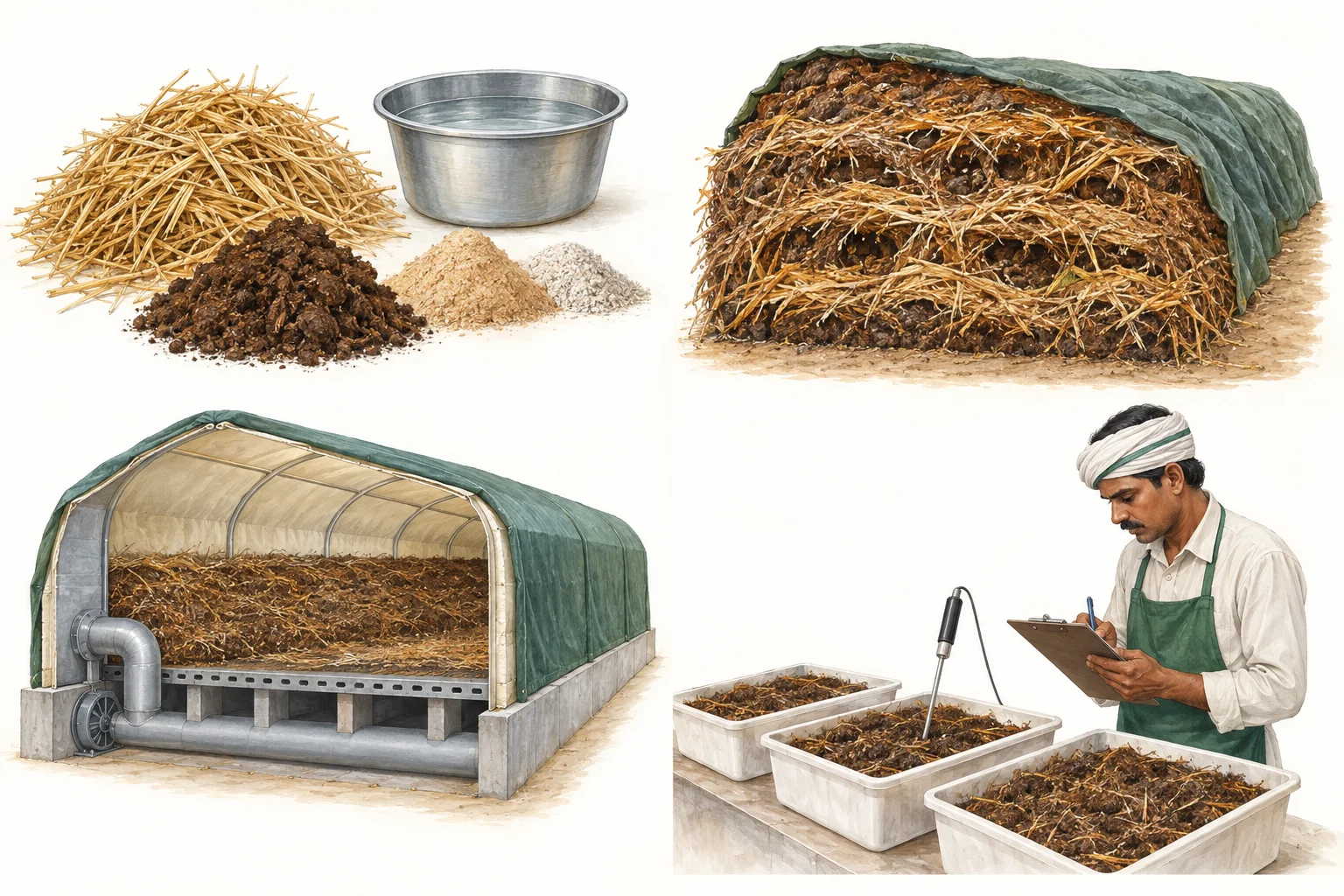
Structure and air
- Notice
- The heap has structure, depth and internal variation.
- Understand
- One central reading does not describe every part of the material.
- Try it
- Record representative readings and the actual preparation sequence.
01Who does the work
Composting is a relay. Mesophilic organisms, which live at everyday temperatures, start on the easy sugars as soon as straw is wet and nitrogen is available. Their own heat then pushes them out and hands the heap to thermophilic bacteria, fungi and actinomycetes, which prefer high temperatures and break down tougher material.
That is why a heap which will not heat is a feeding problem, not a heating problem. DMR notes that when nitrogen is kept below 1.5 per cent the heap may not pass 55 to 60 degrees Celsius, because there is too little microbial activity to make the heat.
02Heat is the meter reading
In the long method the heap rises quickly and may reach 70 degrees Celsius within 24 to 48 hours. The DMR farmer folder describes 65 to 70 degrees in two or three days and calls it a good sign.
There is an upper limit. DMR states that above 80 degrees in the central core is not desirable, because the core goes anaerobic and the friendly thermophilic flora is lost. A heap hot in the middle and cold at the edges is not composting evenly; it is two heaps in one, and the turning schedule exists to swap them.
03Selectivity is the point
Good compost is not just rotted straw. It is food that Agaricus bisporus can use and most of its competitors cannot. That selectivity is built in Phase II, where thermophilic organisms take up the free ammonia and lock it into their own bodies as microbial protein.
DMR keeps the mass at 45 to 52 degrees Celsius for that conversion, and warns against conditioning below 40 degrees because mesophilic fungi set in and make the compost unsuitable. The conditioning band is not comfort; it is the range where useful organisms beat the others.
04What the biology costs
Microbial work burns material. DMR reports about 30 per cent weight loss in Phase I and a further 20 to 25 per cent in Phase II. The carbon to nitrogen ratio falls from 25 to 30 at stacking to around 16 to 1, and nitrogen per cent rises as carbon leaves as carbon dioxide.
This is why finished compost weighs far less than the straw you bought, and why nitrogen readings climb without anyone adding nitrogen. Expect the loss, plan for it, and do not read a rising nitrogen figure as proof of supplementation.
Plot one heap instead of spot checking it
- Fix three probe points: core, mid depth and edge.
- Read all three at the same hour every day.
- Draw the three lines on one sheet of graph paper.
- Mark each turning and watch how fast heat returns.
- Flag any core reading above 80 degrees the same day.
डायरी में लिखें: Date, hour, three probe readings, turning dates, and any smell change such as sharp ammonia.
ये गलतियां न करें
- Treating a cold heap as a thermometer fault instead of checking nitrogen and water.
- Letting the core pass 80 degrees and calling it a strong heap.
- Conditioning below 40 degrees to save fuel, which lets mesophilic fungi in.
खुद को जांचें
तीन सवाल, तुरंत जवाबA heap has not crossed 50 degrees after three days. Suspect:
Holding compost at 45 to 52 degrees is meant to:
Phase I loses about 30 per cent of its weight because:
यह संपादकीय स्व-जांच है, प्रमाणपत्र नहीं। जवाब इस डिवाइस पर भी सहेजे नहीं जाते।
शब्दावली
- Mesophile
- An organism growing at everyday temperatures, roughly 20 to 40 degrees Celsius.
- Thermophile
- An organism growing best above roughly 45 degrees Celsius.
- Selective compost
- Compost that feeds the mushroom well and its competitors poorly.
- Actinomycetes
- Thread like bacteria that give good compost its grey white patches.
संदर्भ और आगे पढ़ें
A lesson cannot replace batch measurements or plant-specific procedures.
संदर्भ खोलें