


तुड़ाई और तुड़ाई के बाद
सही अवस्था पर तोड़ें, कम छुएँ, जल्दी ठंडा करें और पराली मशरूम को कभी 4 डिग्री पर न रखें।
- By the end you can pick each species at the stage the market wants.
- By the end you can handle and grade without bruising or browning.
- By the end you can cool and pack using DMR's temperature bands, and state the paddy straw exception.
- By the end you can match the sales channel to the shelf life you actually have.
तुड़ाई से बाज़ार तक
स्रोत: ICAR-DMR मैनुअल और पोस्ट-हार्वेस्ट बुलेटिन 2008।
- तोड़ेंपरदा खुलने से पहले, कैप 3 से 5 सेमी; घुमाकर खींचें।सुबह
- जड़ काटें और छांटेंमिट्टी वाला हिस्सा काटें; आकार और खुलेपन से ग्रेड।1 घंटे में
- ठंडा करेंगूदे का तापमान 4 से 5 °C तक; बर्फ का सीधा संपर्क नहीं।कुछ घंटों में
- पैक करें200 से 400 ग्राम पैक, हवादार; नमी 87 से 90 प्रतिशत।उसी दिन
- बेचेंफ्रिज में 2 से 3 दिन; कमरे के तापमान पर 12 घंटे।24 से 72 घंटे
ये आंकड़े संबंधित स्रोत और विधि के संदर्भ में हैं। इन्हें हर प्रजाति या फार्म का सार्वभौमिक निर्देश न मानें। पुराने मूल्य वर्तमान बाज़ार भाव नहीं हैं।
Look, explain, then apply
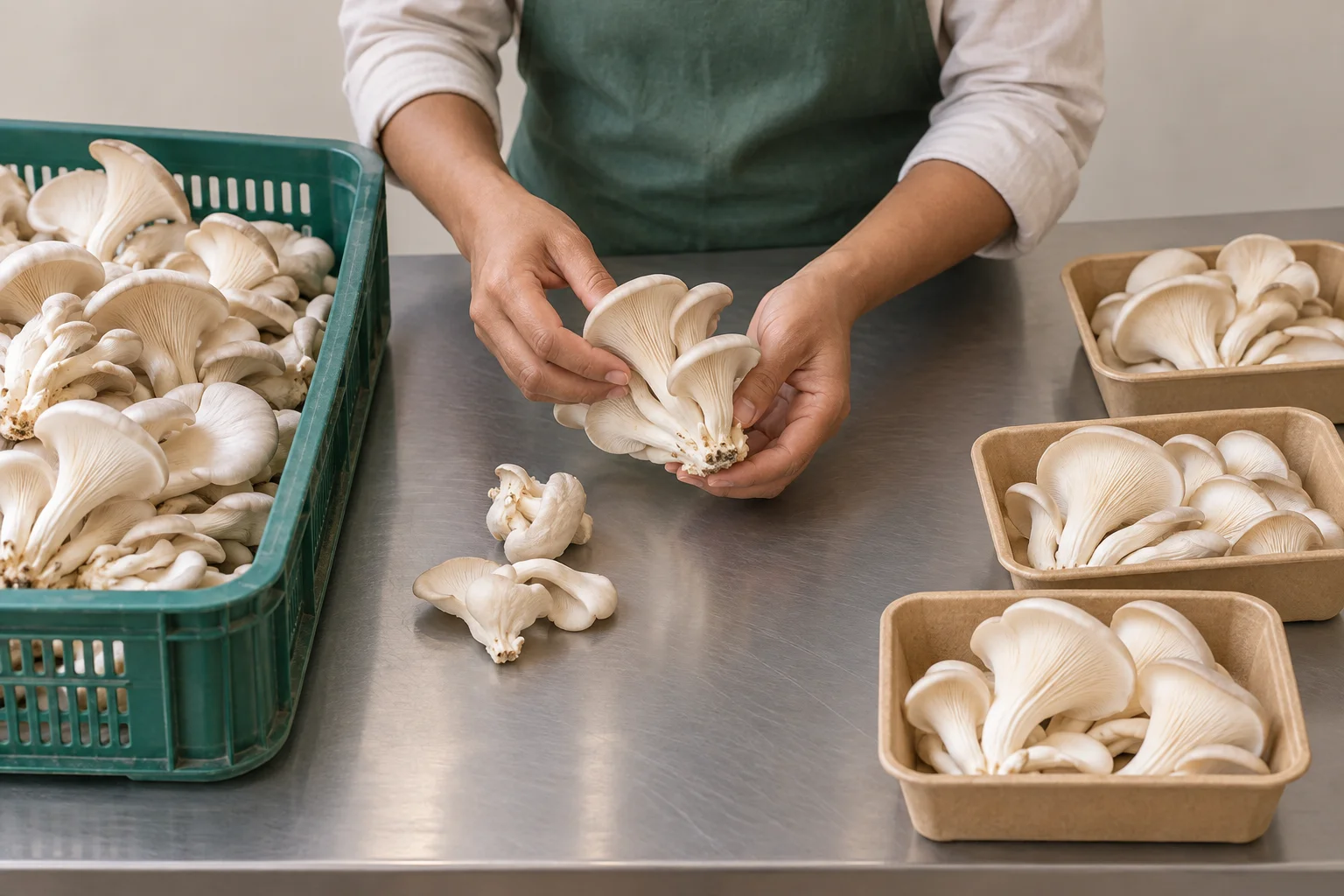
Handling and grading concept. It does not establish a validated hygiene procedure, food safety, shelf life or packing specification.
See where this fits in the full workflow →01When to pick
Each species has a stage the buyer wants. Button: a firm cap of 4 to 5 cm with the veil still closed in DMR's manual, 3 to 4 cm in the farmer folder. Milky: a cap of 5 to 6 cm in the folder, 7 to 8 cm in the manual. Paddy straw: at the button or egg stage before the volva breaks, picked two or three times a day. Shiitake: early, broken from the block by the stalk, never torn.
Oyster is picked before the cap edge flattens and starts to curl up; the site guide treats that as the sign, since DMR gives no cap size.
Twist gently and lift. For button, cut the soil off the base straight away.
02Handling and grading
Mushrooms bruise like ripe fruit. Handle each one once. Harvest into shallow trays, never deep sacks, and keep trays out of the sun.
Grade on a clean table by size and by whether the cap is closed or open. Trim stems level. DMR's oyster folder says spread the mushrooms on a cloth for about two hours so surface moisture evaporates before packing. Never wash mushrooms: a water film on the cap is where bacterial blotch spots start.
Weigh each grade separately. Rejected mushrooms are a number to write down, not a number to hide, because the cost of the crop is spread over what you actually sell.
03Cooling: the cold chain
A picked mushroom keeps breathing. DMR's post-harvest bulletin says respiration at 10 degrees is 3.5 times that at 0 degrees, so heat must leave fast. The target is to bring the mushroom itself to 4 to 5 degrees as quickly as possible. The manual asks for button to be chilled at 4 degrees for 6 to 8 hours before it goes to market. Household refrigerators run at 4 to 7 degrees; chill stores at minus 1 to minus 4; freezing below minus 18.
Shelf life without cold is short. Oyster keeps 24 to 48 hours at room temperature and 2 to 4 days in a refrigerator. Milky keeps 3 to 4 days. Button keeps about 12 hours at ambient and 2 to 3 days in a fridge.
The exception: paddy straw mushroom breaks down at 4 degrees. Hold it at 10 to 15 degrees for up to three days, and sell it the same day if you can.
04Packing and choosing the channel
Indian retail packs are 200 g or 400 g in thin polythene under 100 gauge, with holes giving about 5 percent vent area, according to DMR. Humidity inside the pack of 87 to 90 percent gives the best colour. Unpacked paddy straw loses 40 to 50 percent of its weight in four days; packed, about 10 percent.
Channels differ by speed. A local shop or a WhatsApp group of households pays fastest. A mandi or wholesaler takes volume but pays less and later. Hotels want a steady grade. Dried oyster at 2 to 4 percent moisture keeps 3 to 4 months in sealed packs and turns a glut into a shelf product.
This lesson gives no prices. Record the price you were actually paid, by grade and date.
Time your first hour
- Pick early in the morning when the room is coolest, at the stage listed for your species.
- Write the clock time of the first pick on the tray.
- Grade on a clean table into two grades and weigh each.
- Pack in vented bags at the size your buyer wants.
- Move the packs to a refrigerator or ice box within the hour, except paddy straw, which goes to a cool shaded 10 to 15 degree spot.
- Ask the buyer what time the lot arrived and what, if anything, was rejected.
डायरी में लिखें: Pick time, kilograms per grade, time the lot went cold, kilograms rejected and why, buyer name and price actually paid.
ये गलतियां न करें
- Picking after the caps open to gain weight; open caps grade lower and spoil faster.
- Washing mushrooms before packing; the water film starts bacterial blotch and cuts shelf life.
- Putting paddy straw mushrooms in the refrigerator with the others; at 4 degrees they break down.
खुद को जांचें
तीन सवाल, तुरंत जवाबWhere should paddy straw mushroom be held after harvest?
DMR's pre-market step for button mushroom is
Why must water never be left on caps?
यह संपादकीय स्व-जांच है, प्रमाणपत्र नहीं। जवाब इस डिवाइस पर भी सहेजे नहीं जाते।
शब्दावली
- Veil
- The thin skin under a button cap that covers the gills; closed means fresh.
- Volva
- The cup at the base of a paddy straw mushroom; picked before it breaks.
- Pre-cooling
- Removing field heat from picked mushrooms quickly, before storage or transport.
- Shelf life
- How long the mushroom stays saleable under given storage conditions.
- Grade
- A class of mushrooms by size, cap condition and damage that sells at one price.
संदर्भ और आगे पढ़ें
Course completion does not establish practical competence.
संदर्भ खोलें