


व्यवसाय की वास्तविकता
आय, लागत, नकदी प्रवाह और लाभ चार अलग संख्याएँ हैं; हर अनुमान का प्रमाण अपने खेत और अपने बाज़ार से जुटाएँ।
- By the end you can define revenue, cost, cash flow and profit in mushroom terms.
- By the end you can trace cost to the unit that matters: a kilogram sold, not a kilogram grown.
- By the end you can list the assumptions in any project report that only your own farm can prove.
- By the end you can use MIDH cost norms as a structure, not as a quotation.
उदाहरण: छोटे बटन फार्म का पहला साल
दो कमरों वाली खरीदी हुई कम्पोस्ट की इकाई के अनुमानित हिस्से। आपका कोटेशन और खरीदार असली आंकड़े तय करते हैं।
ये आंकड़े संबंधित स्रोत और विधि के संदर्भ में हैं। इन्हें हर प्रजाति या फार्म का सार्वभौमिक निर्देश न मानें। पुराने मूल्य वर्तमान बाज़ार भाव नहीं हैं।
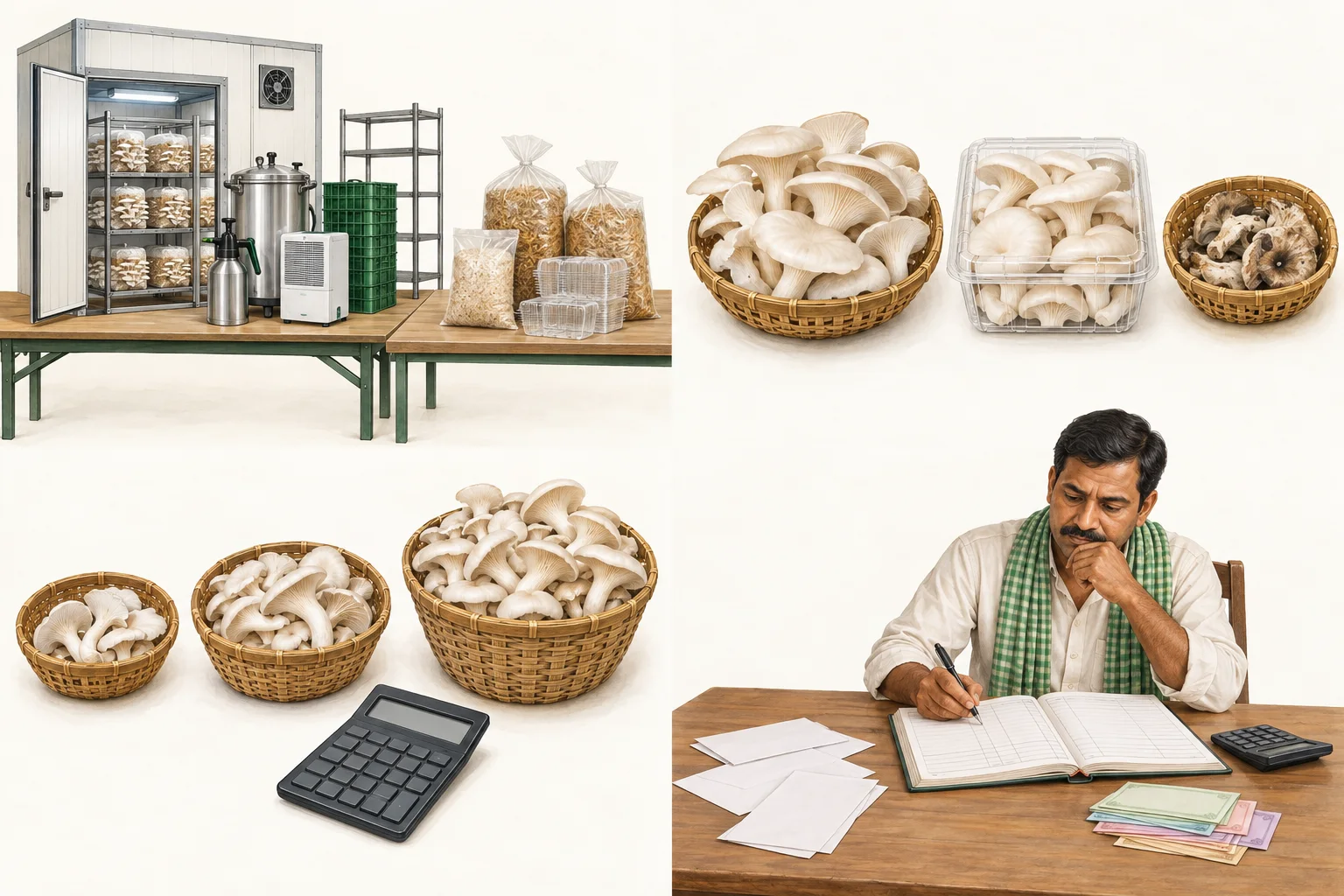
Harvest is not all sold
- Notice
- Harvested, sold and rejected quantities are different records.
- Understand
- Only accepted sales support the sales calculation.
- Try it
- Weigh each destination and keep buyer deductions visible.
01Four numbers, not one
Sales revenue is based on accepted sales, prices, returns and deductions. Money collected is a separate cash-flow measure: credit sales can create receivables before payment arrives. Record harvested, sold and paid quantities without treating them as interchangeable.
Profit compares revenue with the relevant costs over a defined period. Cash flow tracks actual receipts and payments. Keep asset purchases, operating expenses, depreciation and loan cash flows clearly labelled to avoid double counting.
02What the institutes actually give you
DMR's 2011 manual built its models on 70 percent biological efficiency for oyster and 18 kg per 100 kg compost with six crops a year for button in controlled rooms. Its undated folders put the cost of producing a kilogram at 10 to 15 rupees for oyster, 20 to 25 for button and 20 to 25 for milky, with milky selling at 60 to 80.
Every one of those is a dated reference from 2011 or the early 2010s, marked medium confidence in this course's fact base. Use them to learn the shape of the sums, never as today's numbers.
NHB's model report page returns an error and its DPR template leaves the financial cells empty. Nobody in Delhi or Solan has a current price for your district.
03Cost per saleable kilogram
Divide total cost by kilograms sold, after rejection, unsold lots and failed bags. That is the only cost that matters. A yield measured in Solan is not a sales figure in your block.
The downside is real. DMR reports competitor moulds taking up to 70 percent of an oyster yield. Unpacked paddy straw mushrooms lose 40 to 50 percent of their weight in four days. A buyer can refuse a lot.
So run a sensitivity: redo the sum with yield 30 percent lower, price 20 percent lower, and one crop lost. If the project only works in the best case, it is not yet a business.
04Capital, schemes and the assumptions you must prove
MIDH's 2025 cost norms: production unit 30 lakh rupees, spawn unit 20 lakh, compost unit 30 lakh, each with 40 percent assistance for private growers and 50 percent in north-eastern and Himalayan states and scheduled areas. The low-cost unit is 2 lakh for a 200 square foot structure at 50 percent, up to five units per beneficiary. Assistance is credit-linked and back-ended: a bank loan is mandatory and the money arrives after the build. A cost norm is a ceiling for subsidy, not the price of a unit. Get local quotations.
Write down what only you can prove: straw price by month, spawn price and the laboratory's reliability, a named buyer and weekly volume, price by grade, rejection percent, hours of power, labour, and how many days a year the room is actually full.
A one-crop cash calendar
- List every rupee one crop will need, item by item, with the week it leaves your hand.
- List the week each flush will sell and the week the buyer will actually pay.
- Write the running cash balance week by week and circle the lowest point; that is the cash you must have before starting.
- Redo the sheet with 30 percent less yield and 20 percent lower price.
- Write the three assumptions you are least sure of and the name of the person who can confirm each.
- Compare any scheme cost norm with two real quotations before writing it in a plan.
डायरी में लिखें: Spend by item and week, kilograms sold by grade, price received, date the money arrived, and the lowest cash week.
ये गलतियां न करें
- Using an online retail price as the farm-gate price; wholesale realisation is lower and paid later.
- Forgetting the payment gap; spawn and straw are paid weeks before a wholesaler pays for the first flush.
- Treating a MIDH cost norm as a quotation; it is a subsidy ceiling, and the money comes after the build.
खुद को जांचें
तीन सवाल, तुरंत जवाबRevenue is
The MIDH low-cost unit norm is
A DMR 2011 selling price of 50 rupees a kilogram should be used as
यह संपादकीय स्व-जांच है, प्रमाणपत्र नहीं। जवाब इस डिवाइस पर भी सहेजे नहीं जाते।
शब्दावली
- Revenue
- The value of recognised mushroom sales. Cash received may differ because of credit sales or payment timing.
- Cash flow
- The timing of money going out and coming in, week by week.
- Cost per saleable kilogram
- Total cost divided by kilograms sold, not kilograms grown.
- Credit-linked back-ended subsidy
- Assistance paid through a bank loan after the unit is built, not before.
- Sensitivity test
- Redoing the sums with worse yield, price or losses to see if the plan survives.
संदर्भ और आगे पढ़ें
Course completion does not establish practical competence.
संदर्भ खोलें