


खेती का चक्र
तैयारी, बीजाई, कवकजाल फैलाव, फलन, तुड़ाई और सफ़ाई: हर मशरूम फसल इन्हीं छह चरणों से गुज़रती है।
- By the end you can list the six stages of a mushroom crop in order and say what changes at each.
- By the end you can put DMR durations on each stage for oyster and button.
- By the end you can explain why the room must change between colonisation and fruiting.
- By the end you can plan the reset between crops so the next crop does not inherit the last one's problems.
An oyster bag at stage four: fully white, opened, with the first flush coming out.
- PrepareChop, wet and heat-treat straw, or compost it for button.
- SpawnMix spawn into cooled substrate in a clean, closed room.
- ColoniseDark, warm, closed bags until the substrate is white.
- Induce fruitingOpen bags, cool the room, add fresh air, humidity and light.
- Harvest flushesPick each wave at the right stage; rest days between waves.
- ResetRemove spent bags, cook out or wash, dry, and refill.
ये आंकड़े संबंधित स्रोत और विधि के संदर्भ में हैं। इन्हें हर प्रजाति या फार्म का सार्वभौमिक निर्देश न मानें। पुराने मूल्य वर्तमान बाज़ार भाव नहीं हैं।
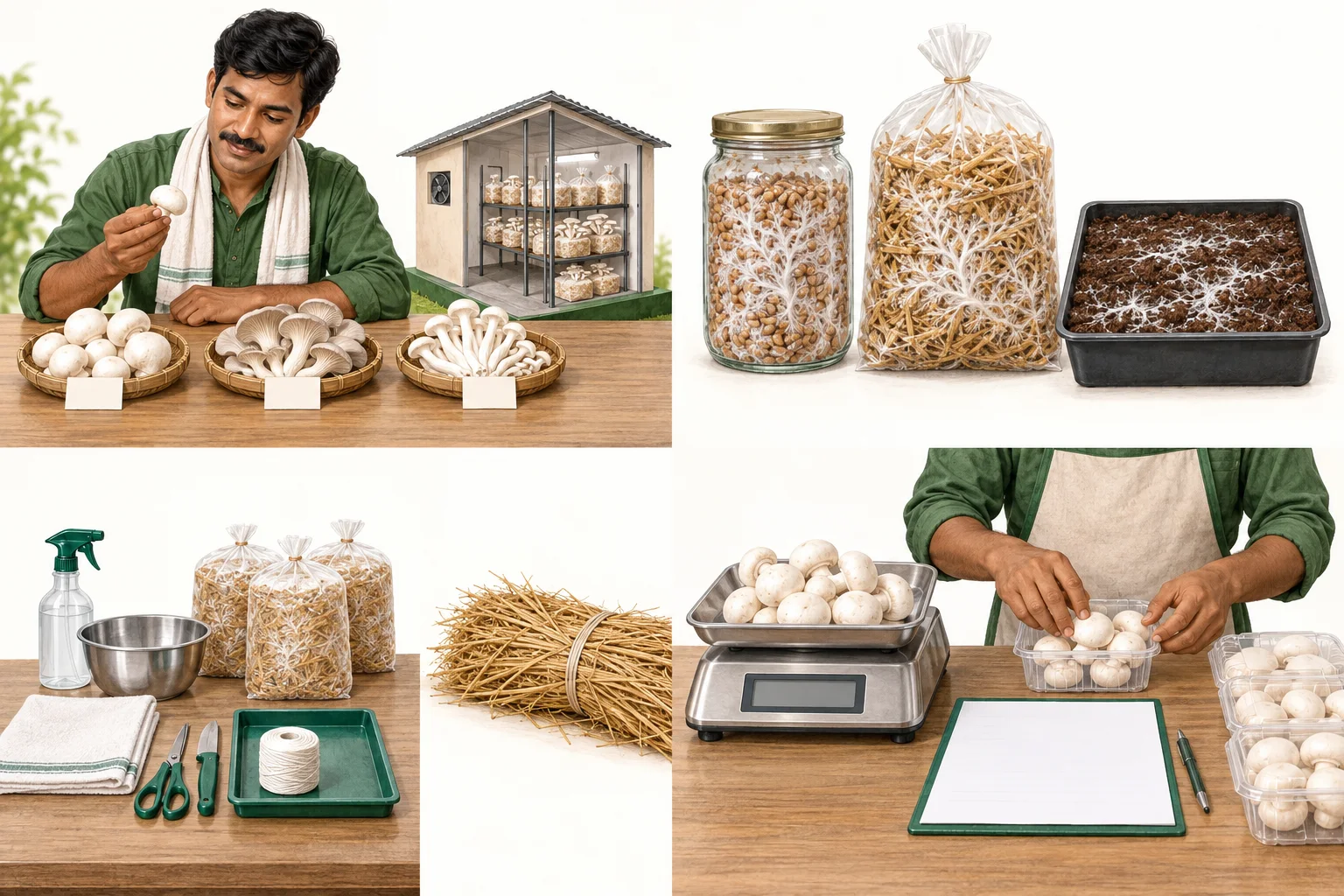
Prepare the workflow
- Notice
- Raw inputs and treated material need different handling areas.
- Understand
- A clean-looking room can still have crossing clean and dirty workflows.
- Try it
- Trace the routes for inputs, clean work, harvest and spent material.
01Stage 1: prepare the substrate
Collect, chop, wet and treat. For oyster and milky the straw is soaked and then heated: 60 to 65 degrees for 20 to 30 minutes in DMR's oyster folder, or 65 to 70 degrees for one hour in the manual. It is drained to about 65 to 70 percent moisture.
For button, straw is composted: 28 to 30 days by the long method or 10 to 12 days indoors, then given a Phase II heat treatment at 58 to 59 degrees. For paddy straw, bundles are soaked 12 to 18 hours.
This stage decides most of the contamination risk of the whole crop. Rushing it is the most expensive shortcut on the farm.
02Stages 2 and 3: spawn and colonise
Spawning is mixing spawn into cooled substrate in a clean room. Oyster uses 2 to 3 percent of wet weight in polythene bags of 40 to 45 by 30 to 35 cm with 10 to 12 small holes, according to the folder.
Colonisation, or spawn run, is the wait while the bag turns white. Follow the species-specific bag and incubation protocol. The crop respires and releases heat; room ventilation and monitoring remain necessary. Oyster takes 15 to 25 days and DMR says never open bags before 16 to 18 days. Button takes 12 to 14 days, then a 3 to 4 cm casing layer of soil is laid on top and a further week of case run follows. Milky takes 15 to 20 days, then casing and 10 to 12 days of case run.
During this stage the diary entry is short: bed temperature and any coloured patch.
03Stage 4: switch the room to fruiting
Fruiting does not start by itself. The fungus needs a signal that its food is ending and conditions outside are good. The grower gives that signal by changing the room: open or cut the bags, drop the temperature, bring in fresh air, raise humidity and give light.
Oyster pinheads appear about a week after bags are opened and reach full size four to five days later. Button pins come 3 to 4 days after venting and become solid buttons in another 3 to 4 days. Milky pins appear 3 to 5 days after the case run ends.
If pins do not come, the switch was not sharp enough. Check that the drop in temperature and the fresh air really happened at bag height.
04Stages 5 and 6: harvest in flushes, then reset
Mushrooms come in waves called flushes. DMR's oyster folder counts three productive flushes with 8 to 10 days between them, and says the first is half the total or more. Paddy straw gives 70 to 90 percent of its yield in a first flush lasting three days. Button is picked almost daily for 8 to 10 weeks in seasonal rooms, or on a 60-day cycle giving six crops a year in controlled rooms.
Reset means emptying, cleaning and starting again. Spent bags go to a pit; a button room gets NHB's cook-out at 70 degrees for 12 hours; the room is washed and dried before refilling.
Plan reset days into the calendar. An oyster cycle of 45 to 60 days is not six crops a year unless the reset is fast and the season allows.
Draw one crop on a calendar
- Choose your species and write day 0 as the spawning day.
- Add the DMR duration for each stage and mark the expected day bags open and pins appear.
- Mark the likely harvest days for each flush and write who will pick.
- Add five to seven days of reset at the end.
- Lay the calendar over your temperature months. If the last flush falls outside the band, plan two flushes or start earlier.
- Keep the sheet on the wall and write the actual date beside each planned date.
डायरी में लिखें: Planned and actual date for every stage, the bed temperature on the day of each change, and the reason for any delay.
ये गलतियां न करें
- Opening bags early to see what is happening; DMR sets 16 to 18 days as the earliest for oyster.
- Skipping the reset because the room looks clean; spores and flies from the last crop go straight into the next.
- Planning six oyster crops a year in a seasonal room; the season, not the cycle length, sets the count.
खुद को जांचें
तीन सवाल, तुरंत जवाबThe correct order of stages is
What should determine whether an oyster bag is ready for its fruiting operation?
Which species gives most of its yield in a first flush lasting three days?
यह संपादकीय स्व-जांच है, प्रमाणपत्र नहीं। जवाब इस डिवाइस पर भी सहेजे नहीं जाते।
शब्दावली
- Colonisation (spawn run)
- The stage when mycelium spreads through the whole substrate.
- Casing
- A layer of treated soil laid over colonised compost for button and milky mushrooms.
- Pinhead
- The first tiny knot of a mushroom, the size of a pin head.
- Induction
- Changing the room to signal the fungus to start fruiting.
- Reset
- Emptying, cleaning and disinfecting the room between crops.
संदर्भ और आगे पढ़ें
Course completion does not establish practical competence.
संदर्भ खोलें