


भारत के प्रमुख खेती योग्य मशरूम
बटन, ढींगरी, दूधिया, पराली और शिटाके मशरूम की तुलना तापमान, भोजन, मौसम और कौशल के आधार पर करें, न कि बाज़ार भाव के आधार पर।
- By the end you can name the five main cultivated mushrooms of India with their Hindi names.
- By the end you can read each species' spawn-run and fruiting temperature band from the DMR table.
- By the end you can explain why button needs compost while oyster, milky and paddy straw grow on treated straw.
- By the end you can say which species suit the plains, the hills and the coast, and in which months.
पांच मशरूम एक नज़र में
हरी पट्टी = फलन का तापमान। स्रोत: ICAR-DMR मौसमी फोल्डर और मैनुअल।
ये आंकड़े संबंधित स्रोत और विधि के संदर्भ में हैं। इन्हें हर प्रजाति या फार्म का सार्वभौमिक निर्देश न मानें। पुराने मूल्य वर्तमान बाज़ार भाव नहीं हैं।
Choose your crop
- Notice
- Crop, room, season and buyer belong in one decision.
- Understand
- A popular mushroom is not automatically the best fit for your room.
- Try it
- Record indoor conditions and ask a buyer what they will accept.
01Five mushrooms, two kinds of food
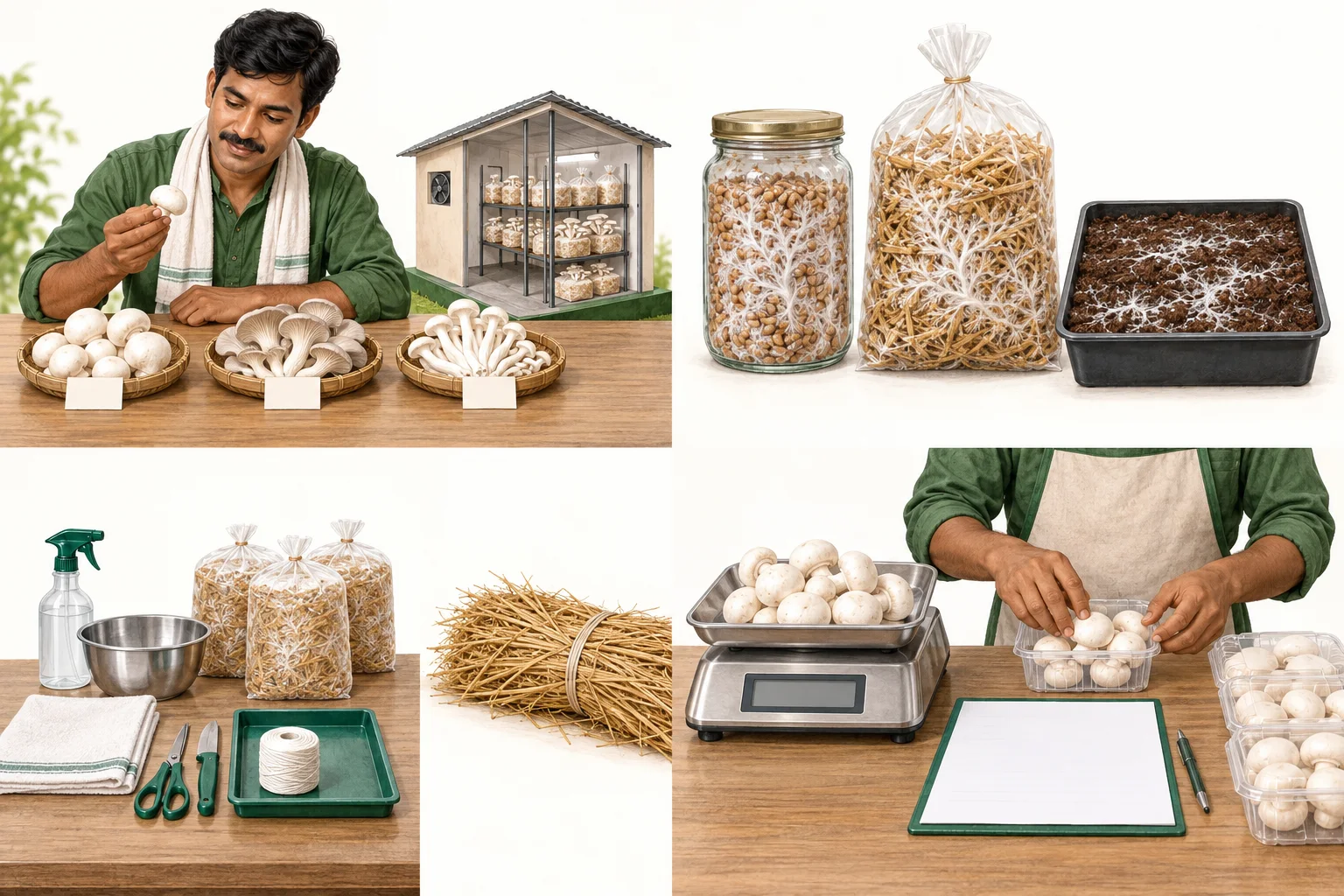
The five are white button (Agaricus bisporus, बटन), oyster (Pleurotus species, ढींगरी), milky (Calocybe indica, दूधिया), paddy straw (Volvariella volvacea, पराली) and shiitake (Lentinula edodes).
They fall into two groups by food. Button eats straw that has first been composted: heaped, wetted and turned until it has partly rotted. DMR gives 28 to 30 days for the long composting method and 10 to 12 days for the indoor method. Oyster, milky and paddy straw eat straw that has only been pasteurised, that is heated enough to kill competitors but not rotted. Shiitake eats wood: sawdust blocks or logs.
The food decides the infrastructure. Composting needs a yard and weeks of labour. Pasteurising needs a drum and a fire.
02Temperature is the first filter
DMR's species table gives two bands for each mushroom: one for spawn run, one for fruiting. Button: 22 to 25 then 14 to 18. Oyster Pleurotus florida: 25 to 30 then 18 to 22. Pleurotus sajor-caju: 25 to 32 then 22 to 26. Milky: 25 to 30 then 30 to 35. Paddy straw: 32 to 34 then 28 to 32. Shiitake: 22 to 27 then 15 to 20, all in degrees Celsius.
Read the table twice. Milky and paddy straw fruit in heat that would kill a button crop. Shiitake and button want cool rooms that a plains farmer only gets in winter.
This is why a grower in Bhubaneswar and a grower in Solan should not copy each other's protocol.
03Season and region
Without air conditioning, the calendar is the farm plan. DMR's seasonal folder gives it by region.
North Indian plains: button November to February (the 2011 manual says October to February), oyster September to May, milky February to April and again July to September, paddy straw July to September. Mid-hills: button September to March, oyster all year, milky April to June, shiitake October to February. High hills: button March to November, oyster May to August, shiitake December to April.
Coastal states can grow oyster, paddy straw and milky in natural conditions all year, and DMR names Odisha, Andhra Pradesh, Tamil Nadu, Kerala and West Bengal as the paddy straw heartland.
04Speed, cycle and skill
Crop cycles differ a lot. Paddy straw finishes in 4 to 5 weeks. Oyster takes 45 to 60 days. Button needs 80 to 100 days on the same straw once composting is counted. Shiitake blocks need 60 to 80 days of spawn run before the first mushroom.
Skill rises in steps. Oyster is the usual first crop: no compost, no casing. Milky adds a casing layer of soil. Button adds composting, casing and a cold room. Shiitake adds sterile bag filling and patience. Paddy straw is fast but the most perishable: DMR says it cannot be kept at 4 degrees because it breaks down, and is sold on the day of harvest.
DMR's yield figures are institute results under institute conditions. Treat them as reference, never as your farm's number.
Build your own temperature calendar
- Write the twelve months down one page of the diary. Against each, note the usual daytime high and night low where you live.
- Shade the months where both stay inside 18 to 26 (oyster), 14 to 18 (button) or 28 to 35 (milky and paddy straw).
- Write which straw is cheapest within 20 km and in which month it is available.
- Check which species has a full crop cycle inside one of your shaded windows.
- Visit the nearest mandi and note which mushrooms are sold and in which months. Do not treat today's price as next year's price.
डायरी में लिखें: Monthly high and low, straw type and month of supply, the species windows that fit, and the species seen in the mandi.
ये गलतियां न करें
- Choosing a species from an online retail price instead of from your months of suitable temperature.
- Copying a Solan protocol on the Andhra coast; the DMR bands show the same species behaves differently in each climate.
- Ignoring which straw is local; paddy straw in the east and wheat straw in the north change both cost and method.
खुद को जांचें
तीन सवाल, तुरंत जवाबWhich mushroom fruits at 30 to 35 degrees?
Which species needs composted straw rather than pasteurised straw?
DMR's plains season for paddy straw mushroom is
यह संपादकीय स्व-जांच है, प्रमाणपत्र नहीं। जवाब इस डिवाइस पर भी सहेजे नहीं जाते।
शब्दावली
- Primary decomposer
- A fungus that eats fresh plant material directly, like oyster or paddy straw mushroom.
- Secondary decomposer
- A fungus that needs material already broken down by other microbes, like button mushroom on compost.
- Pasteurisation
- Heating substrate enough to kill most competitors without cooking it sterile.
- Composting
- Controlled rotting of straw with nitrogen and water over weeks to make button mushroom food.
- Crop cycle
- Days from spawning to the last harvest of one batch.
संदर्भ और आगे पढ़ें
Course completion does not establish practical competence.
संदर्भ खोलें