

मशरूम क्या है
मशरूम कोई पौधा नहीं बल्कि कवक का फल है, जिसका असली शरीर कवकजाल भूसे या खाद के भीतर छिपा रहता है।
- By the end you can explain the difference between a fungus, its mycelium and the mushroom you sell.
- By the end you can say why a mushroom farm feeds a fungus instead of giving sunlight to a plant.
- By the end you can name the parts of a mushroom and say what each part does.
- By the end you can use the words spawn, substrate, spawn run and flush correctly.
बटन मशरूम और उसका घर
जो हम खाते हैं वह फल है; जीव कम्पोस्ट के अंदर जाल के रूप में रहता है।
ये आंकड़े संबंधित स्रोत और विधि के संदर्भ में हैं। इन्हें हर प्रजाति या फार्म का सार्वभौमिक निर्देश न मानें। पुराने मूल्य वर्तमान बाज़ार भाव नहीं हैं।
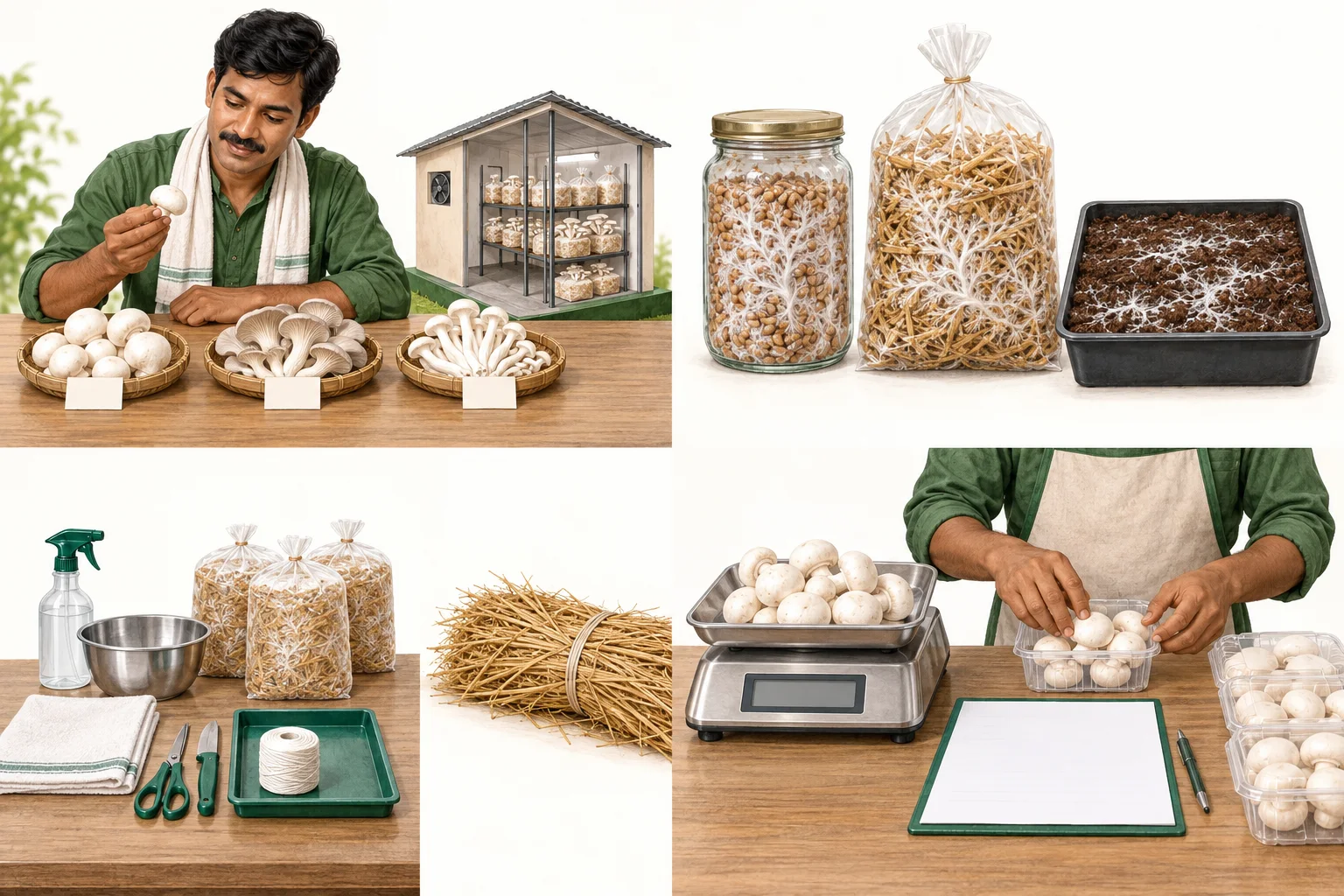
Know the materials
- Notice
- Spawn introduces the fungus; substrate supplies its food.
- Understand
- A spawn bag, a colonised block and a fruiting-ready bag are different purchases.
- Try it
- Ask the supplier which production stage the material has reached.
01A fungus, not a plant
Plants make their own food from sunlight. Fungi cannot. A fungus feeds by pushing thin threads into dead plant material and digesting it from the outside. Wheat straw, paddy straw, sawdust, cow dung: these are its food.
This is why mushroom farming needs no field and no sunlight. It needs a clean growing medium, called the substrate, and a room with the right warmth and moisture. The mushroom on the plate is only a small part of the organism. Most of it stays hidden inside the bag.
The fungus you farm may be eating wheat straw in Haryana, paddy straw in Odisha or sawdust in Himachal. The biology is the same. Only the food changes.
02Mycelium: the hidden body
Mycelium is the network of fine threads through which the cultivated fungus grows in its substrate. Visible white growth is useful to observe, but a white surface alone does not prove uniform colonisation or freedom from contamination.
Spawn run is the colonisation stage. Its duration and environmental requirements depend on the species, strain, substrate and method. The fungus respires and releases heat: a closed cultivation bag does not mean the room needs no ventilation. Follow the validated bag design and incubation protocol, and monitor representative substrate and air conditions.
03The mushroom: a fruiting body
When the mycelium has eaten enough and the surroundings change, cooler air, more fresh air, more moisture and some light, it forms tiny knots called pinheads. Pinheads grow into mushrooms. The mushroom's only job is to release spores, the fungus's dust-like seeds, from the gills under the cap.
Learn the parts: the cap on top, the gills beneath it, the stem that lifts it. Button mushrooms have a veil, a skin that covers the gills while the cap is closed. Paddy straw mushrooms sit in a cup at the base called the volva.
Growers pick before spores fly: button with the veil still closed, paddy straw at the egg stage. Oyster spores can cause allergy, so DMR says open the room two hours before entering and wear a mask.
04Why this changes how you farm
Because your crop is a fungus, four things follow. First, the substrate must be clean, because other fungi and bacteria want the same food. That is what growers call contamination.
Second, the temperature that matters is inside the bag, not on the wall. Third, a mushroom is mostly water, so humidity in the air and gentle handling decide its quality. Fourth, there are no roots. A dry bag cannot be rescued by watering like a pot plant. The water must be in the substrate from the start.
One more word you will hear: flush. A flush is one wave of mushrooms. Bags fruit in several flushes, with rest days in between.
Watch a fungus work this week
- Observe a sealed, labelled spawn bag with your trainer. Identify the mycelium without opening it or deliberately smelling it.
- Take one fresh mushroom apart. Find the cap, gills and stem. On a button, find the veil; on a paddy straw mushroom, the volva.
- Lay a cap gills-down on white paper under a glass overnight. In the morning you will see a spore print.
- Put one thermometer inside a spawned bag and one in the room air. Note the difference morning and evening.
- Write spawn, substrate, mycelium, pinhead and flush in your diary, each with your own one-line meaning.
डायरी में लिखें: Date, spawn source and packing date, visible development through sealed packaging, bag temperature versus room temperature, and the colour of the spore print.
ये गलतियां न करें
- Watering a bag during spawn run as if it were a pot plant; DMR says no water is needed then, and wet bags invite moulds.
- Buying spawn without identity, production and storage records or a supplier-defined use-by period.
- Reading only the wall thermometer; active substrate can be warmer than room air and needs representative monitoring under the strain protocol.
खुद को जांचें
तीन सवाल, तुरंत जवाबWhat is mycelium?
Which stage needs light?
Why must the substrate be clean?
यह संपादकीय स्व-जांच है, प्रमाणपत्र नहीं। जवाब इस डिवाइस पर भी सहेजे नहीं जाते।
शब्दावली
- Fungus
- A living thing that feeds by digesting dead material from outside; neither plant nor animal.
- Mycelium
- The white thread network that is the real body of the fungus.
- Spawn
- Mycelium grown on sterilised grain, used as the seed of a mushroom crop.
- Substrate
- The prepared material the fungus eats: straw, compost or sawdust.
- Flush
- One wave of mushrooms; bags give several flushes with gaps between them.
संदर्भ और आगे पढ़ें
Course completion does not establish practical competence.
संदर्भ खोलें