


कवकजाल, स्पॉन और माध्यम
स्पॉन प्रयोगशाला में अनाज पर उगाया गया कवकजाल है और माध्यम उसका भोजन; दोनों की गुणवत्ता ही फसल तय करती है।
- By the end you can explain what spawn is, how a laboratory makes it, and why it is called seed but is not one.
- By the end you can describe what a good substrate gives the fungus: food, water, air and freedom from competitors.
- By the end you can apply DMR spawn rates by species instead of guessing.
- By the end you can judge spawn and straw with simple farm checks.
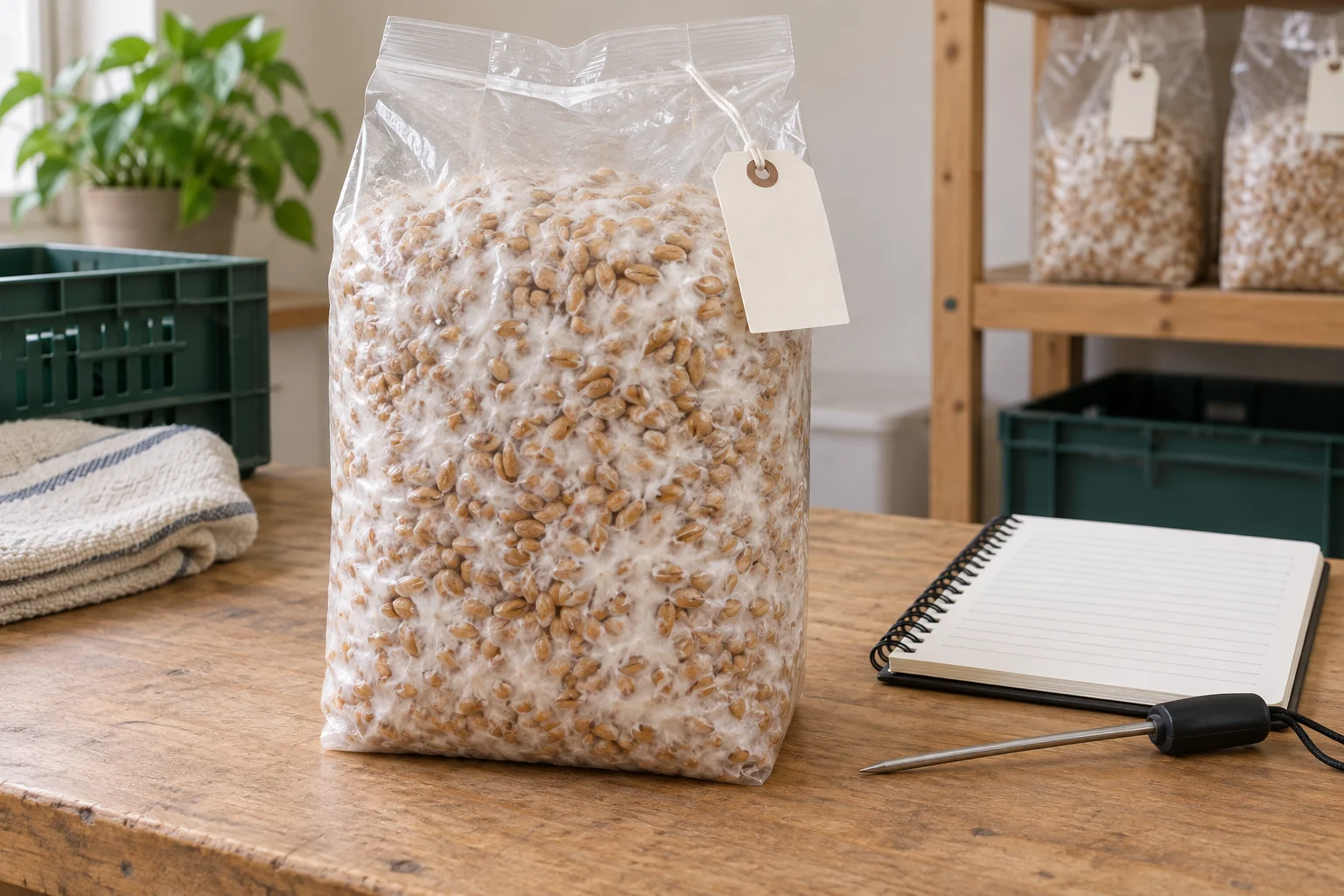
A bag of grain spawn: white mycelium covering every grain is what you are paying for.
- Pure cultureThe laboratory keeps the fungus on agar in a sterile tube.
- Mother spawnCulture is transferred to sterilised grain and incubated.
- Commercial spawnMother spawn is multiplied into the bags or bottles you buy.
- Substrate preparedStraw is chopped, wetted and pasteurised, or compost is made.
- SpawningSpawn is mixed or layered into cooled substrate in a clean room.
- Spawn runMycelium spreads through the bag in the dark until it is white.
ये आंकड़े संबंधित स्रोत और विधि के संदर्भ में हैं। इन्हें हर प्रजाति या फार्म का सार्वभौमिक निर्देश न मानें। पुराने मूल्य वर्तमान बाज़ार भाव नहीं हैं।
Look, explain, then apply
Receiving concept, not a laboratory-production or purity standard. Keep material closed during initial inspection; the blank tag must be replaced by real batch information in practice.
See where this fits in the full workflow →01What spawn is and where it comes from
Spawn is mycelium grown on sterilised grain, usually wheat, in bottles or bags. The grain is only a carrier. The living part is the white mycelium wrapped around each grain.
A laboratory keeps a pure culture of the fungus on a jelly called agar. From that it grows mother spawn on grain, then multiplies it into the commercial spawn you buy. This needs a pressure steriliser called an autoclave and a clean-air cabinet. The MIDH spawn unit norm lists sterilisation, inoculation and incubation rooms, an autoclave and a laminar flow chamber. NHB gives 25 to 27 degrees for incubation and cold storage for finished spawn.
So buy spawn from a laboratory. Kitchen spawn is the commonest source of a failed first crop.
02Judging spawn on arrival
Inspect sealed spawn packaging, its label, lot identity, production date, integrity and visible abnormalities. Appearance alone cannot establish purity or performance. Do not open or deliberately smell suspect spawn; keep it separate and contact the supplier.
Ask for species- and strain-specific storage conditions and the validated use-by period. There is no single age limit or refrigeration rule for all mushroom spawn. Record transport conditions and use the supplier protocol rather than a universal 30-day rule.
03What a substrate must do
The substrate is the food, but it must also hold water, let air in, have the right acidity and be free of competitors.
Water: DMR's straw treatment aims at 65 to 70 percent moisture. The farm test is a squeeze: no drops fall and the palm feels slightly damp. Air: straw is chopped, 2 to 3 cm in the oyster folder or 5 to 10 cm in the manual, so the mycelium can breathe. Acidity: oyster mycelium likes pH 6 to 7, button compost 7.2 to 7.8, shiitake sawdust 5.5 to 6.
Freshness: straw must be dry, this season's, and never rained on. DMR lists old wheat straw and high moisture among the triggers for ink cap weeds.
04Three ways to prepare it, and the spawn rate
Pasteurise for straw mushrooms: hot water at 60 to 65 degrees for 20 to 30 minutes in the oyster folder, or 65 to 70 degrees for one hour in the manual. Sterilise for shiitake and specialty species: bags in an autoclave. Compost for button: weeks of heaps and turnings, then Phase II heat. DMR also describes a chemical steeping method using a fungicide and formalin; label approval changes, so check it and use hot water if unsure.
Spawn rate is spawn weight per substrate weight. DMR: oyster 2 to 3 percent of wet straw, one 300 g bottle for 10 to 12 kg wet straw; milky 4 to 5 percent; button 0.5 to 0.7 percent of compost; shiitake 3 percent of dry weight.
More spawn runs faster and leaves less room for competitors, but costs more.
Spawn and straw checks before your first batch
- Ask two laboratories for a quote. Note species, strain, packing date, how they store it and how it will travel.
- On arrival, inspect sealed packaging, identity, age under the supplier protocol and visible abnormalities. Quarantine suspect material and contact the supplier.
- Weigh 1 kg of dry straw, soak it, drain it and weigh it again to learn how much water your straw takes.
- Do the squeeze test after draining and write down what you felt.
- Calculate spawn needed for your batch from the DMR rate for your species.
- Store spawn cool and use it within a week.
डायरी में लिखें: Laboratory name, strain, packing date, condition on arrival, straw dry and wet weight, and your squeeze-test verdict.
ये गलतियां न करें
- Using old or patchy spawn to save money; a weak run gives competitors weeks to take over the bag.
- Over-wet straw that drips when squeezed; it turns airless and sour and the mycelium stalls.
- Skipping or shortening heat treatment because the fire was slow; under-treated straw is the commonest cause of green mould.
खुद को जांचें
तीन सवाल, तुरंत जवाबSpawn is
DMR's oyster spawn rate is
The squeeze-test result you want is
यह संपादकीय स्व-जांच है, प्रमाणपत्र नहीं। जवाब इस डिवाइस पर भी सहेजे नहीं जाते।
शब्दावली
- Spawn
- Mycelium grown on sterilised grain; the seed material of a mushroom crop.
- Mother culture
- The pure fungus kept on agar in a laboratory, from which all spawn descends.
- Pasteurisation
- Heating straw enough to kill most competitors while keeping helpful microbes.
- Sterilisation
- Killing every living thing in the substrate, usually in an autoclave under pressure.
- Spawn rate
- Weight of spawn added per weight of substrate, stated on a wet or dry basis.
संदर्भ और आगे पढ़ें
Course completion does not establish practical competence.
संदर्भ खोलें