


कम्पोस्ट समस्या निवारण
पहले चरण, फैलाव और हाल का बदलाव लिखें, फिर एक ही लक्षण के कई संभावित कारण सूचीबद्ध करके अगली माप तय करें, दवा नहीं।
- By the end you can describe a symptom by stage, pattern and recent change.
- By the end you can list competing causes instead of one favourite.
- By the end you can choose the next measurement before any corrective action.
लक्षण से कारण तक
पहली नज़र, निदान नहीं। स्रोत: ICAR-DMR मैनुअल और रोग बुलेटिन।
| क्या दिखता है | संभावित कारण | पहला कदम |
|---|---|---|
| लंबी डंडी, छोटे कैप | CO₂ ज़्यादा (1,500 ppm से ऊपर) | ताज़ी हवा बढ़ाएं |
| कम्पोस्ट पर हरे धब्बे | ट्राइकोडर्मा; कम pH या बची अमोनिया | अलग करें, हटाएं; अगला बैच जांचें |
| केसिंग के बाद पिन नहीं | ठंडा और हवादार नहीं किया | 16 से 18 °C, हवा दें |
| कैप पर भूरे धंसे धब्बे | बैक्टीरियल ब्लॉच; गीले कैप | सतह सुखाएं, नमी 85% से कम |
| सफेद गीली गांठें | वेट बबल, केसिंग से | नमक से ढकें, हटाएं; केसिंग को भाप दें |
| छोटी मक्खियां | सियारिड/फोरिड | जाली, लाइट ट्रैप, स्वच्छता |
ये आंकड़े संबंधित स्रोत और विधि के संदर्भ में हैं। इन्हें हर प्रजाति या फार्म का सार्वभौमिक निर्देश न मानें। पुराने मूल्य वर्तमान बाज़ार भाव नहीं हैं।
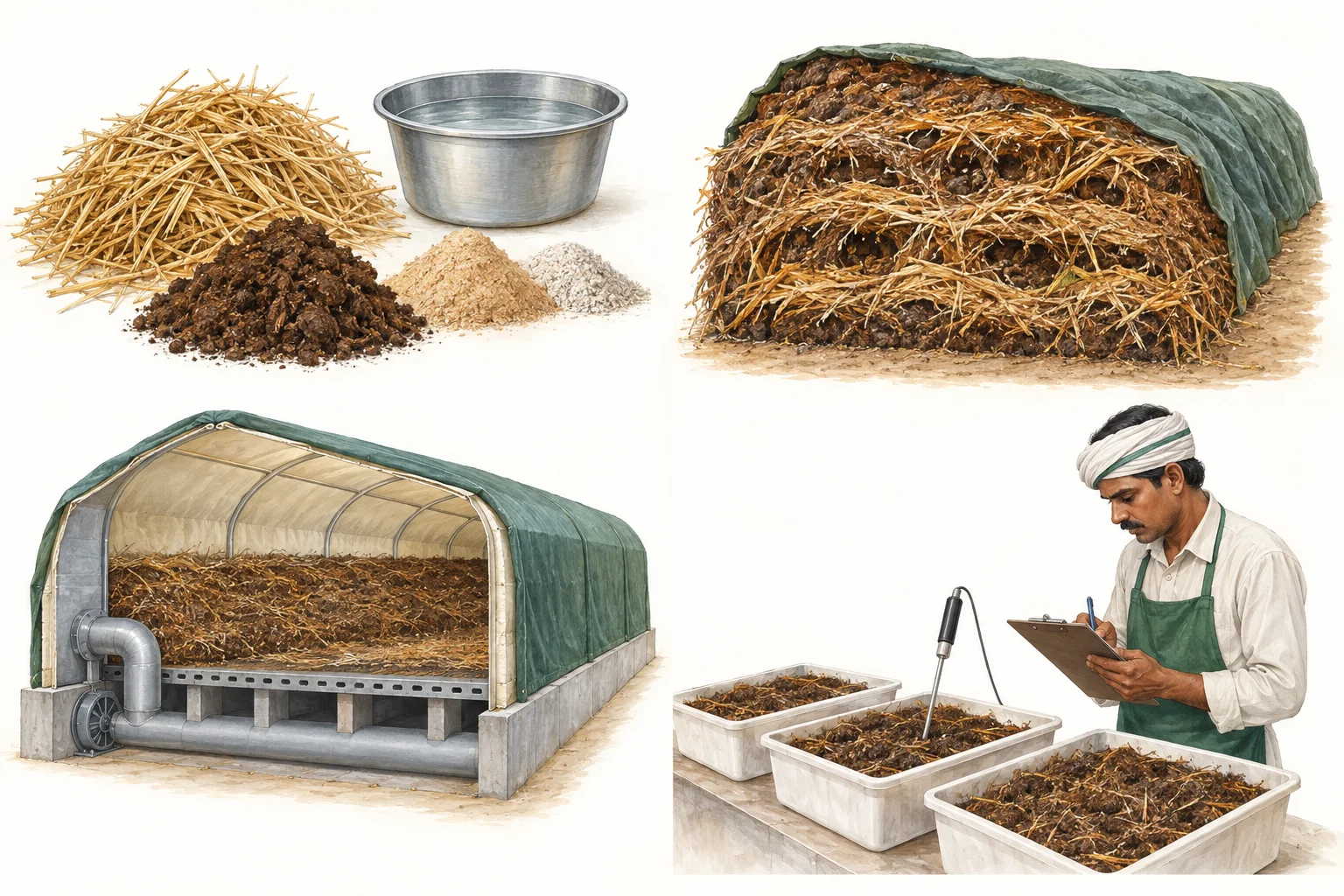
Release with evidence
- Notice
- The batch record brings measurements and observations together.
- Understand
- The calendar alone cannot prove compost is ready for spawning.
- Try it
- Hold unresolved batches for a competent release assessment.
01Describe before you diagnose
Three facts come before any cause. Which stage is this: pre-wetting, Phase I, Phase II, or after release? What is the pattern: the whole mass, one end, the top layer, or the zone beside the door? And what changed: a new straw lot, a different manure supplier, unseasonal rain, a fan that was repaired last week.
Write those three down while the batch is in front of you. A symptom described only as compost is bad cannot be investigated next month, and most compost problems are only understood by comparing several batches.
02List competing causes
Take a heap that will not heat. DMR reports that below 1.5 percent nitrogen the material is not properly fermented and the heap may not pass 55 to 60 °C, and it sets a minimum base batch of 300 kg because small heaps lose heat too fast. The heap may also be too wet and airless, or genuinely too dry.
Each of those causes predicts something else you can check. Low nitrogen means the formulation record will show it. Too wet means leachate at the base and a sour smell. Too small means the outside is cool but the very core is warm. Go and look for what you should not find.
- Nitrogen too low
- Too wet and airless
- Batch too small
- Too dry
03Let the numbers name the domain
Several Indian figures act as boundaries, and crossing one points at a domain. Compost above 72 percent moisture cannot aerate properly, turns airless and invites brown and white plaster moulds. NHB links compost below 64 percent, under wet casing, to weeper mushrooms.
Outside pH 7.2 to 7.8 the mycelium slows and white plaster mould may invade. Above 60 °C at pasteurisation DMR warns that the useful thermophilic fungi die and olive green mould follows. Ink caps and Oedocephalum point back at ammonia and nitrogen. The symptom does not prove the cause, but it tells you which measurement to take next.
04Measure next, do not spray next
Compost problems are process problems. No spray corrects moisture, pH, nitrogen or air distribution, and anything applied on a mushroom farm must be checked against its current label approval and state rules before use, not chosen from an old note book.
So the next step after a diagnosis is a measurement, not a chemical. Change one thing in the limiting domain, record what you changed and why, then look for the response in the same measurement. If the response does not come, your cause was wrong and the record you kept is what lets you say so.
Run one structured investigation
- Write the symptom as stage, pattern and what changed recently.
- List three causes that could each produce that exact symptom.
- For each cause, write what you would expect to find if it were true.
- Take that measurement first, then change one thing and watch it.
डायरी में लिखें: Symptom description, the competing causes, the evidence found and missing, the change made and the response.
ये गलतियां न करें
- Naming one cause immediately, then fixing it every batch whether or not it was there.
- Changing three things at once, so no response can be linked to any of them.
- Reaching for a chemical for what is a moisture, nitrogen or airflow problem.
खुद को जांचें
तीन सवाल, तुरंत जवाबA heap will not heat. The first step is to:
DMR sets a minimum base batch of:
Negative evidence means:
यह संपादकीय स्व-जांच है, प्रमाणपत्र नहीं। जवाब इस डिवाइस पर भी सहेजे नहीं जाते।
शब्दावली
- Pattern
- Where a symptom appears: whole mass, one end, top layer or one zone.
- Negative evidence
- A sign that a suspected cause would produce, which you cannot find.
- Limiting domain
- The one part of the process that is actually holding the batch back.
संदर्भ और आगे पढ़ें
A lesson cannot replace batch measurements or plant-specific procedures.
संदर्भ खोलें