


प्रजाति और बाज़ार का मेल
पहले अपने ज़िले के खरीदार देखें, फिर प्रकाशित तापमान सीमा और फसल चक्र के अनुसार एक ही प्रजाति चुनें।
- By the end you can shortlist species using published temperature bands for your season.
- By the end you can say which species your district's buyers already handle.
- By the end you can explain why two ICAR-DMR documents give different months for one crop.
Choosing a species is a sequence of tests, and the market test comes first.
- List local buyersName, weekly quantity, grade and rate per species sold.
- Read your own climateDaily high and low at your site, not a state average.
- Match the published bandsKeep species whose fruiting band overlaps your season.
- Check the cycle lengthCan you fund two cycles before the first payment lands?
- Choose one speciesWrite the reason and the evidence beside the choice.
ये आंकड़े संबंधित स्रोत और विधि के संदर्भ में हैं। इन्हें हर प्रजाति या फार्म का सार्वभौमिक निर्देश न मानें। पुराने मूल्य वर्तमान बाज़ार भाव नहीं हैं।
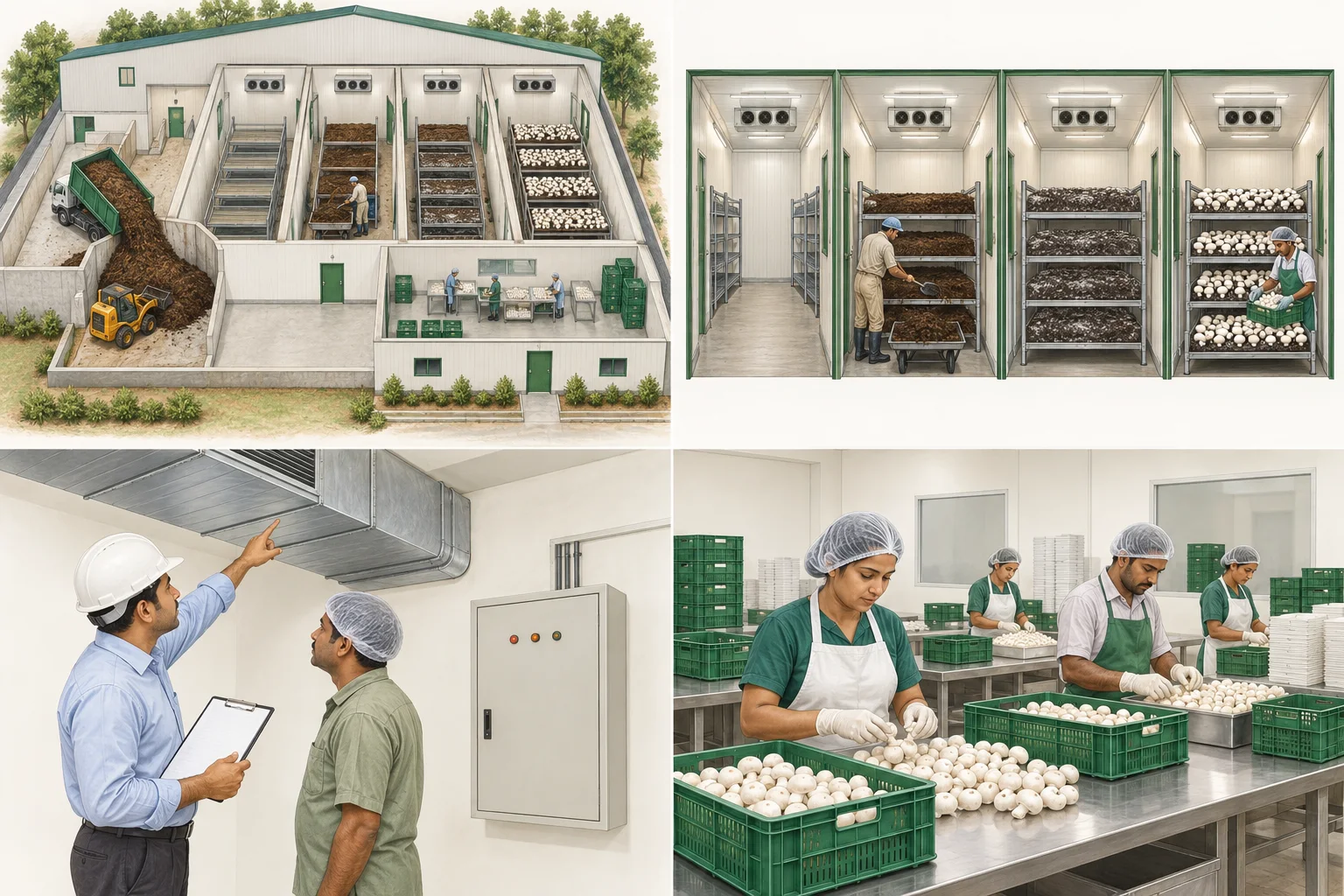
See the whole operation
- Notice
- Receiving, growing, packing and dispatch need coordinated space.
- Understand
- Capacity is a whole-farm outcome, not just the number of racks.
- Try it
- Define the incoming compost stage and the product buyers will accept.
01Buyer first, then species
A commercial plan that begins with a species is a plan looking for a market. Turn it around. Walk the mandi, the cold store and two hotels, and write which mushrooms already move there, in what pack and at what rate.
If only button mushroom sells in your town, an oyster plan must include the cost of creating demand, and that cost belongs in the project. If milky mushroom already arrives from a neighbouring district each summer, you have a price benchmark and a competitor.
Write one line per species: who buys it here, how much weekly, at what grade.
02Temperature decides what is possible
ICAR-DMR's species table gives the bands that matter. White button fruits at 14 to 18 °C after a spawn run at 22 to 25 °C. Pleurotus florida fruits at 18 to 22 °C while Pleurotus sajor-caju fruits at 22 to 26 °C. Milky mushroom fruits at 30 to 35 °C and paddy straw mushroom at 28 to 32 °C.
Compare those bands with your district month by month. Where band and season overlap, the crop is possible in a simple room. Where they do not, every degree of difference has to be bought with insulation and power.
03Season and region, with the sources named
DMR's seasonal folder gives the plains calendar: white button November to February, oyster September to May, milky February to April and July to September, paddy straw July to September. In the mid hills oyster runs all year and button runs September to March.
The documents do not always agree. That folder starts button in November, while the 2011 manual's round the year chapter says October to February. Treat the one month as the margin of the estimate and settle it with your own weather record.
Coastal states can grow oyster, paddy straw and milky mushroom naturally all year.
04Cycle length is a cash decision
Species differ in how long your money stays locked up. ICAR-DMR gives 45 to 60 days from dry straw to fresh oyster mushrooms, and 80 to 100 days for button including compost preparation. The paddy straw bulletin finishes a whole cycle in 4 to 5 weeks.
A short cycle returns cash sooner and lets you correct mistakes sooner, which matters most in year one. A long cycle may carry a better price but needs deeper working capital and a colder room.
For a first project, one species at a cycle you can fund twice over beats three at once.
District species scan
- Record arrivals and rates for each mushroom species at your nearest mandi for a week.
- Write your site's highest and lowest temperature each day for the same week.
- Mark which published fruiting bands your week actually falls inside.
- Shortlist two species and name the buyer who would take each one.
डायरी में लिखें: Species, buyer, weekly quantity, rate, your temperature range, fruiting band, cycle length.
ये गलतियां न करें
- Choosing a species from a video and only then looking for a buyer.
- Using a state average temperature instead of the reading inside your own shed.
- Starting three species in year one, so no record is clean enough to learn from.
खुद को जांचें
तीन सवाल, तुरंत जवाबYour site runs at 30 to 34 °C in July. Which species fits without cooling?
DMR documents give the button season in the plains as:
Which crop returns cash fastest?
यह संपादकीय स्व-जांच है, प्रमाणपत्र नहीं। जवाब इस डिवाइस पर भी सहेजे नहीं जाते।
शब्दावली
- Fruiting band
- The temperature range in which a species forms mushrooms.
- Crop cycle
- Days from substrate preparation to the last pick.
- Species table
- ICAR-DMR's list of spawn run and fruiting temperatures.
संदर्भ और आगे पढ़ें
Outputs are scenarios from explicit assumptions, not forecasts.
संदर्भ खोलें