


ढाँचा, जलवायु और बिजली
पहले तय करें कि कमरे को कौन सा तापमान, नमी और हवा बनाए रखनी है, उसके बाद ही भवन और उपकरण तय करें।
- By the end you can write a design brief in temperature, humidity and air terms.
- By the end you can say what a power failure does to your crop within hours.
- By the end you can place hygiene decisions on the site plan, not in a spray schedule.
Design outward from the crop's conditions to the services that deliver them.
- Write the bandsTemperature, humidity and air for each stage of your species.
- Measure the gapCompare the bands with your hottest and coldest months.
- Size the servicesCooling, humidification, ventilation and steam follow from that gap.
- Plan the failureWhat happens in the first four hours without power.
- Lay out for hygieneClean and dirty routes, screens, spent compost pit away from fresh.
ये आंकड़े संबंधित स्रोत और विधि के संदर्भ में हैं। इन्हें हर प्रजाति या फार्म का सार्वभौमिक निर्देश न मानें। पुराने मूल्य वर्तमान बाज़ार भाव नहीं हैं।
Check performance
- Notice
- Installed equipment must be checked against an agreed operating brief.
- Understand
- A component list is not proof of loaded-room performance.
- Try it
- Agree measurements, load conditions and acceptance tests before ordering.
01Start from the conditions, not the drawing
Write what the room must hold before anyone draws it. For white button, ICAR-DMR's species table gives a spawn run at 22 to 25 °C and fruiting at 14 to 18 °C. NHB's model DPR warns that temperatures above 26 to 27 °C during spawn run and after casing should be avoided, and cropping kept below 18 °C.
That is your design brief. In a plains summer it means removing a lot of heat every hour. In the mid hills, almost none.
The gap between your climate and those bands is what the equipment closes.
02Air is a service, not an afterthought
Mushrooms take in oxygen and give out carbon dioxide, so fresh air is part of the crop, not a comfort. ICAR-DMR specifies six air changes per hour through the first two flushes, when carbon dioxide output peaks.
Air costs energy twice: to move it, and to cool and humidify it. A room designed only for temperature gives long stalked mushrooms with small caps, and the grower usually blames the spawn.
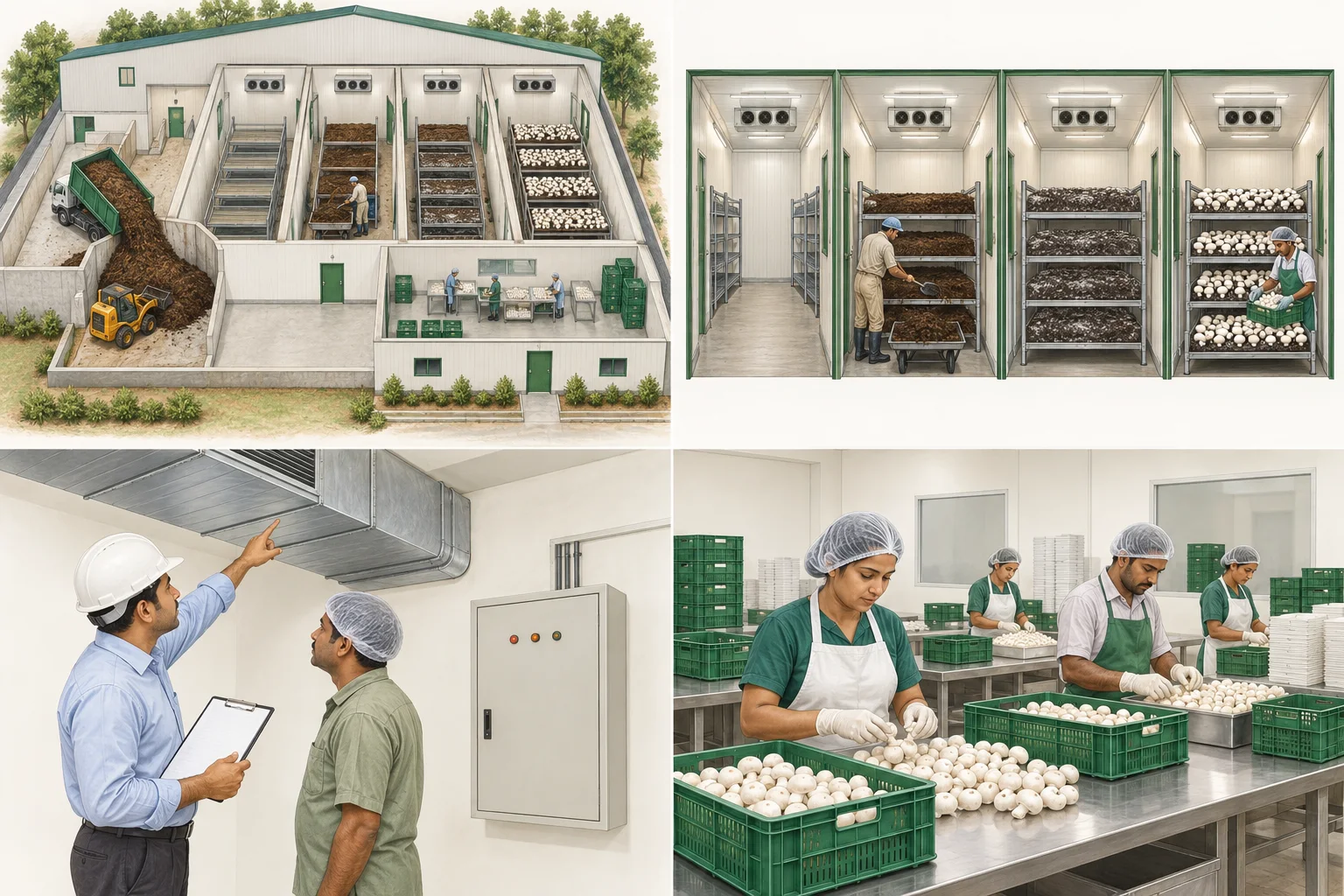
Settle the air path on the drawing: where fresh air enters, how it is filtered, how it reaches the far end, and where it leaves.
03Power, water and the hours you will not have them
Ask for the real supply position at the site: hours of grid supply, voltage stability and the longest recent outage. The design must survive the worst of those, not the average.
A band of 14 to 18 °C has very little room in it. When power stops, the room drifts towards outside temperature within hours, and NHB's ceiling of 26 to 27 °C can be crossed in a plains summer before a generator is arranged.
Water is the quieter constraint. Pasteurisation, humidification and washing all need it daily, at pressure, without interruption.
04Hygiene is built, not sprayed
Several hygiene decisions are taken at the drawing stage. NHB's DPR asks for doors and ventilators screened with nylon net of 35 mesh or finer. It asks that spent compost go into a pit covered with at least 10 cm of manure so flies cannot breed.
It also describes an end of crop cook out at 70 °C for 12 hours, so the steam plant must be sized for it and the room must tolerate it.
A site plan that puts the spent compost pit beside the fresh compost yard cannot be fixed later with any chemical.
Site brief in one page
- Write the temperature and humidity band for each stage of your species.
- Record your site's hottest and coldest month from your own readings.
- Ask the power supplier for supply hours and last year's longest outage.
- Draw clean and dirty routes on the site plan and mark where spent compost goes.
डायरी में लिखें: Stage bands, site extremes, supply hours, longest outage, water source, waste location.
ये गलतियां न करें
- Ordering equipment before writing the bands it has to hold.
- Designing for the average day and losing a crop on the hottest week.
- Placing the spent compost pit upwind of the cropping rooms to save a walk.
खुद को जांचें
तीन सवाल, तुरंत जवाबNHB's model DPR says spawn run and post casing temperature should avoid:
Long stalks with small caps most often point to:
Screening doors and ventilators with 35 mesh net is:
यह संपादकीय स्व-जांच है, प्रमाणपत्र नहीं। जवाब इस डिवाइस पर भी सहेजे नहीं जाते।
शब्दावली
- Air change
- One full replacement of the room's air with fresh air.
- Cook out
- Heating spent compost to kill pests and disease.
- Design brief
- The written conditions a building must deliver.
संदर्भ और आगे पढ़ें
Outputs are scenarios from explicit assumptions, not forecasts.
संदर्भ खोलें