


बटन मशरूम की मूल बातें
बटन मशरूम की खेती कम्पोस्ट, बीजाई, केसिंग और तापमान की कड़ियों से बनी व्यवस्था है, जिसमें कम्पोस्ट भोजन देता है और केसिंग फलन का संकेत।
- By the end you can name the stages of the button crop in order and say what each does.
- By the end you can explain what compost does and what casing does.
- By the end you can state the two temperature bands and match each to its stage.
बटन मशरूम फसल चक्र
A button flush on casing soil: compost below is the food, soil on top is the trigger.
- CompostDay 0Pasteurised, ammonia below 10 ppm
- Spawn run12-15 days22-25 °C in the dark
- CasingDay 153-4 cm layer, pH 7-7.5
- Case run7-10 daysMycelium reaches the surface
- PinningDay 25Air the room, 15-18 °C
- FlushesDay 32-70Three flushes, 7-10 days apart
ये आंकड़े संबंधित स्रोत और विधि के संदर्भ में हैं। इन्हें हर प्रजाति या फार्म का सार्वभौमिक निर्देश न मानें। पुराने मूल्य वर्तमान बाज़ार भाव नहीं हैं।
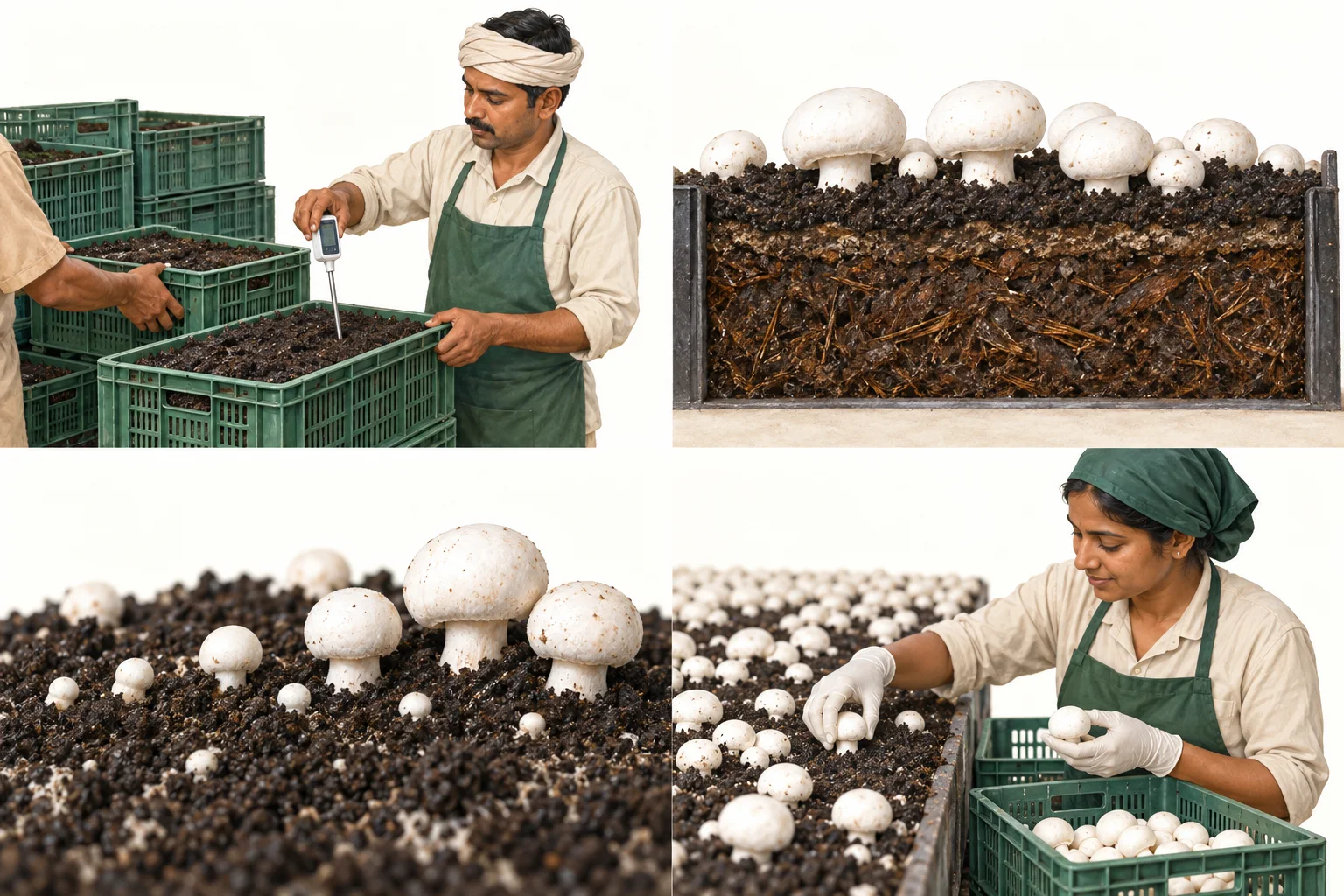
Receive the right compost
- Notice
- The delivered compost stage determines the work still needed.
- Understand
- Phase II and Phase III deliveries require different handovers.
- Try it
- Check the batch identity, supplied stage and release evidence.
01What you are growing
Agaricus bisporus, the white button mushroom, is a fungus. It has no roots or leaves. Its body is a web of fine white threads called mycelium, and what you sell is its fruit body.
In nature it lives on rotted horse manure and straw and cannot digest fresh straw. So the grower first ferments straw and manure into compost the fungus can eat and its competitors cannot. Then the grower adds a moist soil layer, the casing, because casing supports reliable commercial fruiting. Everything else on the farm serves those two facts.
02The stage ladder
The crop climbs fixed rungs. Phase I ferments raw straw. Phase II pasteurises it and clears ammonia. Spawning mixes in grain coated with mycelium. Spawn run is the 12 to 14 days in which mycelium fills the compost. Casing lays 3 to 4 cm of soil on top. Case run lets mycelium climb into that soil, about a week. Pinning is when the grower changes the room and pinheads appear. Cropping is the weeks of picking, in waves called flushes.
ICAR-DMR gives a duration for each rung but no single day count from spawning to last flush. Learn the ladder, not a total.
03Two temperatures, two jobs
The fungus wants warmth to spread and cool to fruit. ICAR-DMR's species table puts spawn run at 22 to 25 °C and fruiting at 14 to 18 °C. Hold the first band until the compost is colonised, then move the room into the second.
The drop is not a small adjustment. With fresh air and lower carbon dioxide it is the signal that tells mycelium to stop spreading and start fruiting. A seasonal grower in the plains gets that drop from winter itself. A controlled farm buys it from a cooling unit. Both are managing the same biology.
04Compost is food, casing is a trigger
New growers treat casing as a second layer of food. It is not. Compost carries the carbon and nitrogen the mycelium eats. Casing carries almost none: it holds water, lets carbon dioxide escape, and its surface is where pins form.
So a farm can have good compost and no crop when the casing is too dry, too wet or diseased. And good casing gives a poor crop when the compost was spawned with ammonia still in it. Yield is counted per 100 kg of compost because compost is the input everything else scales from.
Walk one grow room and name its stage
- Visit any button unit with a notebook and a thermometer.
- Look at one bag: dark compost is early spawn run, light brown with white threads means the run is complete, soil on top means cased, pins mean pinning.
- Read the air temperature and write which band it sits in.
- Ask the days since spawning and casing, compare with the 12 to 14 day and 7 day rungs, and note what does not fit.
डायरी में लिखें: Date, room, days since spawning and casing, air temperature, the stage you judged, what did not fit.
ये गलतियां न करें
- Treating the crop as one process, so a Phase II fault gets blamed on the room.
- Keeping the room warm after casing, so the crop never gets its fruiting signal.
- Comparing your yield per bag with a neighbour's yield per 100 kg compost.
खुद को जांचें
तीन सवाल, तुरंत जवाबWhat is the main job of the casing layer?
A room reads 24 °C and the bags are dark brown with a few white threads. Which stage?
Why is yield quoted per 100 kg of compost?
यह संपादकीय स्व-जांच है, प्रमाणपत्र नहीं। जवाब इस डिवाइस पर भी सहेजे नहीं जाते।
शब्दावली
- Mycelium
- The white thread-like body of the fungus that grows through compost and casing.
- Spawn
- Sterilised grain colonised by mycelium, the seed of the crop.
- Flush
- A wave of mushrooms maturing together; a crop gives several.
संदर्भ और आगे पढ़ें
Operating values require stage, strain, sensor and production-system context.
संदर्भ खोलें