


ढींगरी मशरूम की प्रजाति का चुनाव
इस पाठ में आप अपने क्षेत्र, मौसम और कमरे के तापमान के अनुसार ढींगरी की सही प्रजाति चुनना सीखते हैं।
- By the end you can name the main Pleurotus species grown in India and their fruiting bands.
- By the end you can place an oyster crop in the DMR calendar for your region.
- By the end you can decide seasonal or controlled before buying spawn.
पांच मशरूम एक नज़र में
हरी पट्टी = फलन का तापमान। स्रोत: ICAR-DMR मौसमी फोल्डर और मैनुअल।
ये आंकड़े संबंधित स्रोत और विधि के संदर्भ में हैं। इन्हें हर प्रजाति या फार्म का सार्वभौमिक निर्देश न मानें। पुराने मूल्य वर्तमान बाज़ार भाव नहीं हैं।
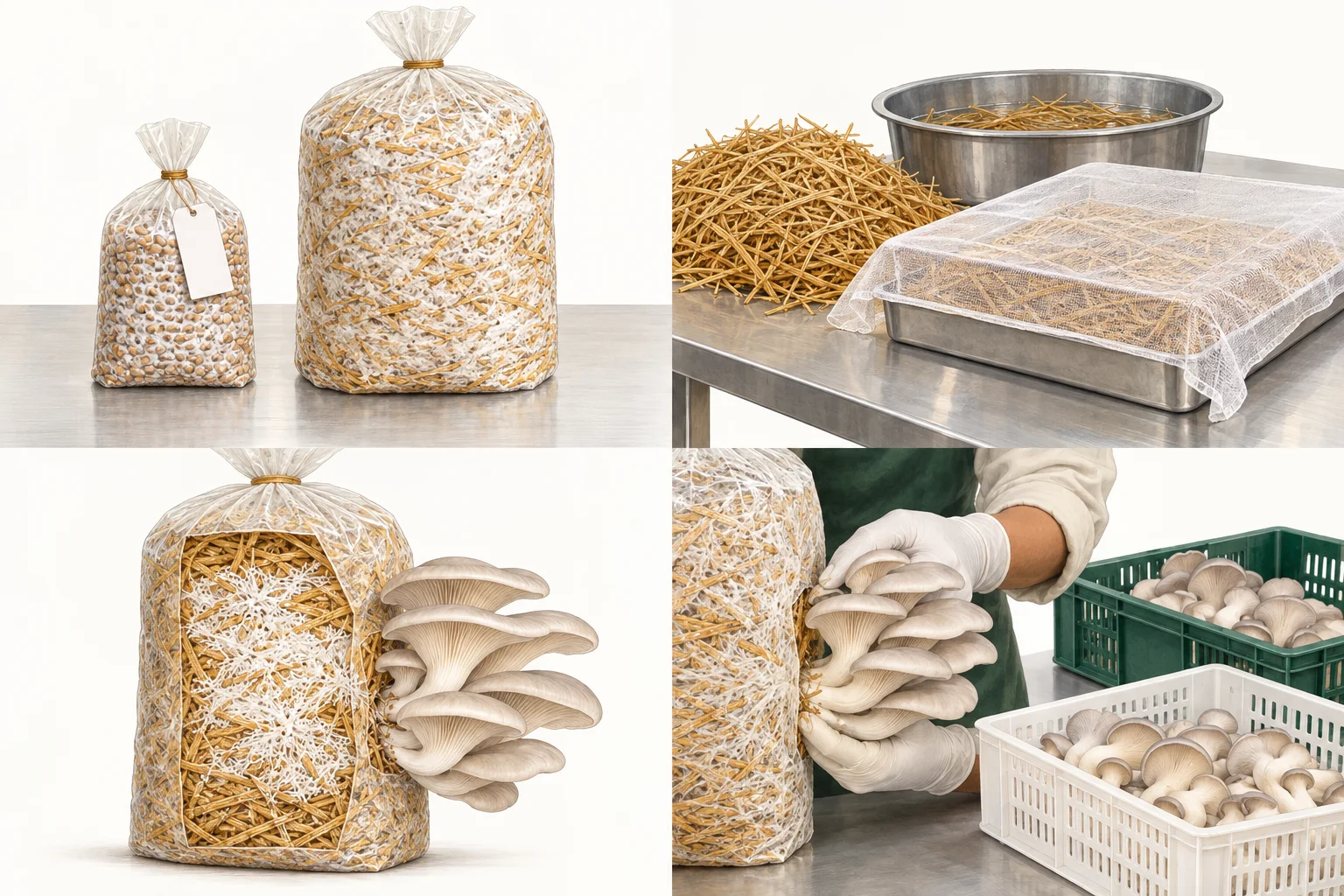
Choose your starting point
- Notice
- Buying spawn and buying a prepared bag leave different tasks on your farm.
- Understand
- Bag production adds preparation, treatment and clean inoculation work.
- Try it
- Choose the production boundary and confirm the exact species and strain.
01Dhingri is a family, not one mushroom
Oyster mushroom, dhingri in Hindi, is the common name for a group of fungi in the genus Pleurotus. Each species has its own fruiting temperature, the air temperature at which mushroom bodies form on the bag.
ICAR-DMR sorts them into two groups. Winter or low temperature species fruit at 10-20 C: Pleurotus ostreatus, P. florida, P. eryngii, P. fossulatus and P. cornucopiae. Summer or moderate temperature species fruit at 16-30 C: P. flabellatus, P. sapidus, P. citrinopileatus and P. sajor-caju.
So the first question is not 'how do I grow oyster' but 'which oyster, in which month, in which room'.
02Read the DMR temperature table
DMR's species table gives two numbers per species: the spawn-run temperature, when white mycelium spreads through the straw, and the fruiting temperature.
P. florida runs at 25-30 C and fruits at 18-22 C. P. sajor-caju runs at 25-32 C and fruits at 22-26 C. P. flabellatus runs at 25-30 C and fruits at 22-26 C. P. eryngii, the Kabuli dhingri, runs at 18-22 C and fruits at 14-18 C.
These are source-specific examples, not a universal relationship between stages. Match the supplier's strain protocol to the measured room conditions. Active substrate can differ from room air; measure both instead of assuming a fixed temperature offset.
03Season by region in India
The DMR seasonal folder gives a calendar. On the north Indian plains dhingri grows from September to May. In the mid-hills it grows all year. In the high hills it grows from May to August. Coastal states can grow oyster, paddy straw and milky mushroom in the natural climate all year; central and western India can grow dhingri in every season except summer.
Within that calendar, switch species. The oyster folder says: in summer grow P. sajor-caju, P. flabellatus, P. sapidus, P. djamor or P. citrinopileatus; in winter, when air falls below 20 C, choose P. florida or P. cornucopiae.
04Colour, grade and the unit you build
Temperature also sets colour. DMR reports P. florida caps light brown at 10-15 C but white to pale yellowish at 20-25 C; P. sajor-caju at 15-19 C is white with high dry matter, at 25-30 C brown with less. Below 100 lux of light caps go pale yellow; in bright light dark brown. Buyer preferences vary with market and product. Agree colour, cluster size and maturity with the intended buyer instead of assuming all buyers want white mushrooms.
Then settle the unit. A seasonal room follows the weather and changes species by season. A controlled room holds one band all year at much higher cost. The folder says an 18 x 15 x 10 foot room holds about 300 bags; start with one room and one species.
Match a species to your next three months
- Hang a min-max thermometer at bag height and record the room's high and low daily for a week.
- Pick a species whose DMR fruiting band sits inside that range on most days.
- Ask the supplier for species, strain, batch date, storage conditions and the stated use-by guidance. Resolve condition or handling concerns before accepting the lot; do not impose a universal age limit across products.
- If the room cannot hold the band, change species with the season or plan cooling first.
डायरी में लिखें: Species, strain, spawn date, daily high and low at bag level, date of first pinheads.
ये गलतियां न करें
- Buying oyster spawn without identifying species and strain; the chosen crop may not suit the measured room conditions.
- Reading temperature at the door; bags run 2-4 C warmer than room air.
- Copying a Coimbatore calendar in Solan; DMR's calendar changes with region.
खुद को जांचें
तीन सवाल, तुरंत जवाबA room reaches 28 C, but a source gives a candidate strain a 22-26 C fruiting band. What can you conclude?
P. florida grown at 10-15 C gives caps that are:
DMR's oyster months on the north Indian plains are:
यह संपादकीय स्व-जांच है, प्रमाणपत्र नहीं। जवाब इस डिवाइस पर भी सहेजे नहीं जाते।
शब्दावली
- Pleurotus
- The genus of all oyster mushrooms; each species has its own temperature needs.
- Fruiting temperature
- Air temperature range in which a species forms mushrooms.
- Spawn run
- The weeks when mycelium grows through the straw before mushrooms appear.
- Seasonal unit
- A room without cooling that follows the outside weather.
संदर्भ और आगे पढ़ें
Species, strain, climate and production method must remain explicit.
संदर्भ खोलें