


आमदनी, लागत और प्रति किलो लागत
एक चक्र के सभी बिलों को तीन परतों में बाँटकर बिकी हुई मात्रा से भाग दें, तभी प्रति किलो असली लागत सामने आती है।
- By the end you can tell receipts apart from what is actually left over.
- By the end you can place every bill of a cycle into one of three cost layers.
- By the end you can work out cost per kilogram and say which assumption moves it most.
उदाहरण: छोटे बटन फार्म का पहला साल
दो कमरों वाली खरीदी हुई कम्पोस्ट की इकाई के अनुमानित हिस्से। आपका कोटेशन और खरीदार असली आंकड़े तय करते हैं।
ये आंकड़े संबंधित स्रोत और विधि के संदर्भ में हैं। इन्हें हर प्रजाति या फार्म का सार्वभौमिक निर्देश न मानें। पुराने मूल्य वर्तमान बाज़ार भाव नहीं हैं।
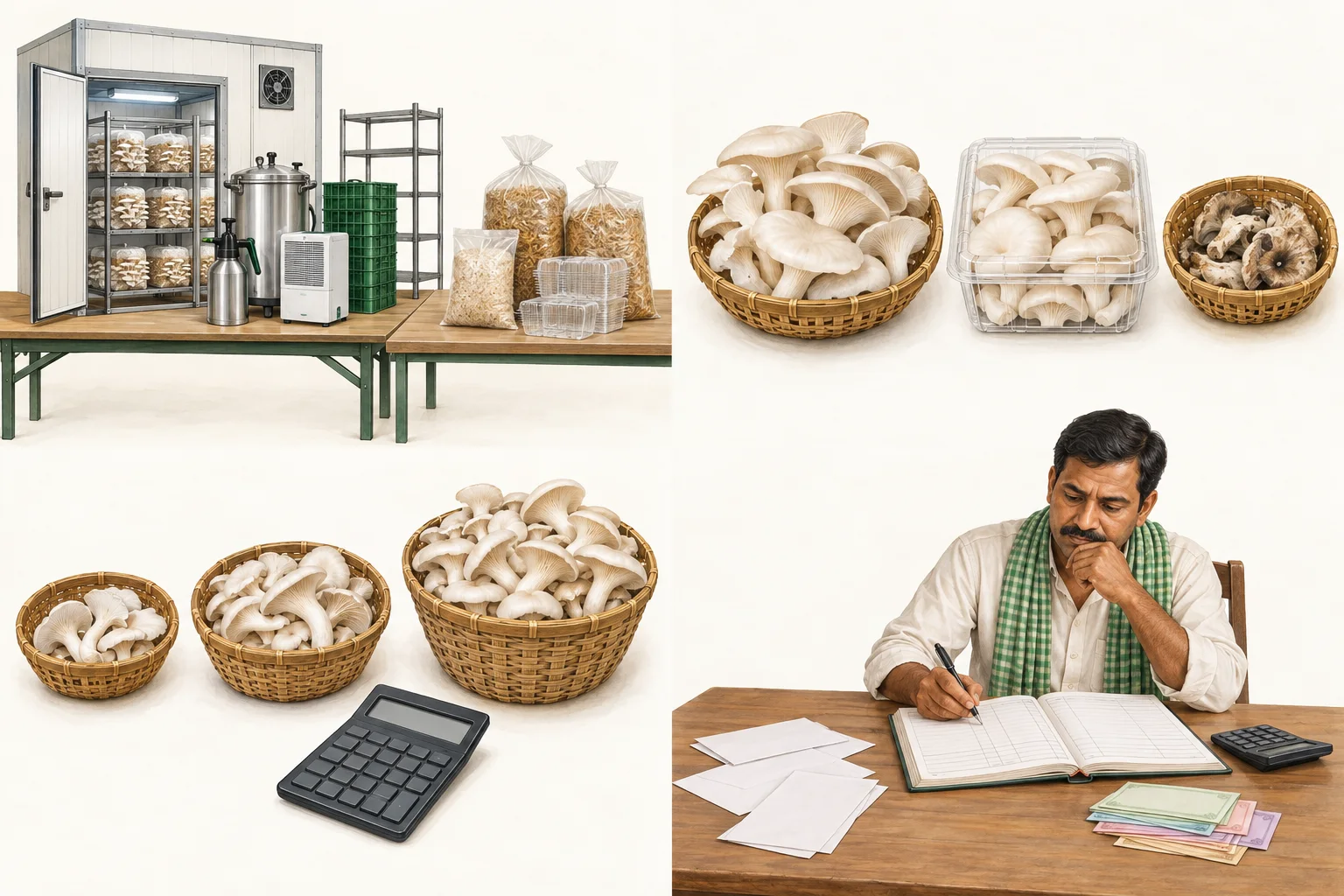
Harvest is not all sold
- Notice
- Harvested, sold and rejected quantities are different records.
- Understand
- Only accepted sales support the sales calculation.
- Try it
- Weigh each destination and keep buyer deductions visible.
01Receipts are not profit
Money reaching your hand is a receipt. Profit compares recognised revenue with the applicable costs; the timing of payment is a separate cash-flow question.
For sales, record kilograms accepted by the buyer and the agreed price for each grade. Unsold and rejected kilograms do not become sales merely because they were harvested. Record buyer deductions separately. For cash flow, record what has actually been collected and what remains owed.
To compare net realisation per kilogram, state which selling expenses you deduct, such as commission, packing or transport, then divide the resulting amount by the corresponding sold kilograms. Do not deduct those same expenses again when calculating profit. Compare your asked price, invoiced value, selling expenses and receipts without treating them as the same figure.
02The three cost layers
Costs behave differently in time, so group them before adding them. Some are consumed in every cycle. Some are spent every cycle but do not rise and fall with substrate. Some run all year whether or not a crop is inside.
Put every bill from one finished cycle into one of the three layers below. A cost you cannot place is usually one you forgot to plan for.
- Consumed each cycle: compost or straw, spawn, casing soil, bags, treatment materials.
- Spent each cycle: labour, power, fuel, water, packing, transport, market commission.
- Running all year: rent, depreciation on rooms and racks, loan interest, your own salary.
03Cost per kilogram and its denominator
Label both the cost boundary and denominator. Cost per harvested kilogram measures production; cost per sold kilogram also reflects unsold and rejected product. Payment collection is a separate cash-flow measure.
Keep harvested, saleable, sold and rejected quantities distinct, and record invoices and collections separately. A buyer paying late changes working-capital needs, not the number of kilograms that were grown.
04A published model figure is not your figure
ICAR-DMR's Hindi farmer folders print a cost of production of about Rs 20 to 25 per kg for seasonal white button and Rs 10 to 15 per kg for oyster. Those folders are undated and carry early 2010s prices.
Historical figures do not establish current costs or the relative profitability of different crops. Use current quotations and measured local performance; do not submit historical prices as a current bank estimate.
Your own figure comes from one completed cycle with every bill kept. Until that cycle is finished, label the number plainly: assumed, not measured.
Cost sheet for one finished cycle
- Keep every bill of one cycle in one envelope, including family labour at the local wage.
- Sort the bills into the three layers and total each layer.
- Write kilograms picked, kilograms sold and rupees actually received.
- Divide total cost by kilograms sold, then again by kilograms picked, and compare.
डायरी में लिखें: Cycle number, dates, layer totals, kg picked, kg sold, rupees received, both cost figures.
ये गलतियां न करें
- Treating sale receipts as profit, so the cycle looks good until the spawn bill arrives.
- Leaving family labour out of the cost sheet, which hides the real cost per kilogram.
- Quoting an undated folder price to a bank as the current cost of production.
खुद को जांचें
तीन सवाल, तुरंत जवाबFor a stated cost-per-sold-kilogram calculation, which denominator should you use?
ICAR-DMR's Table 7.1 yield for short method compost is:
A folder price of Rs 20 to 25 per kg should be treated as:
यह संपादकीय स्व-जांच है, प्रमाणपत्र नहीं। जवाब इस डिवाइस पर भी सहेजे नहीं जाते।
शब्दावली
- Net realisation
- Rupees per kilogram left after commission, transport and rejection.
- Cost layer
- A group of costs that behave the same way in time.
- Denominator
- The number you divide by. Here, kilograms sold.
संदर्भ और आगे पढ़ें
Outputs are scenarios from explicit assumptions, not forecasts.
संदर्भ खोलें