


पूँजी व्यय, संचालन व्यय और कार्यशील पूँजी
इमारत पर खर्च एक बार होता है, भूसा और बीज हर चक्र में, और खर्च से बिक्री तक का समय ही कार्यशील पूँजी की ज़रूरत तय करता है।
- By the end you can sort any bill into capital, operating or working capital.
- By the end you can count the days between your first spend and your first sale.
- By the end you can explain why a back ended subsidy does not pay next month's wages.
उदाहरण: छोटे बटन फार्म का पहला साल
दो कमरों वाली खरीदी हुई कम्पोस्ट की इकाई के अनुमानित हिस्से। आपका कोटेशन और खरीदार असली आंकड़े तय करते हैं।
ये आंकड़े संबंधित स्रोत और विधि के संदर्भ में हैं। इन्हें हर प्रजाति या फार्म का सार्वभौमिक निर्देश न मानें। पुराने मूल्य वर्तमान बाज़ार भाव नहीं हैं।
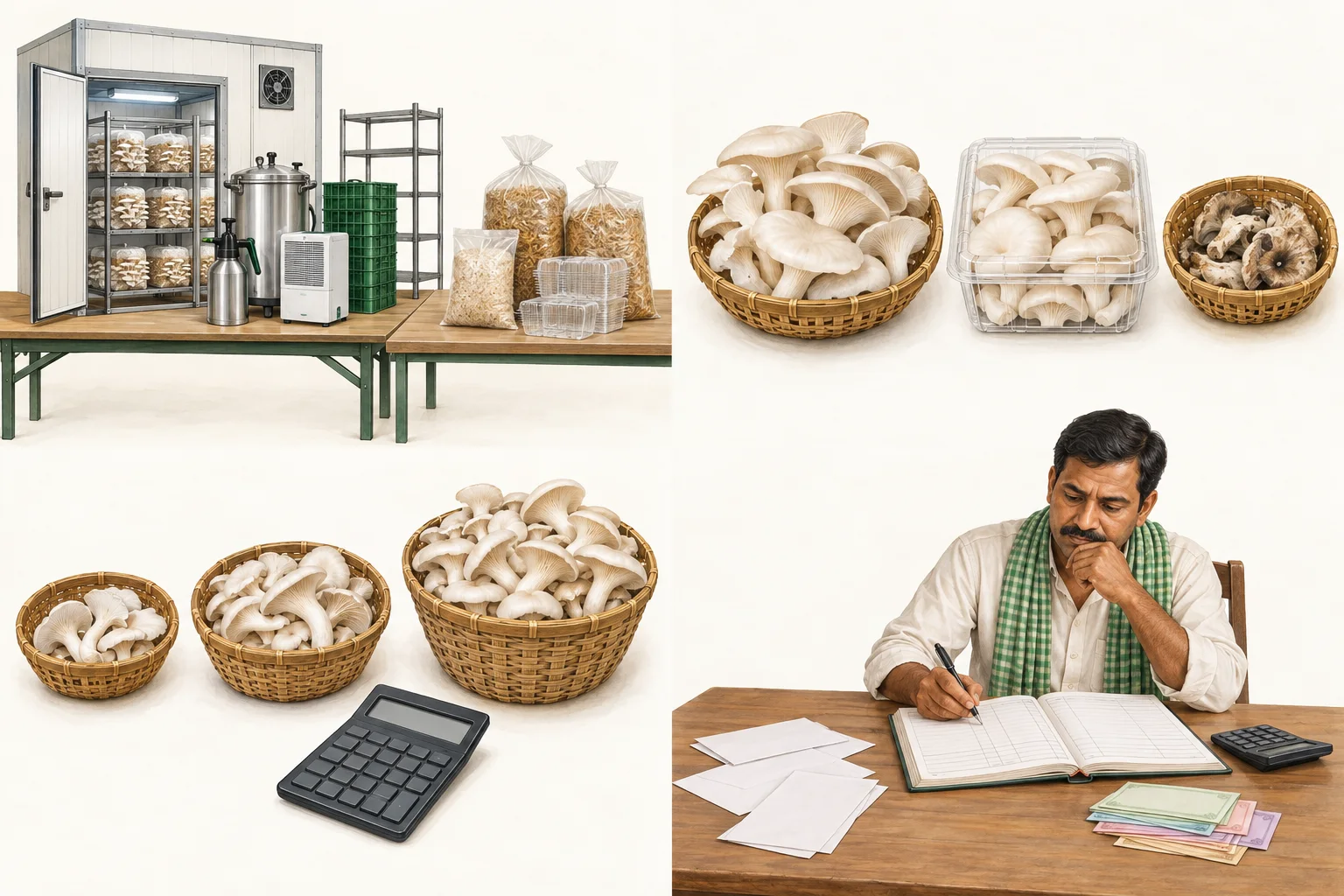
Assets and running inputs
- Notice
- Equipment investment and recurring crop inputs are different costs.
- Understand
- Comparisons only work when they include the same cost boundary.
- Try it
- Separate assets, operating expenses and payment dates.
01Capital spend buys the box
Capital expenditure, or CAPEX, is money spent once on things that stay: site levelling, growing rooms, racks, cooling plant, boiler, chaff cutter and drums.
The MIDH Operational Guidelines 2025 set a cost norm of Rs 30 lakh for a mushroom production unit. Telangana's State Horticulture Mission prints the break-up behind that norm: two PUF panel growing rooms of 60 by 18 by 16 ft with a corridor at Rs 14,00,000, plus an environmental control system at Rs 16,00,000.
Those are the scheme's model figures, published by a state agency, not quotations for your site. Get your own quotations and compare the shape.
02Operating spend feeds the box
Operating expenditure, or OPEX, is what a cycle eats: straw or compost, spawn, casing soil, bags, fuel, electricity, labour, packing, transport and commission. Write OPEX per cycle, not per year. ICAR-DMR's own economics model for environment controlled rooms assumes six crops of 60 days per room per year. That is six separate OPEX events, and each one must be paid before its own sale arrives.
The MIDH low cost route, a 200 sq ft structure with a cost norm of Rs 2 lakh, still buys straw and spawn cycle by cycle.
03Working capital is a timing problem
Working capital is not a third kind of cost. It is money that must sit ready because spending comes before earning.
Count the days. ICAR-DMR states that one tonne of dry straw gives fresh oyster mushrooms in 45 to 60 days, while the same straw taken through button compost needs 80 to 100 days including compost preparation. Your first rupee arrives at the end of that stretch. Then add the buyer's credit period, often another week or two.
So the requirement is one full cycle of OPEX, plus the credit period, plus a reserve for one cycle going wrong.
04Where the scheme does not help
The MIDH implementation guidance is blunt. The assistance is a credit linked back ended subsidy, a bank loan is mandatory for a private applicant, and the money may be used only for buildings, infrastructure, machinery and equipment. It states there is no provision for recurring charges, staff or contingency costs.
Read that as a cash flow instruction. The scheme may reduce what the box finally costs you, after your claim is settled. It will not buy spawn in month two.
Working capital comes from your own funds or a separate bank limit. The state implementing agency decides how and when any subsidy part is released.
Three column bill sort
- Make three columns: capital, operating, working capital reserve.
- Place every quotation and bill you already hold into one column.
- Write the date you expect to spend each item and the date of your first sale.
- Multiply one cycle of operating cost by that gap and ask your bank when a back ended claim is settled.
डायरी में लिखें: Column totals, first spend date, first sale date, day gap, reserve amount agreed.
ये गलतियां न करें
- Spending the whole loan on the building and having nothing left for two cycles of spawn.
- Treating a published cost norm as a price list instead of getting site quotations.
- Assuming subsidy money will arrive in time to pay wages, when it is released after verification.
खुद को जांचें
तीन सवाल, तुरंत जवाबA chaff cutter bought once is:
MIDH assistance for a private applicant is described in the guidelines as:
Which gap creates the need for working capital?
यह संपादकीय स्व-जांच है, प्रमाणपत्र नहीं। जवाब इस डिवाइस पर भी सहेजे नहीं जाते।
शब्दावली
- CAPEX
- Money spent once on things that remain, such as rooms and racks.
- OPEX
- Money spent every cycle on things that get used up.
- Back ended subsidy
- Assistance released after the work is done and verified.
संदर्भ और आगे पढ़ें
Outputs are scenarios from explicit assumptions, not forecasts.
संदर्भ खोलें