


सेंसर, मैपिंग और नियंत्रण
कोई भी रीडिंग तभी काम की है जब उसकी जगह, विधि और अंशांकन दर्ज हो, इसलिए पहले माप की जांच करें और तभी मशीन में बदलाव करें।
- By the end you can place a sensor where it reads the crop.
- By the end you can check one instrument against another.
- By the end you can change one thing at a time and prove the effect.
The measurement loop that has to close before any control action is taken.
- PlaceSensors at crop level and in return air.
- VerifyCompare against a reference instrument monthly.
- LogValue, place, time, stage and calibration status.
- Act and recheckOne change, wait, then read again.
ये आंकड़े संबंधित स्रोत और विधि के संदर्भ में हैं। इन्हें हर प्रजाति या फार्म का सार्वभौमिक निर्देश न मानें। पुराने मूल्य वर्तमान बाज़ार भाव नहीं हैं।
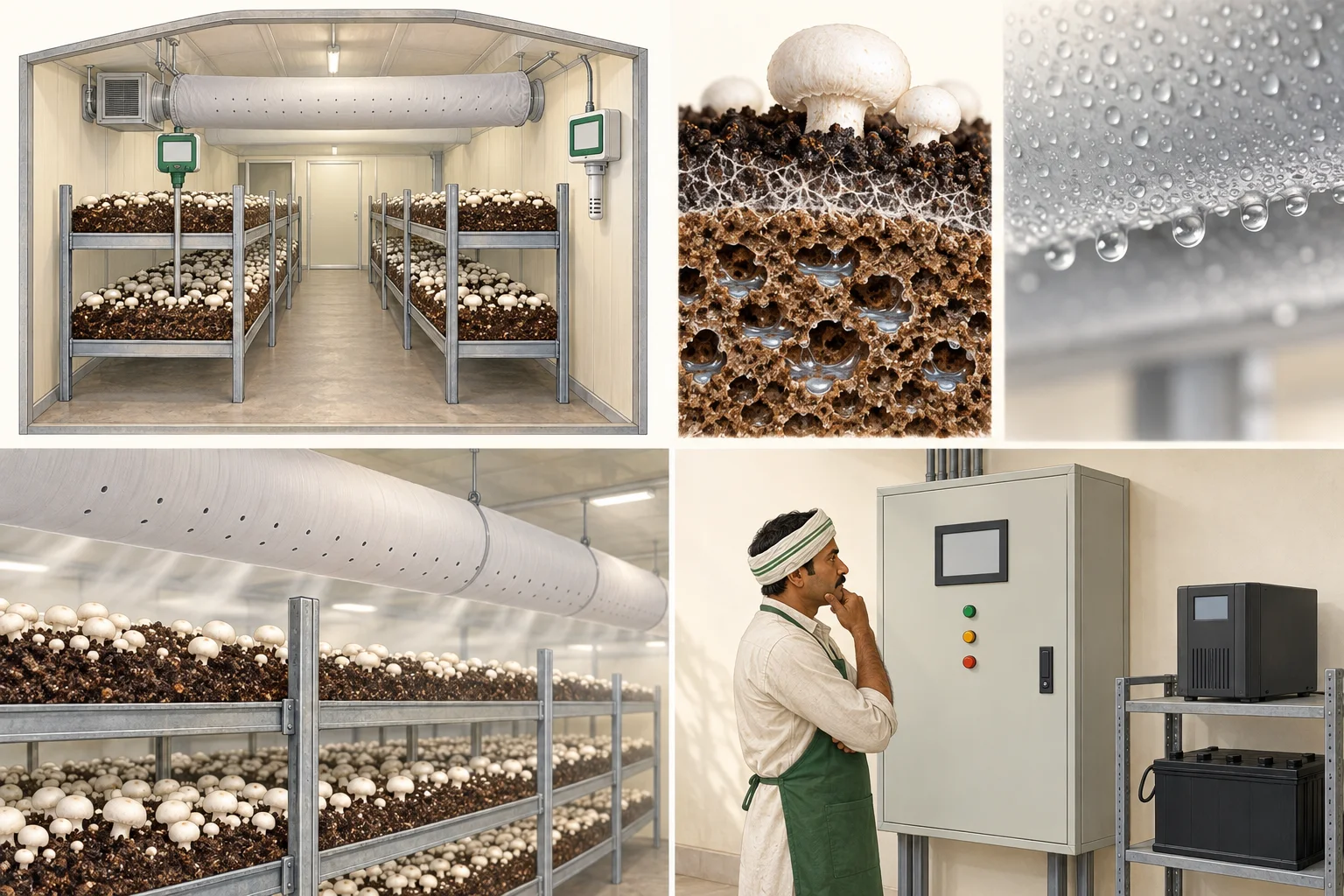
Air versus bed
- Notice
- Air and growing material are different measurement locations.
- Understand
- An active crop releases heat; the wall display is not every bed's temperature.
- Try it
- Map probes, sensor locations and representative crop readings.
01A reading is a place
A sensor beside the door reads the door. A sensor in the return air duct reads the average of everything the room has already done to the air.
Neither is the crop. The site engineering guides ask for readings mapped at crop level and at return air, with the measurement method, the placement and the calibration status recorded alongside every value.
That is why DMR can say room air 23 plus or minus 1 C and bed 24 to 25 C in one sentence. Two numbers, two places, one stage. A logbook that does not say where a reading came from cannot be used to fix anything later.
02Check the instrument, not just the crop
Instruments drift. Humidity sensors age in exactly the wet, warm conditions a mushroom room provides, and low cost carbon dioxide sensors need a fresh air reference to stay honest.
The cheap discipline is a second instrument. Keep one thermometer that never leaves the office as your reference, and compare the room instruments against it every month.
If two instruments disagree by more than their stated accuracy, you do not have a number yet. Note the disagreement in the log rather than picking the reading you prefer, and take the sensor out of service until it has been checked.
03What the log must be able to prove
A useful log answers one question: what was the room doing when the crop did that.
Record air temperature, bed or compost temperature, humidity with its dry bulb, carbon dioxide, the damper position, watering, and every set point you changed with the time you changed it.
Then the target bands mean something. Spawn run air at 23 plus or minus 1 C, fruiting at 15 to 17 C, humidity 85 percent at cropping, carbon dioxide 800 to 1,500 parts per million. There is also a measurement DMR warns about: the nose cannot detect ammonia below about 10 parts per million, which is the spawning limit itself.
04One change, then wait, then read
Control is a sequence, not a switch. DMR's own airing schedules show it. A severe airing brings carbon dioxide below 1,000 parts per million within 12 hours and the air to 15 C as fast as possible, to force one heavy first flush.
A soft airing takes the same room to 4,000 parts per million at 48 hours, then 2,000, then 1,000 by 72 hours, and gives smaller, better spaced flushes.
Same room, same crop, different result. So change one parameter, write the time, wait for the room to settle, and read again before touching anything else.
Build a one page room map
- Draw the room and mark every sensor with its exact position.
- Add one portable instrument and take readings at five points.
- Write the difference between each point and the fixed sensor.
- Note which sensor your controller actually uses to decide.
- Change one set point, wait, and record the readings again.
डायरी में लिखें: Sketch with sensor positions, readings at each point, controller source sensor, and changes with times.
ये गलतियां न करें
- Logging a value with no place or time, which makes the record useless.
- Changing temperature, humidity and fresh air together, so nothing can be attributed.
- Trusting a humidity sensor for years without ever checking it against another.
खुद को जांचें
तीन सवाल, तुरंत जवाबTwo thermometers in the same room disagree. What is the right action?
Why is a return air sensor not enough?
What do DMR's soft and severe airings change?
यह संपादकीय स्व-जांच है, प्रमाणपत्र नहीं। जवाब इस डिवाइस पर भी सहेजे नहीं जाते।
शब्दावली
- Calibration
- Checking an instrument against a known reference.
- Return air
- Room air on its way back to the cooling unit.
- Airing
- The planned change from spawn run to fruiting conditions.
संदर्भ और आगे पढ़ें
Biological requirements are not equipment selections.
संदर्भ खोलें