


बीज प्रसार
बीजाई के बाद लगभग 12 से 14 दिन कमरे को 23 डिग्री के आसपास, बिना ताजी हवा और ऊँची कार्बन डाइऑक्साइड पर रखा जाता है, जब तक कम्पोस्ट हल्के भूरे रंग की न हो जाए।
- By the end you can state the air and compost temperatures ICAR-DMR gives for spawn run.
- By the end you can explain why carbon dioxide is wanted now and unwanted later.
- By the end you can describe what a complete spawn run looks like.
फसल अवस्था के अनुसार कमरे का मौसम
White mycelium spreading through compost: warm air, high carbon dioxide and no fresh air.
ये आंकड़े संबंधित स्रोत और विधि के संदर्भ में हैं। इन्हें हर प्रजाति या फार्म का सार्वभौमिक निर्देश न मानें। पुराने मूल्य वर्तमान बाज़ार भाव नहीं हैं।
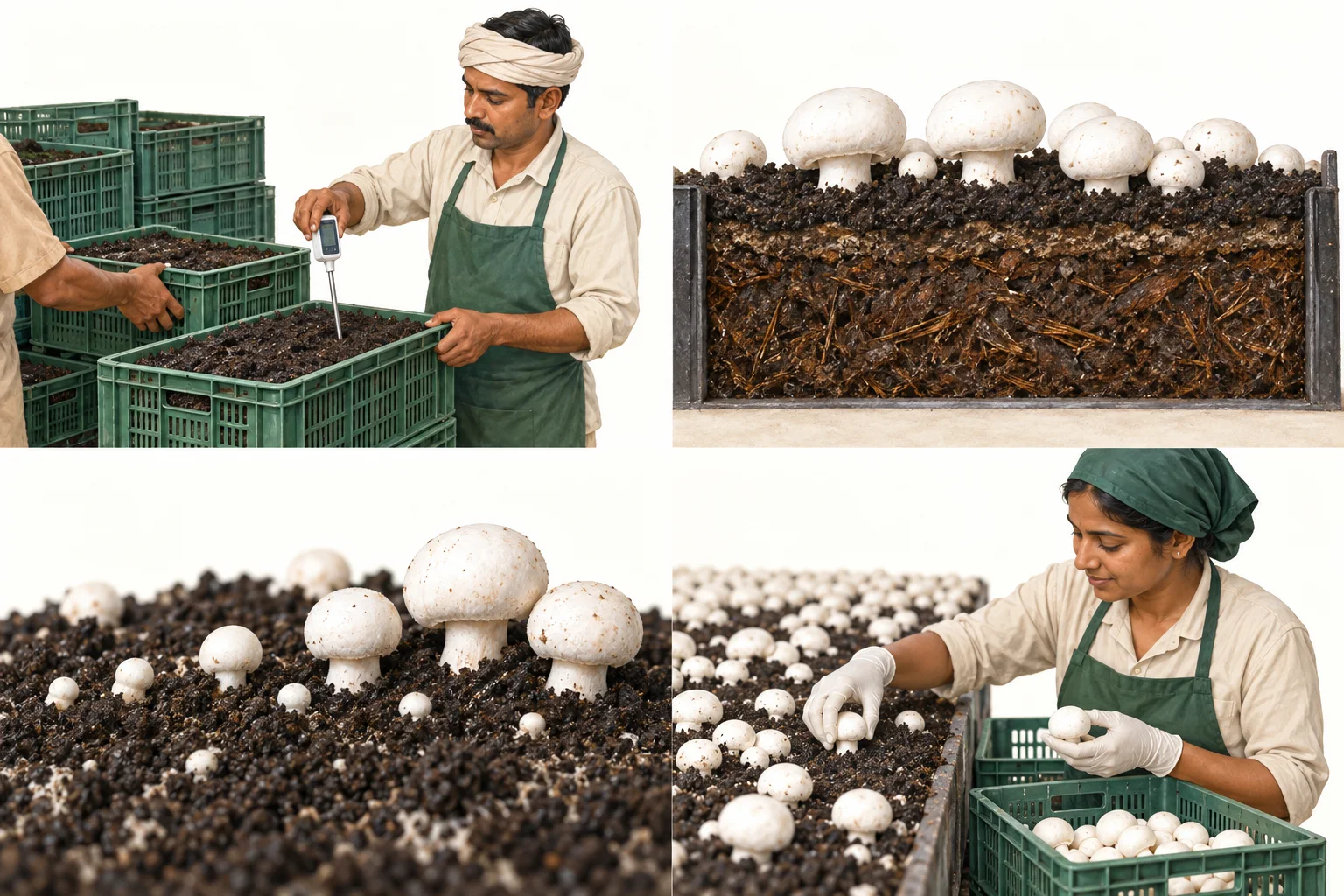
See inside the bed
- Notice
- Compost and casing are separate layers with different jobs.
- Understand
- The crop needs both a colonised food base and a suitable surface environment.
- Try it
- Record compost and casing lots separately; inspect layer uniformity.
01What is happening inside
Each grain of spawn is a starting point. Mycelium grows out of it in every direction, digests the compost and joins threads from other grains. The compost changes from dark brown to light brown as the white web spreads, and ICAR-DMR treats that colour change as the sign the run is complete.
The fungus also makes heat. ICAR-DMR holds the room at 23 plus or minus 1 °C, which gives a bed temperature of 24 to 25 °C, one to two degrees higher. The number that matters is therefore the compost temperature, not the air.
02The climate that suits spreading
Spawn run wants warm, still, wet and stale air. ICAR-DMR recirculates all of the air with no fresh-air entry, keeps carbon dioxide between 10000 and 15000 ppm, and works at 95 percent relative humidity in a controlled room. Its seasonal folder gives 22 to 25 °C and 80 to 90 percent humidity, because a naturally ventilated room cannot hold 95 percent.
Carbon dioxide is useful here. It helps the mycelium move through the compost. After casing the same gas becomes the thing you must remove, so the fan settings for the two stages are opposite.
03The ceiling and the clock
Warm helps, hot does not. The NHB model report, reproducing ICAR-DMR guidance, says temperature above 26 to 27 °C during spawn run and after casing should be avoided. ICAR-DMR adds that false truffle, a competitor that ruins compost, appears above 23 °C and is common in February and early March in the north Indian plains.
The run takes 12 to 14 days under controlled conditions, and the Hindi folder gives 12 to 15 days for a seasonal room. Do not case on a date. Case when the compost has turned light brown right through.
04What to observe, daily
Observe bags without unnecessary opening or handling. Use the farm's hygienic measurement procedure at representative locations and record the same points at comparable times. Compare development across bags, material lots and room positions.
Record stalled growth, abnormal colour, visible insects and packaging damage. Do not deliberately smell bags or diagnose their cause from odour. Several input, environmental and biological problems can produce similar signs; preserve the batch record and obtain an assessment before treating the crop.
Mark five bags and track the run
- Number five bags spread across the room, including one near the door and one at the back.
- Each morning read compost temperature at three depths in each marked bag.
- Record visible development, abnormal areas and their location without opening or deliberately smelling bags.
- On day 12 open one marked bag at the side and check whether white threads reach the bottom.
डायरी में लिखें: Representative temperatures, visible development, dates and locations of abnormal or lagging bags, and associated material lots.
ये गलतियां न करें
- Measuring air temperature only, while the compost sits two degrees hotter.
- Opening bags to look, which lets flies and spores into a warm open substrate.
- Casing on a fixed date instead of when the compost has turned light brown.
खुद को जांचें
तीन सवाल, तुरंत जवाबThe room reads 23 °C. What will the compost read?
Why is high carbon dioxide wanted during spawn run?
Compost is still dark brown on day 14. What is the right next step?
यह संपादकीय स्व-जांच है, प्रमाणपत्र नहीं। जवाब इस डिवाइस पर भी सहेजे नहीं जाते।
शब्दावली
- Spawn run
- The period in which mycelium grows through the whole compost.
- Colonisation
- Mycelium taking over the substrate so competitors have nowhere to start.
- False truffle
- A competitor fungus that appears when the spawn run is too warm.
संदर्भ और आगे पढ़ें
Operating values require stage, strain, sensor and production-system context.
संदर्भ खोलें