


फसल और फ्लश: लहरों में उपज
इस पाठ में आप फ्लश की लय, हर फ्लश में हवा की ज़रूरत और अपनी उपज को कम्पोस्ट के वज़न से जोड़ना सीखते हैं।
- By the end you can describe a flush and the gap between two flushes.
- By the end you can match fresh air to the flush you are in.
- By the end you can build a crop calendar from your own diary.
बटन मशरूम फसल चक्र
A flush coming together on one bag, the wave pattern every button crop follows.
- CompostDay 0Pasteurised, ammonia below 10 ppm
- Spawn run12-15 days22-25 °C in the dark
- CasingDay 153-4 cm layer, pH 7-7.5
- Case run7-10 daysMycelium reaches the surface
- PinningDay 25Air the room, 15-18 °C
- FlushesDay 32-70Three flushes, 7-10 days apart
ये आंकड़े संबंधित स्रोत और विधि के संदर्भ में हैं। इन्हें हर प्रजाति या फार्म का सार्वभौमिक निर्देश न मानें। पुराने मूल्य वर्तमान बाज़ार भाव नहीं हैं।
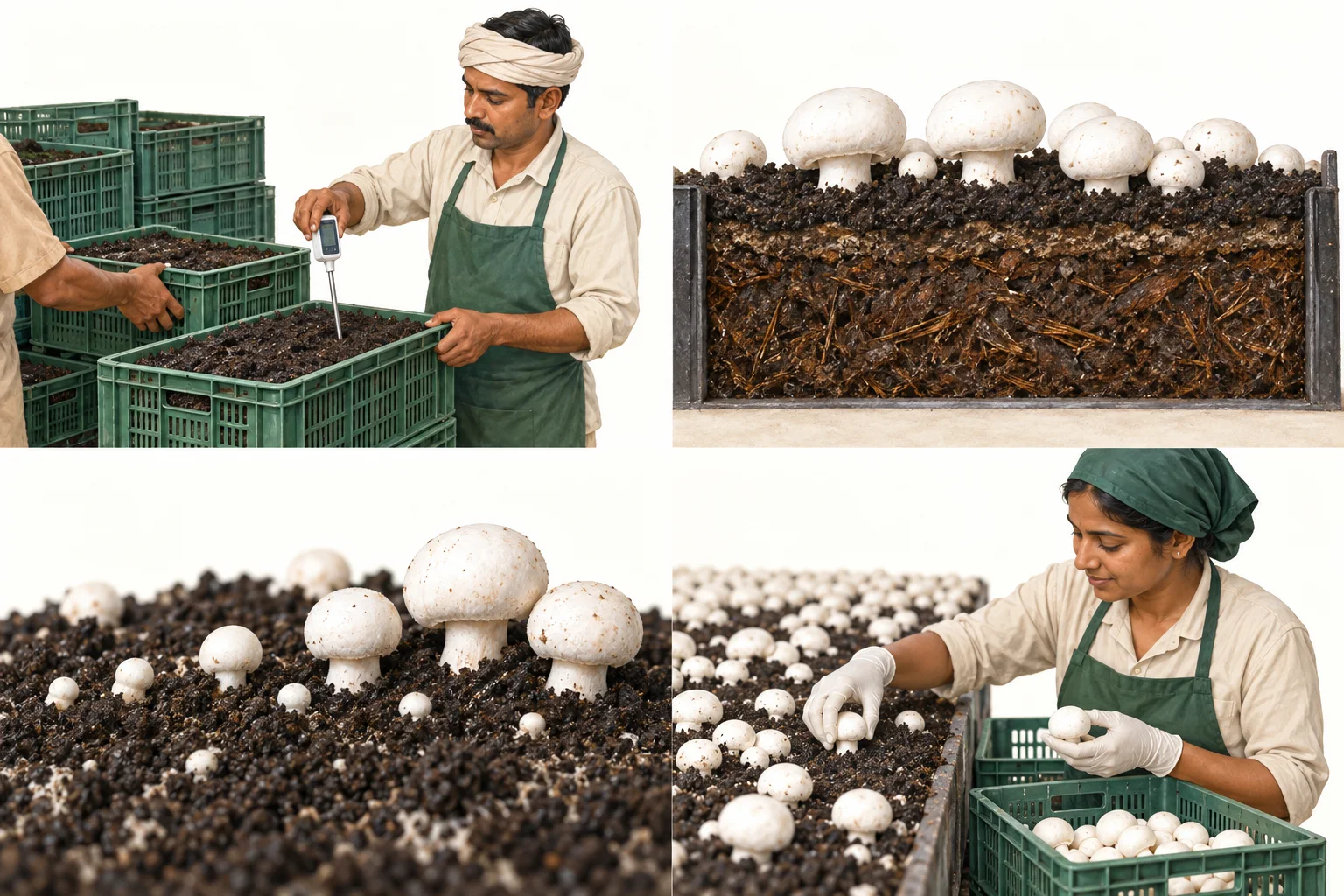
Recognise developing pins
- Notice
- Tiny pins develop at the casing surface before visible mushrooms enlarge.
- Understand
- The condition of the crop matters alongside the planned transition date.
- Try it
- Compare marked bed locations and record where development differs.
01Waves, not a steady harvest
After venting, pinheads appear in 3 to 4 days and reach picking size in another 3 to 4 days. The bed then goes quiet while the mycelium rebuilds, and a second wave follows.
DMR's Hindi farmer folder gives 8 to 10 weeks of picking in seasonal cultivation. Environment controlled units plan a 60 day room cycle and 6 crops per room per year.
DMR does not publish a line saying first flush on day N with so many flushes in total, because compost, strain and room all move it. Your own diary is the calendar.
02Fresh air changes with the flush
Carbon dioxide production peaks in the first two flushes, when DMR measures about 10 g of carbon dioxide per square metre of bed per hour.
For that period DMR asks for about 6 air changes per hour, with the fresh air vent at 30 per cent and 70 per cent recirculated. From the third flush, 4 air changes per hour hold oxygen near 16 per cent and fresh air drops to 20 per cent. Room carbon dioxide during cropping sits at 1000 to 1500 ppm.
Running full fresh air all crop long only burns power and dries the casing.
03What you do between flushes
Pick the bed truly clean. Every stump, broken stalk and dead pin left behind is food for moulds and a breeding site for flies.
Put back the water the crop took away. DMR's rule is one litre of water for every kilogram of mushroom harvested, applied after picking rather than onto swelling pins.
Hold the band steady. Warming the room does not restart a crop, it only invites disease. Expect each flush to be smaller than the one before and plan labour that way, so your pickers are not idle in week six.
04Yield follows the compost
DMR's Table 7.1 gives yields per 100 kg of compost by method: long method 10 to 15 kg, short method 18 to 25 kg, indoor method 20 to 30 kg. Some seasonal growers taking a single crop have reported 18 to 22 kg with long method compost.
NHB's strain table runs from 14 to 16 kg for older strains to 22 to 27 kg for DMR-NBS-5 under Indian conditions. DMR's own project model assumes 18 kg per 100 kg compost.
These are reported ranges, not promises. Weigh your compost and weigh your crop.
Draw your own flush calendar
- Write the venting date as day zero in the farm diary.
- Record the weight picked from each room every picking day.
- Mark the days with no picking; those gaps are your flush intervals.
- Divide total weight by compost weight to get kg per 100 kg.
- Compare that with the DMR range for your compost method.
डायरी में लिखें: Daily picked weight by room, flush number, days with no picking, compost weight.
ये गलतियां न करें
- Leaving stumps and dead pins on the bed, which feed moulds and flies.
- Holding maximum fresh air all crop, which dries the casing and burns power.
- Copying another farm's flush calendar instead of recording your own.
खुद को जांचें
तीन सवाल, तुरंत जवाबDMR asks for how many air changes per hour up to the end of the second flush?
You picked 40 kg from a room today. How much water does DMR's rule ask you to put back?
Long method compost yields, as published by DMR, are:
यह संपादकीय स्व-जांच है, प्रमाणपत्र नहीं। जवाब इस डिवाइस पर भी सहेजे नहीं जाते।
शब्दावली
- Flush
- One wave of mushrooms, picked over a few days, followed by a quiet gap.
- Air change per hour
- How many times the whole room volume of air is replaced in an hour.
- Recirculation
- Air sent back through the cooling unit instead of thrown out.
संदर्भ और आगे पढ़ें
Operating values require stage, strain, sensor and production-system context.
संदर्भ खोलें