


केसिंग के बाद की वृद्धि
केसिंग के बाद लगभग एक सप्ताह तक कमरा 24 डिग्री और ऊँची नमी पर रखा जाता है, और जब कवक जाल केसिंग की दरारों में दिखे तभी ताजी हवा देकर फलन शुरू किया जाता है।
- By the end you can state the conditions ICAR-DMR holds during case run and for how long.
- By the end you can describe the end point that says the layer is ready.
- By the end you can list what to check before changing climate or watering.
बटन मशरूम फसल चक्र
Shelf beds after casing: about a week of climbing, then the change that brings pinheads in 3 to 4 days.
- CompostDay 0Pasteurised, ammonia below 10 ppm
- Spawn run12-15 days22-25 °C in the dark
- CasingDay 153-4 cm layer, pH 7-7.5
- Case run7-10 daysMycelium reaches the surface
- PinningDay 25Air the room, 15-18 °C
- FlushesDay 32-70Three flushes, 7-10 days apart
ये आंकड़े संबंधित स्रोत और विधि के संदर्भ में हैं। इन्हें हर प्रजाति या फार्म का सार्वभौमिक निर्देश न मानें। पुराने मूल्य वर्तमान बाज़ार भाव नहीं हैं।
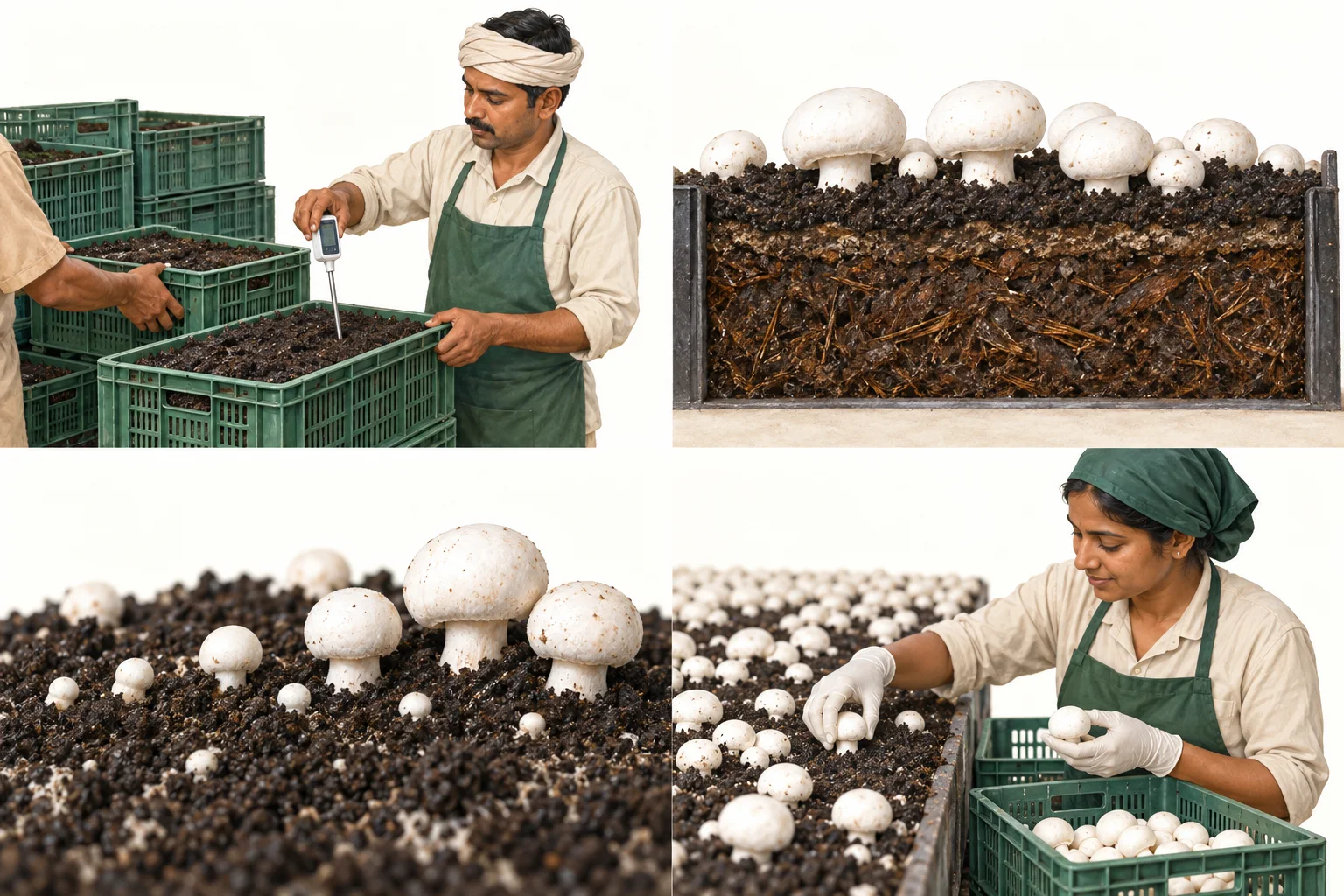
See inside the bed
- Notice
- Compost and casing are separate layers with different jobs.
- Understand
- The crop needs both a colonised food base and a suitable surface environment.
- Try it
- Record compost and casing lots separately; inspect layer uniformity.
01The mycelium climbs
Case run is the week in which mycelium leaves the compost and grows up into the casing. ICAR-DMR runs it at 24 plus or minus 1 °C with 95 percent relative humidity and carbon dioxide above 7500 ppm, with no fresh air, for about one week. The settings are close to spawn run, deliberately.
Its end point is visible. ICAR-DMR looks for mycelium in the casing valleys, the low lines between the ruffled high spots. When white threads show there across the whole bed, the layer is ready for the change.
02Charging the layer with water
This is the last week in which you can water heavily. Once pinheads appear, water sitting on them marks and spoils them, so the casing must carry its reserve before that. ICAR-DMR wants about 50 plus or minus 2 percent moisture in the casing at pinning.
Water little and often rather than once and heavily. Water that runs through into the compost does not come back and drives out air the mycelium needs. Judge by lifting a pinch from three places: it should be damp all through, not wet on top and dusty underneath.
03Reading the layer before you act
An uneven case run is information, not a nuisance. Gather the context before changing anything.
Note days since casing, because a bed on day 4 and a bed on day 8 are not the same problem. Measure casing depth at five points, since a thick patch simply takes longer. Read compost temperature as well as air, because the bed still runs above the room. Note where the slow area sits: near the door, under a vent, at one end of a rack. The same symptom from a different cause needs a different answer.
04The change, and what follows
When mycelium shows in the valleys the room changes: temperature down towards the fruiting band, fresh air in, carbon dioxide down. ICAR-DMR reports pinheads 3 to 4 days after that change.
Timing is the risk. Change too early and the mycelium has not reached the surface, so pinning is thin and late. Change too late and it overgrows the casing into a dense mat that pins poorly. NHB, following ICAR-DMR, adds that temperature above 26 to 27 °C after casing must be avoided, so a warm week is a problem to fix.
Run a case-run water and depth log
- On casing day measure the layer depth at five points on each bed and write them down.
- Each day lift a pinch of casing from three places and record whether it is damp all through.
- Record every watering with date, time and litres per square metre, not a guess.
- From day 5, look into the casing valleys daily and record when white threads appear across the bed.
डायरी में लिखें: Depth at five points, the daily damp check, every watering with quantity, the date mycelium reached the valleys.
ये गलतियां न करें
- Flooding the casing once instead of watering lightly and often, so water reaches the compost.
- Venting on a calendar date before mycelium has reached the casing surface.
- Letting the room run above 26 to 27 °C after casing and waiting for it to pass.
खुद को जांचें
तीन सवाल, तुरंत जवाबWhat tells you the case run is finished?
Why water the casing during case run rather than later?
One end of a bed is slower. What do you gather first?
यह संपादकीय स्व-जांच है, प्रमाणपत्र नहीं। जवाब इस डिवाइस पर भी सहेजे नहीं जाते।
शब्दावली
- Case run
- The week in which mycelium grows from the compost up into the casing.
- Casing valleys
- The low lines in the ruffled casing surface where mycelium first shows.
- Venting
- Letting fresh air in and lowering carbon dioxide to start pinning.
संदर्भ और आगे पढ़ें
Operating values require stage, strain, sensor and production-system context.
संदर्भ खोलें