

फलन और तुड़ाई
शीट हटाने के बाद बिस्तर को 28 से 32 डिग्री पर नम रखें, बटन या अंडे की अवस्था में दिन में दो से तीन बार तोड़ें, छिद्रित थैली में पैक करके उसी दिन बेचें और फ्रिज में कभी न रखें।
- By the end you can manage the bed after the sheet comes off: temperature, humidity, water, air and light.
- By the end you can tell pinhead, button, egg and open stages apart and pick at the right one.
- By the end you can pack, hold and move the crop the same day at 10 to 15 °C.
तुड़ाई से बाज़ार तक
स्रोत: ICAR-DMR मैनुअल और पोस्ट-हार्वेस्ट बुलेटिन 2008।
- तोड़ेंपरदा खुलने से पहले, कैप 3 से 5 सेमी; घुमाकर खींचें।सुबह
- जड़ काटें और छांटेंमिट्टी वाला हिस्सा काटें; आकार और खुलेपन से ग्रेड।1 घंटे में
- ठंडा करेंगूदे का तापमान 4 से 5 °C तक; बर्फ का सीधा संपर्क नहीं।कुछ घंटों में
- पैक करें200 से 400 ग्राम पैक, हवादार; नमी 87 से 90 प्रतिशत।उसी दिन
- बेचेंफ्रिज में 2 से 3 दिन; कमरे के तापमान पर 12 घंटे।24 से 72 घंटे
ये आंकड़े संबंधित स्रोत और विधि के संदर्भ में हैं। इन्हें हर प्रजाति या फार्म का सार्वभौमिक निर्देश न मानें। पुराने मूल्य वर्तमान बाज़ार भाव नहीं हैं।
Inspect development
- Notice
- The crop can move through development quickly.
- Understand
- Fast cropping still requires timely observation and harvest planning.
- Try it
- Record bed conditions, abnormalities and the buyer's maturity specification.
01After the sheet comes off
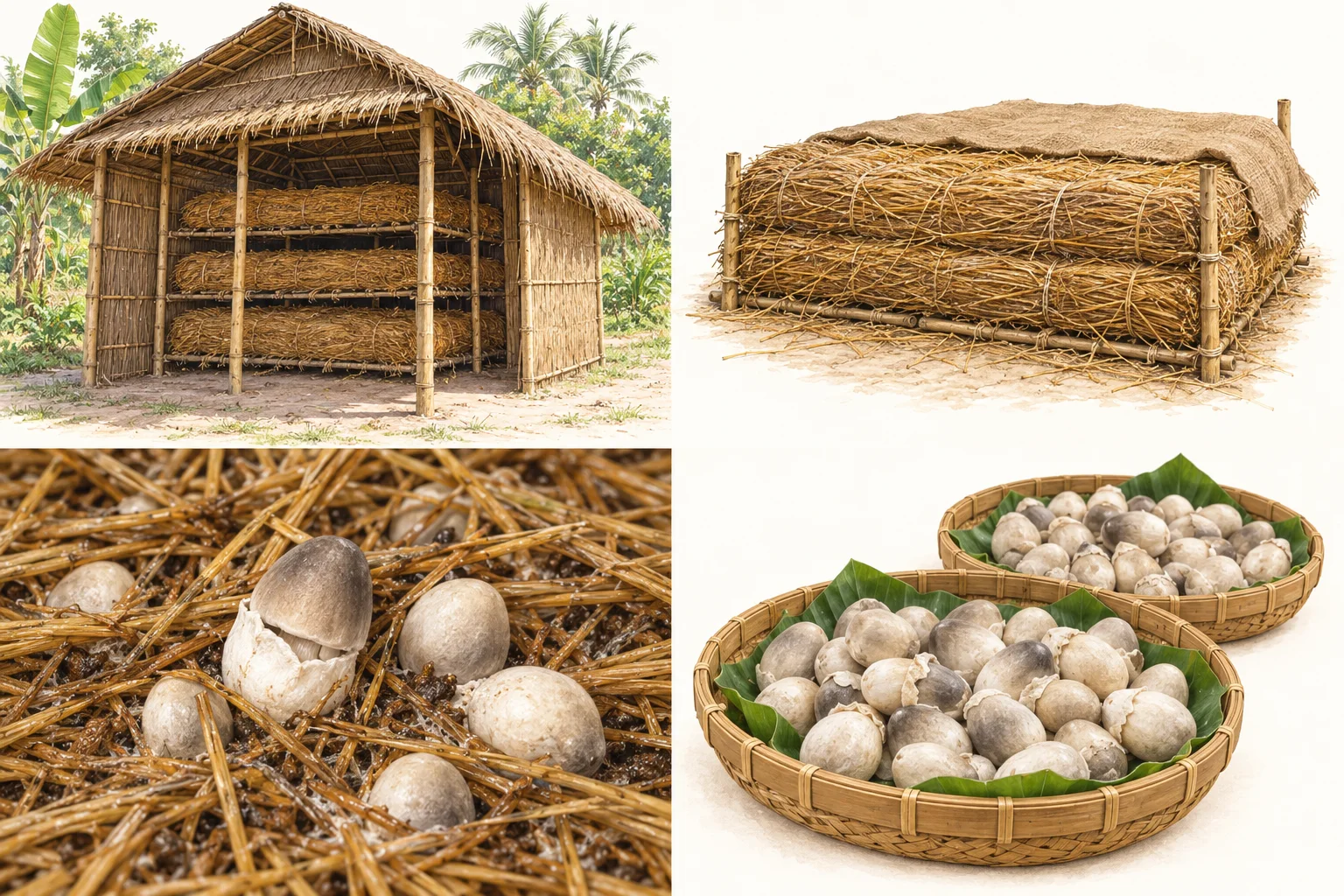
Once white mycelium covers the bed, the sheet is removed and the bed changes from growing to fruiting. DMR now asks for 28 to 32 °C and about 80 percent relative humidity. Keep humidity with a fine mist on the floor and walls, never a direct spray on the bed, which rots the pins.
Give the bed light and a little fresh air. For indoor beds DMR lists fluorescent light and intermittent fresh air. In a film house TNAU works at 25 to 35 °C and 75 to 80 percent humidity. Expect the first mushrooms 4 to 5 days after the sheet comes off; TNAU sees tiny buttons in 6 to 10 days and picks 4 to 5 days later.
02Reading the stages
Pinheads appear as tiny white dots along the sides of the bed. They swell into buttons, small round bodies fully wrapped in the volva, the egg-shell skin. The egg stage is a larger, oval body with the volva stretched tight, about to split. Then the stem pushes up, the volva tears and the cap opens.
DMR says harvest before the volva breaks or just after: the button and egg stages. TNAU adds that an opened sporocarp, the technical word for the whole mushroom body, is fibrous and worth less. This is the opposite of oyster, where a fully opened cap is normal.
03The picking rhythm
Because the stages pass so quickly, DMR asks growers to harvest two or three times a day: morning, noon and afternoon. Twist each egg out gently, holding the base, without pulling up the pins next to it. The first flush lasts about 3 days and gives 70 to 90 percent of the crop. A second flush follows about a week later and adds only 10 to 30 percent; the bed method continues for about 20 days in all.
After the second flush the bed is spent. Dry the used straw and compost it away from the shed. DMR cites Chinese practice of reusing it for oyster mushroom, but that is not an Indian recommendation.
04Holding and selling the same day
DMR states plainly that this mushroom is sold on the day of harvest. It cannot go into a fridge: at 4 °C it undergoes autolysis and collapses. DMR gives 10 to 15 °C for 3 days in perforated polythene bags, and a little longer at 20 °C.
Packing matters even for a few hours. Unpacked mushrooms lose 40 to 50 percent of their moisture in 4 days; in perforated bags the loss is about 10 percent. Let picked eggs cool in shade before bagging. If you must store, DMR gives drying at 60 °C for 7 hours to 5 percent moisture, after blanching 3 to 4 minutes in hot water to keep colour. Price is only real once the buyer has paid.
Keep a three-day picking log on one bed
- Set three fixed picking times and keep to them for the whole first flush.
- At each pick, count eggs, buttons and any opened mushrooms you missed.
- Weigh each pick separately and write the weight against the time.
- Bag in perforated polythene only after the mushrooms have cooled in shade.
- Note the temperature of the room where packed produce waits and the hour it left the farm.
डायरी में लिखें: Pick time, count by stage, weight per pick, opened mushrooms missed, holding-room temperature, dispatch time.
ये गलतियां न करें
- Spraying water straight onto the bed after pinning: pins abort and rot; mist floor and walls instead.
- Picking once a day: half the flush opens and turns fibrous before you return.
- Bagging warm mushrooms in a sealed bag: they sweat, heat and spoil within hours.
खुद को जांचें
तीन सवाल, तुरंत जवाबWhich stage should be on the buyer's scale?
How often does DMR pick a paddy straw bed in flush?
What happens to this mushroom at 4 °C?
यह संपादकीय स्व-जांच है, प्रमाणपत्र नहीं। जवाब इस डिवाइस पर भी सहेजे नहीं जाते।
शब्दावली
- Egg stage
- The oval, unopened body wrapped in a tight volva; the top grade for sale.
- Sporocarp
- The scientific word for the whole mushroom body.
- Flush
- One wave of mushrooms; the first flush here gives most of the crop.
- Perforated pack
- A polythene bag with small holes that slows drying and lets the mushroom breathe.
संदर्भ और आगे पढ़ें
Species, strain, climate and production method must remain explicit.
संदर्भ खोलें