


पराली मशरूम की खेती की प्रणाली
पराली मशरूम गर्म और नम मौसम में धान के पुआल पर चार से पाँच सप्ताह में तैयार होने वाली तेज़ फसल है, जिसकी अधिकांश उपज पहली तुड़ाई में ही मिलती है।
- By the end you can explain why Volvariella volvacea grows in heat that would stall other mushrooms.
- By the end you can lay the 4 to 5 week cycle on a calendar and fit it to your region's season.
- By the end you can state the three rules that decide whether the crop sells: harvest stage, flush timing and the no-fridge rule.
फसल अवस्था के अनुसार कमरे का मौसम
Paddy straw mushrooms at egg stage on a straw bed in Odisha, the stage at which they are picked.
ये आंकड़े संबंधित स्रोत और विधि के संदर्भ में हैं। इन्हें हर प्रजाति या फार्म का सार्वभौमिक निर्देश न मानें। पुराने मूल्य वर्तमान बाज़ार भाव नहीं हैं।
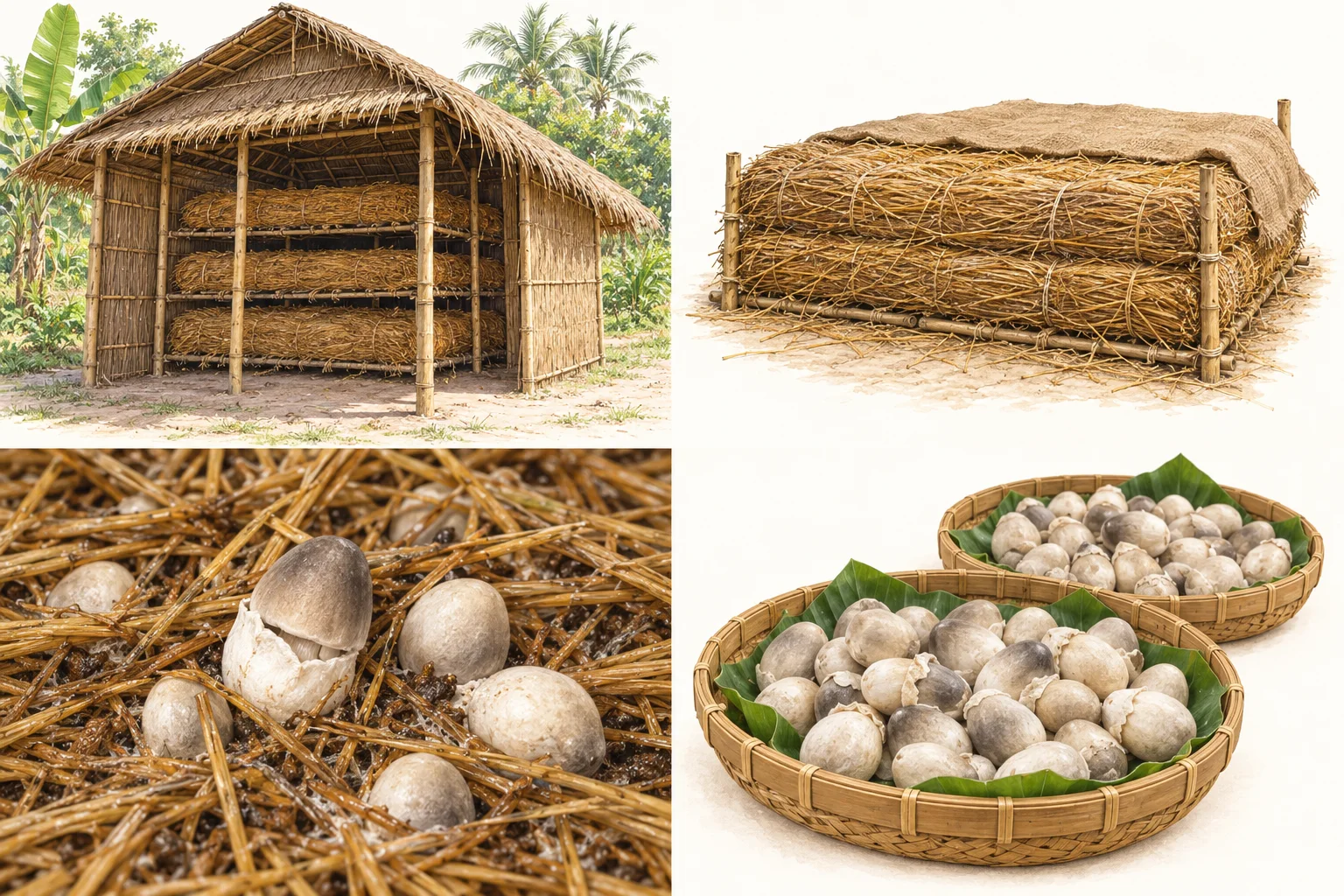
Choose a bed system
- Notice
- Traditional beds and controlled indoor systems are different methods.
- Understand
- Combining isolated instructions from different methods can create gaps.
- Try it
- Train in one complete method before preparing a batch.
01A mushroom built for heat
Paddy straw mushroom is Volvariella volvacea. Growers in Odisha and Bengal call it parali or chhatu. It is a warm-climate fungus. Its mycelium, the white thread network that is the living body of the fungus, runs fastest in heat that would kill button mushroom mycelium. The ICAR-DMR species table gives spawn run, the days when mycelium spreads through the straw, at 32 to 34 °C and fruiting at 28 to 32 °C.
DMR reports it is most popular in the coastal states: Odisha, Andhra Pradesh, Tamil Nadu, Kerala and West Bengal. On the north Indian plains the natural window is July to September, the humid monsoon months. In the hills it needs artificial heat and is rarely worth the cost.
02Why rice straw suits it
Every substrate, the material a mushroom feeds on, has a carbon to nitrogen ratio, written C:N. Straw is mostly carbon; nitrogen is the scarce part. DMR states that this mushroom needs a C:N ratio of 40 to 60, far higher than other cultivated mushrooms. In plain words, it is happy on poor, woody material that button mushroom could not use without weeks of composting.
That is why plain paddy straw, soaked and drained, is enough. Indoor growers use cotton waste, which DMR calls the preferred material for that method. Either way the wet substrate should hold 60 to 65 percent moisture: squeezed hard, it should not drip.
03The four to five week clock
DMR calls it a fast-growing mushroom: under favourable conditions the total crop cycle finishes in 4 to 5 weeks. First harvest comes 9 to 10 days after spawning, the day you mix spawn into the bed. Spawn is the grain or straw carrier that holds live mycelium; think of it as the seed, though it is not a seed.
The first flush, the first wave of mushrooms, lasts about 3 days and gives 70 to 90 percent of the whole crop. The second flush, a week or so later, adds only 10 to 30 percent. So the calendar is short and lopsided. Labour, packing and buyers must all be ready for three heavy days.
04The rules that make or break sales
Three rules follow from the biology. First, harvest at the button or egg stage, before the volva breaks. The volva is the skin that wraps the young mushroom like an egg shell. Once it tears and the cap opens, the mushroom turns fibrous and the price drops.
Second, this mushroom cannot go into a fridge. At 4 °C it undergoes autolysis, meaning its own enzymes digest it into a wet mess. DMR gives 10 to 15 °C for about 3 days, and says most is sold on the day of harvest.
Third, yield evidence is thin. The only Indian figure in our fact base is TNAU's 1 to 2 kg per 10 kg straw. One source. Measure your own beds.
Check your season and your buyer before you buy spawn
- Hang a thermometer in the intended shed. Note morning and evening readings for a week and compare them with the 28 to 35 °C band.
- Find out when hand-threshed paddy straw is available near you and what a bundle costs.
- Name two buyers who can take mushrooms on the day of picking, and ask if they can take a three-day peak.
- Work a 35 day calendar backwards from a market day so the first flush lands on it.
- Decide how you will hold produce at 10 to 15 °C without a fridge: a shaded, ventilated room or an evaporative cooler.
डायरी में लिखें: Shed temperatures morning and evening, straw source and price, buyer names and the days each can take produce.
ये गलतियां न करें
- Starting beds in a cool month because straw was cheap: the mycelium stalls below its band and moulds take the bed.
- Handling it like oyster mushroom and chilling it in a fridge: the crop turns to liquid overnight.
- Spawning before a buyer is fixed: 70 to 90 percent of the crop arrives in three days and cannot wait.
खुद को जांचें
तीन सवाल, तुरंत जवाबWhere must fresh paddy straw mushrooms never be held?
How much of the crop arrives in the first flush?
Why does plain rice straw suit this mushroom?
यह संपादकीय स्व-जांच है, प्रमाणपत्र नहीं। जवाब इस डिवाइस पर भी सहेजे नहीं जाते।
शब्दावली
- Mycelium
- The white network of threads that is the living body of the fungus; the mushroom is only its fruit.
- Spawn
- Grain or straw carrying live mycelium, used to seed the bed; it is not a true seed.
- C:N ratio
- Carbon compared with nitrogen in a substrate; a high ratio means poor, woody material.
- Volva
- The skin that wraps the young mushroom like an egg shell; harvest before it breaks.
- Autolysis
- Self-digestion; at fridge temperature this mushroom's own enzymes turn it to liquid.
संदर्भ और आगे पढ़ें
Species, strain, climate and production method must remain explicit.
संदर्भ खोलें