


अवलोकन और पैटर्न
रोग का नाम रखने से पहले जो दिखता है उसे पाँच तथ्यों में लिखना सीखें: क्या, कहाँ, कितना, कब से और क्या बदला।
- By the end you can describe a problem in five facts: what, where, how many, since when, what changed.
- By the end you can tell a spreading pattern from a uniform or localised one.
- By the end you can separate a mushroom sign from a room sign and count flies against a published threshold.
लक्षण से कारण तक
पहली नज़र, निदान नहीं। स्रोत: ICAR-DMR मैनुअल और रोग बुलेटिन।
| क्या दिखता है | संभावित कारण | पहला कदम |
|---|---|---|
| लंबी डंडी, छोटे कैप | CO₂ ज़्यादा (1,500 ppm से ऊपर) | ताज़ी हवा बढ़ाएं |
| कम्पोस्ट पर हरे धब्बे | ट्राइकोडर्मा; कम pH या बची अमोनिया | अलग करें, हटाएं; अगला बैच जांचें |
| केसिंग के बाद पिन नहीं | ठंडा और हवादार नहीं किया | 16 से 18 °C, हवा दें |
| कैप पर भूरे धंसे धब्बे | बैक्टीरियल ब्लॉच; गीले कैप | सतह सुखाएं, नमी 85% से कम |
| सफेद गीली गांठें | वेट बबल, केसिंग से | नमक से ढकें, हटाएं; केसिंग को भाप दें |
| छोटी मक्खियां | सियारिड/फोरिड | जाली, लाइट ट्रैप, स्वच्छता |
ये आंकड़े संबंधित स्रोत और विधि के संदर्भ में हैं। इन्हें हर प्रजाति या फार्म का सार्वभौमिक निर्देश न मानें। पुराने मूल्य वर्तमान बाज़ार भाव नहीं हैं।
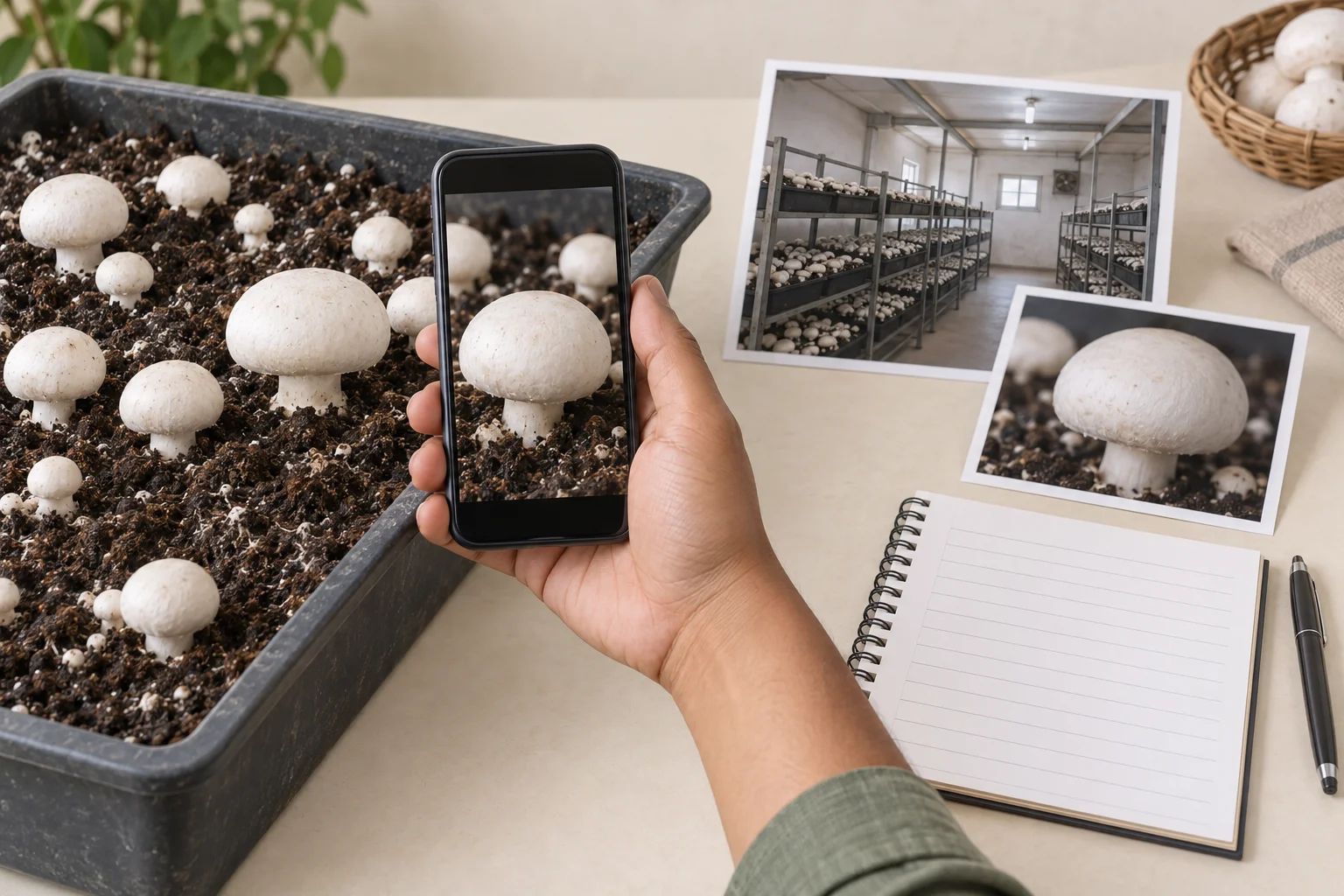
Look, explain, then apply
Document the room, affected area and detail. All pictured scenes are synthetic; these are not disease-reference photographs or laboratory findings.
See where this fits in the full workflow →01Describe first, name later
A disease name is a conclusion. An observation is a fact. When a grower says "I have green mould", the adviser still asks: green where, on compost or casing, in one bag or twenty, since when? The name skipped every question that decides the action.
ICAR-DMR describes bacterial blotch by behaviour, not name: cap spots that enlarge when temperature is at least 20 °C and a film of water stays on the cap more than 3 hours. That tells you where to look, what to measure and what changed. Write the description before any name; if the name proves wrong, the description is still true.
02The five facts
Every diary entry carries five facts. What: the sign in plain words, with a photo and a coin for scale. Where: room, rack, shelf height, bag numbers, distance from door and air inlet. How many: a count, not "some", repeated 48 hours later. Since when: the date and the crop day, meaning days after spawning or casing. What changed: watering, a power cut, a new casing lot, a visitor, in the previous three days.
The five facts do half the diagnosis. Trouble only near the inlet points at air. Trouble in every bag from one compost batch points at compost. Trouble the day after a power cut points at temperature.
03Reading the pattern
Pattern is the shape of the problem across the room. Uniform: every bag the same, usually environment or a whole compost or casing lot. Spreading: a few bags on day one, neighbours by day three, the signature of infection or a moving pest. Localised: only under the leak or by the door, so look for a physical cause there. Single bag: one odd bag, often a filling or spawn fault.
Speed matters as much as shape. ICAR-DMR warns that dry bubble, left uncontrolled, can destroy a crop in 2 to 3 weeks. A count that doubles every two days is an emergency; a flat count is a fault, not an epidemic.
04Mushroom sign or room sign?
Some signs that look like disease are the room talking. ICAR-DMR describes high carbon dioxide at pinning producing onion-shaped mushrooms with a bulbous base and small cap, and later long stalks with small open caps. In oyster the same cause gives a trumpet-mouth shape. No organism is involved; spraying wastes money and adds residue.
Pests are counted, not guessed. ICAR-DMR's sciarid table says any live adult in the first flush is already a reason to act, and from the second flush more than 20 per trap per week. NHB describes the trap: a 15 W yellow bulb over a polythene sheet coated with mustard oil.
A ten-minute observation walk, daily this week
- Walk the same route daily: door, inlet side, middle, far wall, bottom and top shelves.
- Write the five facts for anything unusual and photograph it with a coin for scale.
- Count affected bags today and after 48 hours; write both numbers side by side.
- Hang one yellow light trap and record the weekly count beside the flush number.
डायरी में लिखें: Date, crop day, room, five facts, count now and at 48 h, trap count, pattern word.
ये गलतियां न करें
- Naming the disease first and fitting evidence to it, so the room is never checked.
- Writing "some bags" instead of a count, which hides whether the problem is spreading.
- Photographing the mushroom but not its position, so the pattern is lost.
खुद को जांचें
तीन सवाल, तुरंत जवाबLeggy mushrooms with small open caps appear only far from the inlet. First suspect?
Which entry is an observation, not a conclusion?
Second flush, 8 sciarid adults in the trap this week. Action?
यह संपादकीय स्व-जांच है, प्रमाणपत्र नहीं। जवाब इस डिवाइस पर भी सहेजे नहीं जाते।
शब्दावली
- Symptom
- What the crop shows: spot, shape, colour, smell. Not the cause.
- Crop day
- Days counted from spawning or casing.
- Action threshold
- A published count at which to act.
संदर्भ और आगे पढ़ें
Identification and current India label verification remain separate gates.
संदर्भ खोलें