

जैव सुरक्षा और रसायन सावधानी
रोग के प्रवेश मार्गों को भौतिक रूप से बंद करें, पहले रोकथाम करें, और किसी भी रसायन से पहले भारत में मशरूम के लिए वर्तमान लेबल स्वीकृति जाँचें।
- By the end you can name each entry route and its physical barrier.
- By the end you can run a contain-first routine within the hour.
- By the end you can apply the India label gate and explain why older chemical lists cannot be copied.
नियंत्रित कमरा: हवा कैसे चलती है
ठंडी, नम हवा ऊपर की नली से बेड के ऊपर गिरती है, कमरे से लौटती है, 20 से 30 प्रतिशत ताज़ी हवा मिलती है, बेड पर हवा की चाल लगभग 15 सेमी/सेकंड। स्रोत: ICAR-DMR मैनुअल।
ये आंकड़े संबंधित स्रोत और विधि के संदर्भ में हैं। इन्हें हर प्रजाति या फार्म का सार्वभौमिक निर्देश न मानें। पुराने मूल्य वर्तमान बाज़ार भाव नहीं हैं।
Close the loop
- Notice
- Entry routines and dedicated tools are part of prevention.
- Understand
- A written procedure only helps when people actually follow it.
- Try it
- Assign one prevention change and check its use in the next crop.
01Control the routes
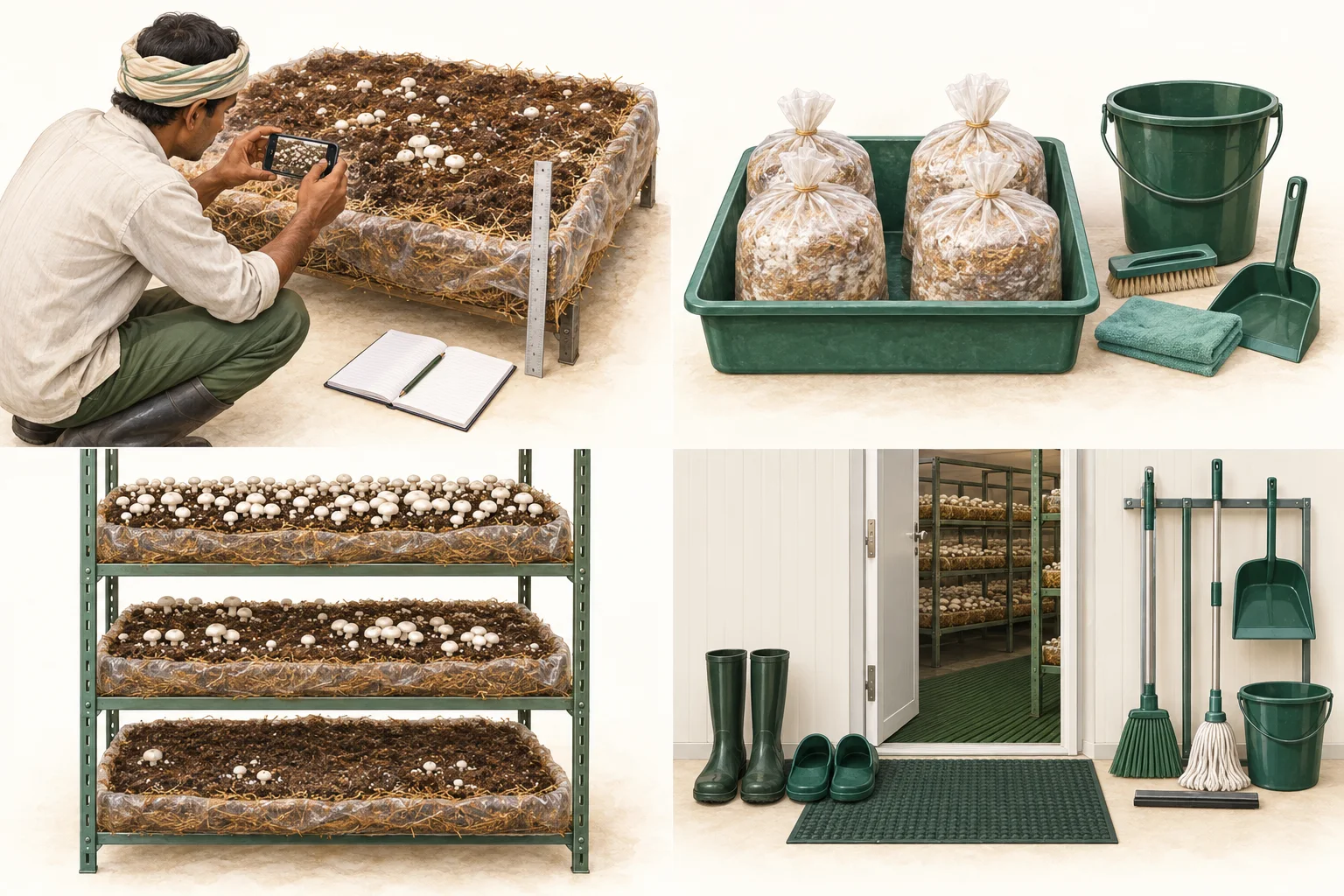
Every route into the room has a cheap physical answer. Air: ICAR-DMR recommends 2 micrometre mesh filters on fresh-air entry points to hold back mould spores. Flies: NHB says screening doors and ventilators with nylon net of 35 mesh or finer checks their entry. Casing: ICAR-DMR's wet bubble folder gives steam at 54.4 °C for 15 minutes; the manual's general casing pasteurisation is 60 to 65 °C for 6 to 8 hours. Spent compost: NHB says put it in the pit under at least 10 cm of manure to stop fly breeding.
People and tools are the last route. A foot dip, crates kept to one room, and visiting the sick crop last need no product at all.
02Contain first, then treat
When a problem is found, the order is contain, diagnose, decide. Containment happens within the hour: cover the affected spot with damp paper so spores are not blown across the room; lift the bag or casing patch into a sealed bag and carry it out without passing over healthy beds; wash hands and tools; mark the rack in the diary.
Then close the routes: screens, filter, foot dip, who entered. Only when spread is stopped does the differential decide whether more is needed. Many outbreaks end at containment; a treatment applied while the source stays open is money spent at the wrong end. At crop end, NHB's cook-out of 70 °C for 12 hours contains the room itself.
03The India label gate
This site gives no chemical doses, for a reason. In India a pesticide may be used only on the crop and for the pest on its approved label, registered through the Central Insecticides Board and Registration Committee. Mushroom is a minor crop and few products carry a mushroom label. A dose copied from a manual, a neighbour or a shop is not a legal or safe basis.
The gate is one question, asked before purchase: is this product currently approved for mushrooms in India, for this problem, and what does the current label say? If the answer is not a current label, the answer is no. NHB's model DPR keeps one timing rule: at least 48 hours between any spray and picking.
04Why old lists cannot be copied
ICAR-DMR's 2011 manual and older folders list chemicals of their time, including some now banned in India. The dataset behind this site records a compost formulation containing BHC (lindane), an organochlorine no longer permitted. Formalin, carbendazim, malathion and dichlorvos appear throughout, each with its own regulatory and residue conditions today, and the manual and the Hindi folder disagree by a factor of ten on one insecticide dose.
Those documents stay valuable for causes, thresholds and process. Treat any chemical name in them as a historical record that must pass the label gate, and expect many will not. The practices that have not aged are physical: filters, screens, steam, cook-out, visit order and a diary.
Close the routes this week
- Walk every route: inlet filter, screens, foot dip, crates; note what is missing or torn and repair it.
- Record the casing lot with treatment method, temperature and time; do not use an untreated lot.
- Write a visit order on each door, youngest crop first, sick room last; start a visitor log.
- For every product on the farm, record whether a current mushroom label exists in India and the date checked.
डायरी में लिखें: Route checklist with repair dates, casing lot and treatment, visit order, visitor log, product register with label status.
ये गलतियां न करें
- Treating before containing, so the product is applied while spores keep arriving.
- Copying a chemical and dose from an older document without checking today's label status.
- Using an untreated casing lot to save time, then fighting wet bubble for three crops.
खुद को जांचें
तीन सवाल, तुरंत जवाबWet bubble appears on one rack. First action?
A 2011 manual names a chemical and dose. What decides whether it can be used today?
Which is NOT a published physical measure?
यह संपादकीय स्व-जांच है, प्रमाणपत्र नहीं। जवाब इस डिवाइस पर भी सहेजे नहीं जाते।
शब्दावली
- Biosecurity
- Practices that keep disease and pests out and stop them moving between rooms.
- Label gate
- A chemical is considered only if it holds a current approved label for mushrooms in India.
- Containment
- Stopping spread within the hour: cover, remove, seal, wash, mark.
संदर्भ और आगे पढ़ें
Identification and current India label verification remain separate gates.
संदर्भ खोलें