


लाभ-हानि बिंदु, नकदी प्रवाह और जोखिम
सबसे खराब स्थिति पर योजना जाँचें: कम उपज, कम भाव और एक चक्र का नुकसान, और महीनेवार नकदी का सबसे निचला बिंदु देखें।
- By the end you can say how many kilograms a cycle must sell to cover its costs.
- By the end you can build a low case using the bottom of published yield ranges.
- By the end you can write a risk list with an early warning sign for each risk.
उदाहरण: छोटे बटन फार्म का पहला साल
दो कमरों वाली खरीदी हुई कम्पोस्ट की इकाई के अनुमानित हिस्से। आपका कोटेशन और खरीदार असली आंकड़े तय करते हैं।
ये आंकड़े संबंधित स्रोत और विधि के संदर्भ में हैं। इन्हें हर प्रजाति या फार्म का सार्वभौमिक निर्देश न मानें। पुराने मूल्य वर्तमान बाज़ार भाव नहीं हैं।
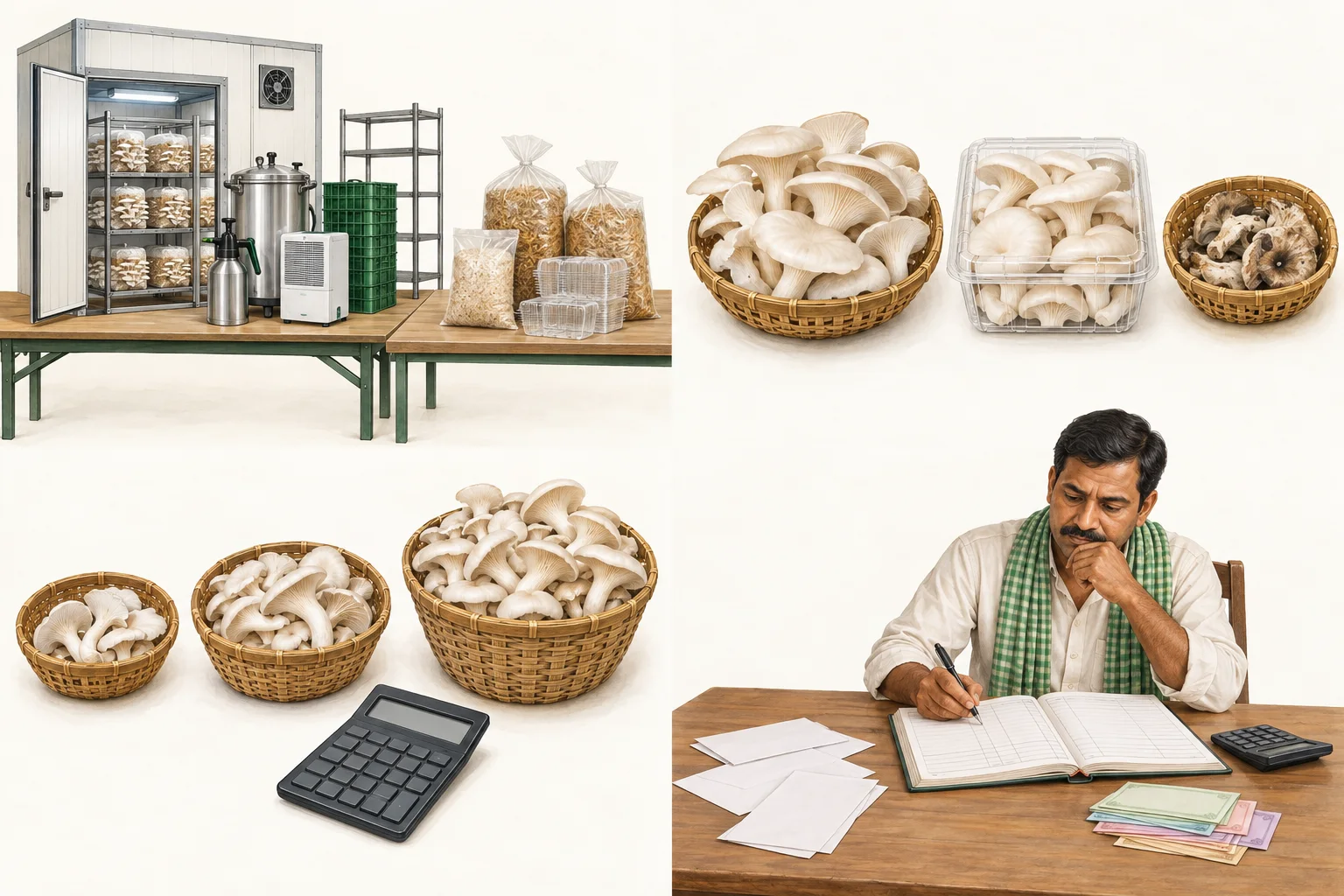
Follow the payments
- Notice
- A sales invoice and cash in hand can arrive at different times.
- Understand
- An operating surplus can coexist with a cash shortage.
- Try it
- Plot actual receipts and payments on a weekly calendar.
01Break even in kilograms
Break even is where a cycle's receipts cover its costs. Work it in kilograms, because kilograms are what you count every morning.
Take the costs that do not change with output for one cycle: rent, depreciation, interest, permanent labour. Then take net price per kilogram and subtract the costs that do change: straw, spawn, casing, packing, commission. Divide the first by the second.
The answer is how many kilograms that cycle must sell before it begins to earn. Write it on the room door. It turns an accounting idea into a daily target.
02Run the downside first
Published ranges exist because results vary. ICAR-DMR's Table 7.1 gives 10 to 15 kg per 100 kg for long method compost and 18 to 25 kg for short method. The NHB model DPR lists Indian strain yields from 14 to 16 kg per 100 kg for S-11 up to 22 to 27 kg for DMR-NBS-5.
A plan that only works at the top of a range is not a plan. Build three cases on one cost sheet: the bottom of the range, the middle, and one where a whole cycle is lost to contamination.
If the bottom case still pays the loan instalment, the project can survive a bad season.
03Cash flow month by month
Annual profit hides the month you run out of money. Lay twelve months across a page. In each month write what leaves and what arrives, using real cycle dates, not an even spread.
Money leaves early: compost or straw, spawn, casing, fuel, wages. Money arrives late, after picking and after the buyer's credit period. In a six cycle year with rooms filled one after another, the next cycle's outflow lands before the last one's inflow clears.
The lowest point on that page, not the yearly total, is the working capital the project truly needs.
04A risk list you will actually use
A risk list is not a paragraph about uncertainty. It is a table with four columns: the risk, its early warning sign, what you will do, and who does it.
Keep it short and specific to your site. A bad casing lot shows as uneven pinning within a week of casing. A power failure shows as room temperature drifting out of band. A buyer in trouble shows as payment slipping from seven days to twenty.
- Crop risks: contamination, casing lot quality, spawn age.
- Site risks: power, water, labour, cold chain.
- Money risks: buyer default, price fall, instalment date.
Build three cases on one sheet
- Write one cost sheet for a single cycle, separating fixed costs from per kilogram costs.
- Calculate break even kilograms and compare it with your planned output.
- Repeat the sheet at the bottom of the yield range and at a price 20% lower.
- Lay twelve months of real inflows and outflows and mark the lowest point.
डायरी में लिखें: Break even kg, planned kg, three case results, lowest cash month and its amount.
ये गलतियां न करें
- Deciding on a single best case and calling the range optimism.
- Reading an annual profit figure and never laying the months out.
- Writing a risk list with no early warning sign, so nobody notices it arriving.
खुद को जांचें
तीन सवाल, तुरंत जवाबBreak even kilograms are found by dividing fixed cost per cycle by:
Which yield should a downside case use?
The working capital need is best read from:
यह संपादकीय स्व-जांच है, प्रमाणपत्र नहीं। जवाब इस डिवाइस पर भी सहेजे नहीं जाते।
शब्दावली
- Break even
- The output at which receipts exactly cover costs.
- Fixed cost
- A cost that does not change when output changes.
- Sensitivity
- How much the result moves when one assumption changes.
संदर्भ और आगे पढ़ें
Outputs are scenarios from explicit assumptions, not forecasts.
संदर्भ खोलें