


हवा और कम्पोस्ट का तापमान
कमरे की हवा, बेड और कम्पोस्ट का तापमान अलग-अलग होता है, इसलिए एक ही थर्मामीटर के भरोसे फसल का निर्णय न लें।
- By the end you can name the temperatures a mushroom room actually has.
- By the end you can quote stage bands for a controlled button crop.
- By the end you can treat a temperature ceiling as a disease threshold.
फसल अवस्था के अनुसार कमरे का मौसम
Air and compost temperature bands for each stage, with the ceilings that are disease limits.
ये आंकड़े संबंधित स्रोत और विधि के संदर्भ में हैं। इन्हें हर प्रजाति या फार्म का सार्वभौमिक निर्देश न मानें। पुराने मूल्य वर्तमान बाज़ार भाव नहीं हैं।
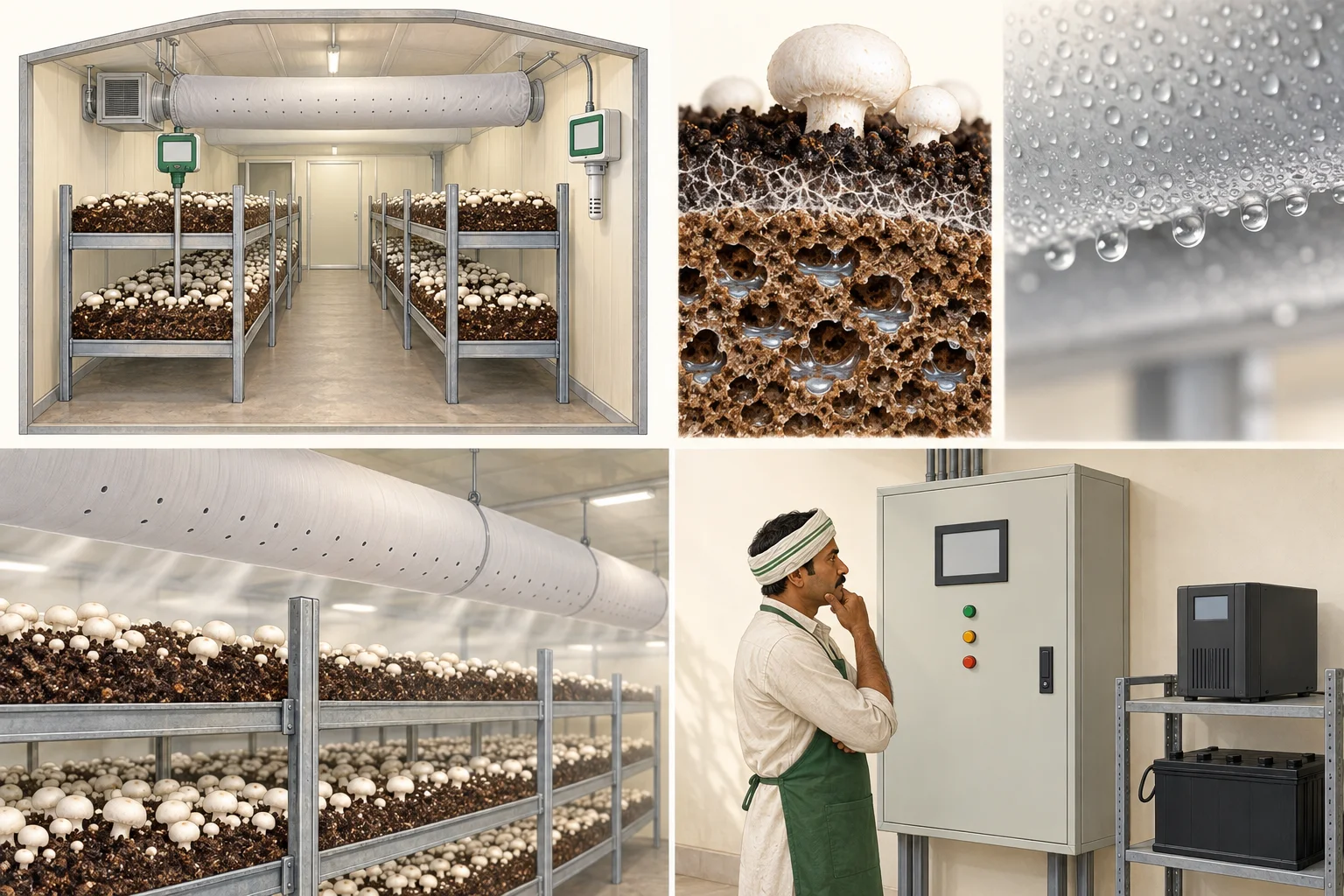
Air versus bed
- Notice
- Air and growing material are different measurement locations.
- Understand
- An active crop releases heat; the wall display is not every bed's temperature.
- Try it
- Map probes, sensor locations and representative crop readings.
01Three temperatures, not one
Room air is what a wall thermometer reads. Bed or compost temperature is what the crop actually lives in. Outdoor design temperature is what your cooling plant has to fight.
ICAR-DMR keeps these separate. For button spawn run it holds the room air at 23 plus or minus 1 C, and states that this corresponds to a bed temperature of 24 to 25 C, one to two degrees higher. For oyster it reports bed temperature generally 2 to 4 C above room temperature.
That gap is not an error. The compost is alive and making heat. If you set the room to the crop number, the crop sits above it.
02The bands by stage
Using button mushroom as the worked example, the 2011 manual gives a ladder. Spawn run: air 23 plus or minus 1 C. Case run: 24 plus or minus 1 C. Then cropping: the air is brought down to 15 to 17 C.
DMR's other documents give other fruiting figures: 14 to 16 C in one table, 14 to 18 C in the seasonal folder, 16 to 18 C in the Hindi farmer folder. These are all ICAR-DMR.
The lesson is not that one is right. It is that a band published for a controlled room, a seasonal shed and a species table are three different claims.
03The crop is a heater
DMR quantifies it. During the first two flushes a button bed gives off about 10 watts of heat per square metre at 17 C and 88 percent humidity, along with its carbon dioxide.
That is why a room cannot be held at one temperature by one setting. Air warms as it crosses the beds, so the far end of a long room runs warmer than the near end.
DMR gives the engineering answer for its own rooms: to obtain 17 C and 85 percent humidity at the bed, air leaves the air handling unit at 14 C and 100 percent humidity. The supply air is deliberately colder than the target.
04Ceilings that are disease thresholds
Some numbers are not preferences. False truffle appears above 23 C, and NHB, reproducing ICAR guidance, says avoid temperatures above 26 to 27 C during spawn run and after casing, and keep cropping below 18 C.
Blotch needs 20 C or above with water on the cap. DMR ties olive green mould to pasteurisation above 60 C. At the end of a crop, a cook out at 70 C held for 12 hours kills pathogens in the compost.
So when you write a set point, write beside it whether it is a preference or a limit. Only one of those two can be traded for electricity savings.
Map your room against its own crop
- Put one thermometer in the room air and one probe in the bed.
- Read both at the same minute, morning and evening, for a week.
- Note the gap between them and how it changes with the flush.
- Read the far corner of the room as well as the near one.
- Write your set point beside the DMR band for that stage.
डायरी में लिखें: Date, time, air reading, bed reading, corner reading, stage of crop, and any set point you changed.
ये गलतियां न करें
- Setting the room to the crop number, which leaves the bed above the band.
- Reading one thermometer near the door and calling it the room.
- Treating a disease ceiling as a comfort target that can be relaxed.
खुद को जांचें
तीन सवाल, तुरंत जवाबWhy is the compost warmer than the room air?
DMR delivers 14 C air to hold what at the bed?
What kind of number is the 26 C spawn run figure?
यह संपादकीय स्व-जांच है, प्रमाणपत्र नहीं। जवाब इस डिवाइस पर भी सहेजे नहीं जाते।
शब्दावली
- Set point
- The value you ask the controller to hold.
- Bed temperature
- Temperature measured inside the compost, not in the air.
- Cook out
- Heating a finished crop to kill pests and pathogens.
संदर्भ और आगे पढ़ें
Biological requirements are not equipment selections.
संदर्भ खोलें