


कक्ष भराई: हवा और फसल का संबंध
इस पाठ में आप सीखते हैं कि बेड क्षेत्रफल मशीन पर भार तय करता है और असमान भराई से फ्लश कैसे बिखरते हैं।
- By the end you can explain why bed area sets the duty on your machine.
- By the end you can spot a fill pattern that starves part of the room.
- By the end you can record loading so a later problem can be traced.
नियंत्रित कमरा: हवा कैसे चलती है
ठंडी, नम हवा ऊपर की नली से बेड के ऊपर गिरती है, कमरे से लौटती है, 20 से 30 प्रतिशत ताज़ी हवा मिलती है, बेड पर हवा की चाल लगभग 15 सेमी/सेकंड। स्रोत: ICAR-DMR मैनुअल।
ये आंकड़े संबंधित स्रोत और विधि के संदर्भ में हैं। इन्हें हर प्रजाति या फार्म का सार्वभौमिक निर्देश न मानें। पुराने मूल्य वर्तमान बाज़ार भाव नहीं हैं।
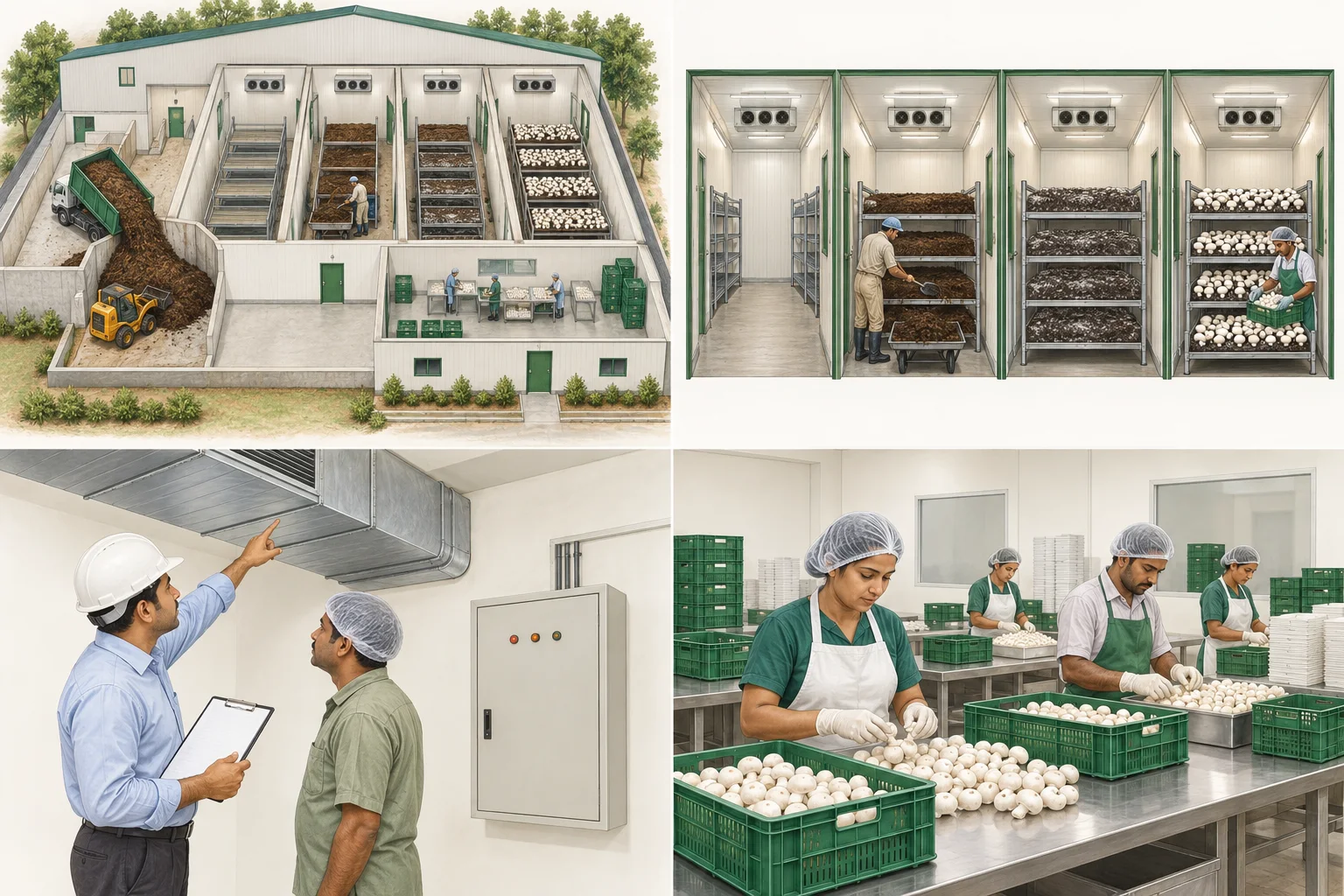
See the whole operation
- Notice
- Receiving, growing, packing and dispatch need coordinated space.
- Understand
- Capacity is a whole-farm outcome, not just the number of racks.
- Try it
- Define the incoming compost stage and the product buyers will accept.
01Bed area is the load
Every load DMR publishes is per square metre of bed. In the first two flushes a bed makes about 10 g of carbon dioxide per square metre every hour, about 10 W of heat per square metre, and loses about 31 g of water per square metre every hour at 17 C and 85 per cent humidity.
So if you add a tier and increase bed area, you increase cooling, ventilation and humidification duty in the same proportion. The machine does not know you added shelves.
DMR's project model assumes six crops of 60 days per room per year.
02Fill evenly or grow two crops in one room
Uneven filling is a common cause of staggered flushes. Compost depth, compaction and casing thickness must be the same from the first tray to the last.
Casing thickness is worth agreeing in writing, because DMR's manual defines casing as a 3 to 4 cm layer in one paragraph and instructs a 4 to 5 cm application a few lines later. Pick one figure for your farm and hold it.
A bed that is deeper at one end runs warmer there, pins later and is picked later, so one room then needs two climate decisions at once.
03Leave the air its path
Air must reach the back of the room and return. DMR limits air speed over the bed to 15 cm per second and asks for about 6 air changes per hour from venting to the end of the second flush, dropping to 4 later, with fresh air filtered to 2 micrometres.
That only happens if ducts, returns and doors stay clear. Rows pushed against a return, sheets hanging over a duct, or crates stacked in the corridor all change the map of the room.
Walk the loaded room before the crop starts and find the places where you feel no air.
04Case study: the last two rows
A unit growing in a 60 by 18 foot room, the size MIDH costs in its production unit norm, added two rows against the back wall to use spare compost.
Those rows sat past the end of the duct run. They read 2 C warmer, pinned two days late, and after a normal watering the caps there stayed wet longest, which is the blotch condition.
The operator did not change the set point. He pulled the rows back, cleared the return, remeasured at bed height and wrote the new layout into the room file.
Record one room loading
- Measure and write the bed area you actually filled, tier by tier.
- Weigh the compost per tray and note the depth at both ends.
- Measure casing thickness in six places and set the farm standard.
- Walk the loaded room and mark every place with no air movement.
- Draw the layout in the room file before the crop starts.
डायरी में लिखें: Bed area, compost weight per tray, depths, casing thickness, dead air spots.
ये गलतियां न करें
- Adding beds without asking whether the machine carries the extra load.
- Filling the last rows past the duct run to use spare compost.
- Leaving depth and casing thickness to each worker's judgement.
खुद को जांचें
तीन सवाल, तुरंत जवाबYou add one more tier of beds in the same room. What changes?
Two extra rows past the end of the duct run will probably:
DMR's manual gives casing thickness as:
यह संपादकीय स्व-जांच है, प्रमाणपत्र नहीं। जवाब इस डिवाइस पर भी सहेजे नहीं जाते।
शब्दावली
- Bed area
- Total growing surface in square metres across all tiers.
- Duty
- The work a machine must do to hold a target.
- Return
- The opening through which room air goes back to the unit.
- Room file
- The written record of layout, fill and readings.
संदर्भ और आगे पढ़ें
Operating values require stage, strain, sensor and production-system context.
संदर्भ खोलें